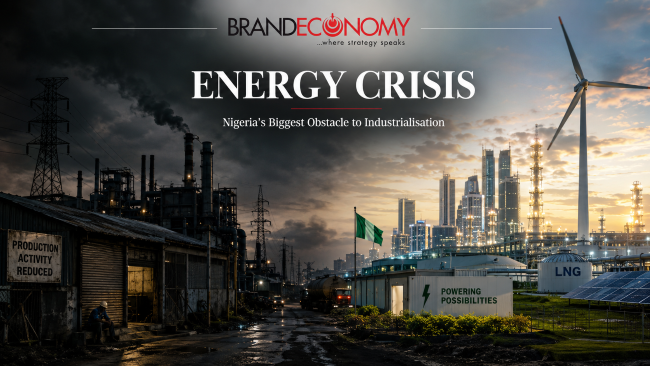
 Nigeria’s persistent inability to provide reliable, affordable and sustainable electricity remains the country’s most formidable barrier to industrialisation, economic growth and broad-based national development, the Emir of Kano, Muhammadu Sanusi II, has said.
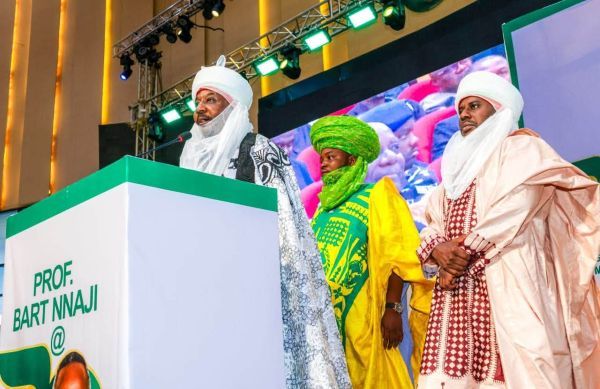
Sanusi made the assertion while delivering the keynote address at the birthday symposium of former Minister of Power and Chairman of Geometric Power Group, Prof. Barth Nnaji, at the International Conference Centre in Enugu.



The Emir described energy security as inseparable from national development, arguing that stable electricity is the foundation upon which productive industries, competitive businesses, modern public services and poverty reduction are built.
“Energy security and national development are inextricably linked,” Sanusi said. “A reliable, affordable and sustainable energy supply is the foundational driver of economic growth, industrialisation and poverty reduction.”
His intervention goes to the heart of Nigeria’s development dilemma. The country possesses a large domestic market, extensive natural resources and a growing entrepreneurial population, yet businesses continue to operate within an energy system marked by unreliable grid supply, expensive self-generation and frequent disruptions.
Weak power supply raises the cost of everything
Sanusi said economies without dependable electricity suffer lower productivity, elevated operating costs and weaker social outcomes.
For Nigerian businesses, the energy crisis extends far beyond inconvenience. Manufacturers, retailers, technology firms, hospitals, schools and small enterprises must often invest in generators, fuel, solar systems, batteries and other alternative arrangements merely to maintain basic operations.
Those costs eventually appear in the prices consumers pay.
Affordable and reliable electricity, Sanusi argued, would enable companies ranging from microenterprises to large manufacturers to increase output, plan investments and operate more efficiently.
He cited International Monetary Fund analysis indicating that energy security influences macroeconomic stability, industrial competitiveness and inflation. Even brief disruptions to electricity supply, he said, can weaken economic activity and intensify price pressures.
This relationship is particularly important for Nigeria, where high energy costs feed directly into food processing, transportation, telecommunications, construction and manufacturing expenses.
Without a durable solution to Nigeria’s Energy Crisis, inflation becomes harder to control and domestic producers struggle to compete with imported goods made in countries with cheaper and more dependable power.
Electricity is also a human-capital issue
The Emir stressed that reliable electricity is essential not only for factories but also for healthcare, education, information and communications technology, and transportation.
Hospitals need stable power for diagnostics, surgery, refrigeration and emergency care. Schools require electricity for laboratories, digital learning and modern teaching tools. Technology businesses depend on uninterrupted connectivity and data infrastructure.
Sanusi also warned that Nigeria risked falling behind as the global economy moved towards electric mobility.
The transition to electric vehicles will require charging networks, stronger distribution systems and greater electricity generation. Unless policymakers deliberately close the energy gap, Nigeria could become a consumer of imported technologies without possessing the infrastructure needed to deploy them effectively.
Gas and renewables must work together
Sanusi advocated an energy transition that combines Nigeria’s substantial natural gas resources with increased investment in renewable energy, particularly solar and wind.
This balanced approach recognises Nigeria’s immediate need for dependable baseload power while preparing the economy for a lower-carbon future.
Natural gas can support industrial power, electricity generation and cleaner alternatives to diesel, while decentralised solar and other renewable technologies can expand access in underserved communities.
However, the energy transition must be managed as an industrial and economic strategy rather than a collection of isolated projects.
Nigeria will need investment in generation, transmission, distribution, metering, storage, gas infrastructure and workforce development.
Nigeria’s Energy Crisis deepened by structural weaknesses
Sanusi identified underinvestment, infrastructure vandalism, corruption, sector illiquidity, regulatory uncertainty and the absence of fully cost-reflective tariffs as major constraints on investment.
He said Nigeria’s transmission and distribution networks lacked sufficient capacity to deliver stable electricity, resulting in repeated grid failures and extensive technical and commercial losses.
The sector’s liquidity problem remains especially damaging. When consumers are poorly metered, tariffs fail to cover efficient costs and market participants cannot collect what they are owed, every segment of the electricity chain becomes financially weaker.
Generation companies struggle to recover revenue, gas suppliers face payment uncertainty and distribution companies lack the capital to upgrade networks.
Sanusi said closing Nigeria’s estimated $100 billion power-infrastructure funding gap would require deep structural reform, stronger institutions and credible policies capable of attracting long-term capital.
 Geometric Power as a practical example
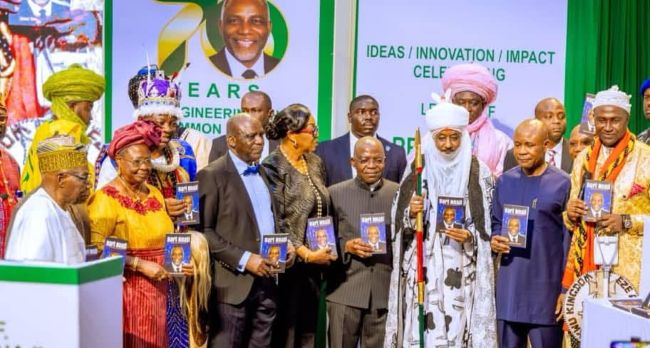 Geometric Power as a practical example
The Emir cited Geometric Power in Abia State as evidence of how dependable electricity can reshape an economy.
“If you want to see the impact of electricity on an economy, just look at Geometric Power and Abia State,” he said. “Look at the transformation in Abia. This is living evidence of what people think is theory.”
Geometric Power’s integrated electricity project has become a reference point in discussions about decentralised power and industrial development, particularly around Aba’s dense concentration of manufacturers, artisans and small businesses.
Reliable electricity in such commercial clusters can raise productivity, reduce generator dependence and strengthen local supply chains.
Sanusi also recalled that during the privatisation of Nigeria’s power sector, Prof. Nnaji had questioned whether some distribution companies possessed the financial capacity to meet their obligations.
Those concerns, he said, demonstrated the importance of ensuring that power-sector investors have the capital, expertise and governance standards required to operate critical national infrastructure.
Market and investor implications
Sanusi’s remarks underline the scale of opportunity across Nigeria’s electricity market.
Investors can find potential in embedded generation, industrial power, mini-grids, renewable energy, smart metering, transmission infrastructure, battery storage and gas-to-power projects.
Yet opportunity alone will not unlock capital.
Investors require clear tariffs, enforceable contracts, credible regulators and confidence that government policy will remain stable over the life of long-term projects.
Nigeria must also reduce vandalism, improve payment discipline and create bankable structures that allow private capital to earn sustainable returns.
Brand implications
Electricity performance has become central to Nigeria’s national investment brand.
A country may promote its population, resources and consumer market, but persistent power shortages weaken every investment proposition.
For state governments, providing reliable electricity to industrial clusters can become a powerful competitive advantage. States able to reduce energy costs, simplify approvals and protect infrastructure will be better positioned to attract manufacturers and technology businesses.
For power companies, trust will depend on service reliability, transparent billing and responsiveness to consumers.
BRANDECONOMY Insight
Nigeria’s industrialisation challenge is fundamentally an energy challenge.
Factories cannot scale on generators. Hospitals cannot deliver modern care through unstable supply. Digital businesses cannot compete globally while spending a disproportionate share of their income on backup power.
The country does not need another diagnosis of the crisis. It needs disciplined execution across tariffs, metering, investment, regulation and infrastructure protection.
Geometric Power offers a useful lesson: electricity becomes transformative when it is closely connected to productive communities and managed with commercial discipline.
Nigeria’s economic ambition will remain constrained until dependable power becomes the rule rather than the exception.
The question is no longer whether electricity drives development.
It is whether Nigeria possesses the political courage and institutional capacity to finally build the power system its economy requires.