The Fuel Wars: How Dangote’s Price Cut Is Shaking Nigeria’s Downstream Oil Market


Nigeria’s downstream petroleum sector has entered its most consequential phase since deregulation, as Africa’s largest refinery moves decisively to seize control of pricing, logistics, and market psychology.
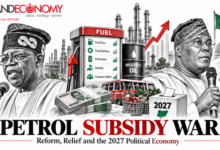
The Dangote Petroleum Refinery’s latest petrol price cut—slashing ex-depot rates to ₦699 per litre—is not merely a commercial adjustment. It is a calculated market intervention, one that exposes deep structural tensions between local refining, fuel import dependency, and regulatory authority in Nigeria’s post-subsidy energy economy.



A Market Reset, Not a Discount
For Aliko Dangote, this is not about short-term profitability. It is about survival—and dominance.
Standing at the Lekki refinery, Dangote framed the price war in stark terms: local refining must not be sacrificed on the altar of import arbitrage. If marketers continue to bypass domestic supply in favour of imports, he insists the refinery will respond with overwhelming logistics power—doubling its already massive CNG truck fleet to flood the market directly.
This is vertical integration in its purest form: refining, haulage, and price enforcement rolled into one strategic play.
“We will meet in the market,” Dangote declared—signalling a willingness to absorb losses today to collapse price manipulation tomorrow.
Why ₦699 Matters
Industry data suggests petrol distribution within Lagos costs no more than ₦10–₦15 per litre. At a ₦699 ex-depot price, retail pump prices should logically sit around ₦739. Anything significantly above that raises hard questions about margins, coordination, and market discipline.
Yet many stations continue to sell near ₦900—prompting allegations that parts of the downstream value chain are deliberately resisting price correction to preserve legacy rent structures.
Import Licences: The Fault Line
The tension escalated when regulators approved import licences covering over 7.5 billion litres of petrol for early 2026—despite assurances of sufficient local supply.
Dangote argues this undermines domestic refining, threatens modular plants, and discourages long-term capital investment. Regulators counter that supply security requires redundancy.
What is clear, however, is that Nigeria is now grappling with a paradox: local refining capacity has arrived, but market behaviour remains import-conditioned.
Regulators, Refiners—and a Public Clash
The dispute spilled into open confrontation when Dangote publicly questioned the integrity of regulatory leadership, triggering swift intervention by the House of Representatives.
The President of the Dangote Group, Aliko Dangote, on Sunday accused the Chief Executive Officer of the Nigerian Midstream and Downstream Petroleum Regulatory Authority (NMDPRA), Farouk Ahmed, of corruption, alleging that he spent $5 million on secondary school education for his children in Switzerland.
Dangote made the allegation during a media briefing at the Dangote Petroleum Refinery and Fertiliser Plant, Lekki, Lagos, describing the alleged expenditure as inconsistent with a public servant’s income and a threat to public trust in regulatory institutions.
Dangote said the alleged payment covered six years of secondary education for four children, an amount he argued could not reasonably be explained by earnings from public service.
The NMDPRA had yet to issue a statement in response to Dangote’s claim, but the businessman said taxpayers deserved accountability and questioned why a public official could afford to spend millions of dollars on his children’s foreign education if public funds were being properly used.
Legislative Intervention
Lawmakers have since summoned all parties, ordered a ceasefire in public commentary, and begun probing critical questions:
- Do local refineries truly meet national demand?
- Are import licences aligned with market realities?
- Is regulatory neutrality being compromised?
This legislative intervention reflects a deeper truth: energy pricing is no longer just an economic issue—it is a political and social stability variable.
Will Nigerians Feel the Relief?
Early street reactions are mixed. Transport operators welcome the relief but remain cautious, citing high spare-part costs and levies. Commuters are skeptical, having seen previous price cuts fail to translate into lower fares.
Analysts agree: the inflation impact will only materialise if the new price regime holds long enough to reset expectations across logistics, food transport, and urban mobility.
The Bigger Picture
This is not just a fuel price story. It is a battle over who controls Nigeria’s energy future:
- Refiners vs Importers
- Market Forces vs Legacy Structures
- Local Capital vs Regulatory Inertia
If sustained, Dangote’s price offensive could anchor a new pricing benchmark, reduce import dependence, and finally give Nigerians the dividend of domestic refining.
If it fails, the sector risks sliding back into fragmented pricing, regulatory distrust, and supply uncertainty.
Nigeria is watching. The market is responding. And the fuel wars have only just begun.
BRANDECONOMY INSIGHT
The Fuel Wars Are Not Just About Price — They Are About Power, Policy, and Nigeria’s Energy Future
Dangote Refinery’s aggressive petrol price cuts have exposed a deeper fault line in Nigeria’s downstream petroleum sector: who truly controls pricing, supply, and market discipline in a post-subsidy era.
At the surface, the ₦699/litre price signals relief for consumers battered by inflation. But beneath it lies a high-stakes contest between local refining ambition and entrenched import-dependent interests, with regulators caught in the crossfire.
This episode underscores three critical realities:
- Local Refining vs Import Lobbies
Dangote’s strategy — scaling logistics with thousands of CNG trucks and flooding the market — is a direct attempt to break the dominance of fuel importers whose margins depend on scarcity and arbitrage. The resistance was inevitable. - Regulatory Credibility on Trial
Allegations against regulators, counter-allegations, and legislative intervention have placed regulatory institutions under intense public scrutiny. In energy markets, perceived regulatory bias can be as destabilising as policy failure. - Price Cuts Alone Won’t Fix the System
Without transparent import licensing, predictable regulation, and enforceable competition rules, price reductions risk becoming episodic shocks rather than sustainable reform. The real test is whether lower prices translate into long-term efficiency, fair competition, and investor confidence.
Bottom Line:
Nigeria’s fuel price war is not a private feud — it is a referendum on the country’s ability to transition from subsidy chaos to a rules-based, locally powered energy economy. How this confrontation is resolved will determine whether Nigeria emerges with a competitive downstream market or slips back into regulatory uncertainty and supply distortions.