

CIBN Inducts 2,020 Chartered Bankers, Urges AI-Driven Transformation in Nigeria’s Financial Sector

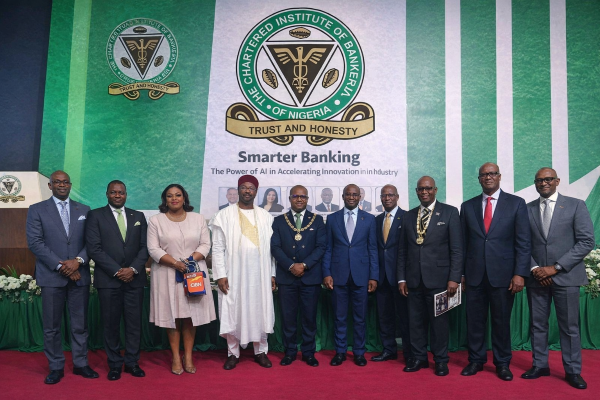 Nigeria’s banking profession received a significant boost as the Chartered Institute of Bankers of Nigeria (CIBN) inducted 2,020 new chartered bankers, reinforcing the industry’s growing talent pool at a time when technology and digital finance are rapidly reshaping the financial services landscape.
Speaking at the induction ceremony in Lagos, the President of CIBN, Pius Olanrewaju, described the event as a major milestone for the new professionals and the broader banking ecosystem.




According to him, the newly inducted members are joining a professional community defined by competence, ethical standards and commitment to safeguarding public confidence in the financial system.
Banking Enters a New Technology Era
The ceremony, themed “Smarter Banking: The Power of AI in Accelerating Innovation in the Industry,” highlighted the increasing role of artificial intelligence in reshaping banking operations.
Olanrewaju noted that financial institutions across the world are already deploying AI technologies to strengthen risk management, enhance customer analytics and combat fraud.
Artificial intelligence tools are now widely used in areas such as:
- credit risk modelling
- fraud detection systems
- automated compliance monitoring
- personalised financial services
He urged the newly inducted bankers to embrace these innovations while maintaining the ethical discipline and governance standards that underpin the credibility of financial institutions.
“The banking industry is evolving rapidly,” Olanrewaju said. “Technology, especially artificial intelligence, is transforming how financial institutions assess risk, serve customers and expand financial inclusion.”
Opportunities in Nigeria’s Digital Economy
The CIBN president noted that Nigeria’s demographic structure and digital adoption trends present unique opportunities for financial innovation.
With a large youth population, increasing smartphone penetration and expanding fintech activity, the country’s financial services industry is positioned to harness AI to deepen financial inclusion and expand access to banking services.
However, he cautioned that barriers remain. The high cost of deploying advanced technologies and the shortage of specialised digital skills continue to limit the pace of AI adoption across parts of the Nigerian banking sector.
For the new chartered bankers, he said, the challenge is to combine professional expertise with technological competence.
FinTech Industry Calls for Collaboration
Delivering the keynote address, Stanley Jacob emphasised the growing intersection between traditional banking institutions and financial technology companies.
Represented by the association’s National Treasurer, Oluwaseun Adesanya, Jacob said artificial intelligence is increasingly driving efficiency, innovation and personalised service delivery across financial institutions.
He warned that banks that fail to adapt to technological change risk losing competitive relevance in a rapidly evolving financial landscape.
Jacob urged stronger collaboration among banks, fintech companies and regulators to build a resilient and technology-enabled financial ecosystem.
Such partnerships, he noted, would accelerate innovation, expand digital financial services and strengthen the stability of Nigeria’s financial sector.
Professional Standards Remain Central
Beyond technology, CIBN emphasised the importance of professional integrity and governance.
As chartered bankers, the inductees are expected to uphold ethical standards that protect depositors, support financial stability and reinforce public trust in the banking system.
For Nigeria’s financial sector, the growing integration of digital technologies makes this ethical foundation even more critical.
As banking services become more automated and data-driven, the role of skilled professionals capable of managing both technological systems and ethical responsibilities becomes increasingly important.
BRANDECONOMY Insight
The induction of more than 2,000 new chartered bankers reflects a broader transformation underway in Nigeria’s financial services industry.
Three strategic shifts are shaping the sector.
First, banking talent is becoming increasingly technology-driven.
Traditional banking expertise is now being complemented by skills in data analytics, cybersecurity, artificial intelligence and digital platform management.
Second, the boundary between banks and fintech companies is rapidly disappearing.
Financial institutions are no longer operating in isolation; they are part of an integrated digital ecosystem where collaboration drives innovation.
Third, professional institutions like CIBN are becoming gatekeepers of trust in the digital age.
As financial services become more automated and complex, the need for well-trained professionals who can balance innovation with regulatory discipline will become even more critical.
In the coming decade, the competitiveness of Nigeria’s banking industry will likely depend not just on capital strength, but on how effectively it develops technologically capable financial professionals.