


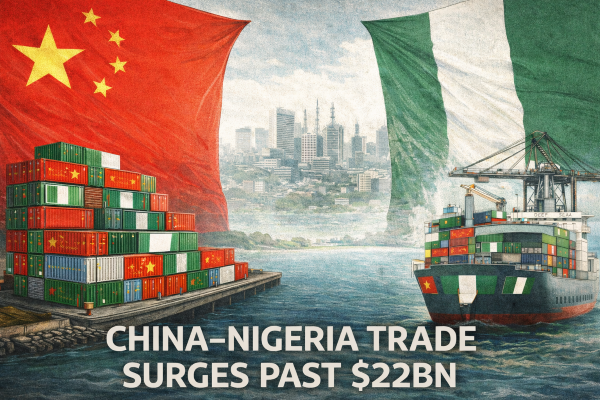
Nigeria’s economic engagement with China is entering a more assertive and consequential phase, as bilateral trade volumes crossed $22.3 billion in the first ten months of 2025—an inflection point that signals both deepening interdependence and shifting global economic alignments.
The latest figures underscore a 30.2 per cent year-on-year expansion, placing Nigeria firmly among China’s most strategic trade and investment partners on the African continent. More significantly, the surge reflects a transition from transactional commerce to a broader geo-economic partnership anchored on infrastructure, industrial capacity, logistics efficiency, and market access.



Trade Momentum Meets Strategic Depth
Beyond headline numbers, the China–Nigeria trade story is increasingly about structure, scale, and strategic intent. Nigeria’s elevation as Guest Country of Honour at major China-Africa trade platforms in 2025 was not ceremonial; it was a recognition of Nigeria’s growing relevance in China’s Africa-focused industrial and supply-chain recalibration.
Agricultural exports such as cashew, sesame, sorghum, and dried ginger have gained improved access to the Chinese market, reinforcing Nigeria’s ambition to diversify export earnings beyond hydrocarbons while integrating deeper into Asian consumption value chains.
Industrial Platforms Driving Real Economy Gains
Two industrial corridors—the Lekki Free Trade Zone and the Ogun–Guangdong Free Trade Zone—continue to anchor manufacturing collaboration, technology transfer, and industrial clustering. These platforms are increasingly aligned with Nigeria’s domestic industrialisation goals, not merely as export enclaves but as job-creating, skills-deepening ecosystems.
A defining asset in this evolving relationship is the Lekki Deep Sea Port, which is fast reshaping West Africa’s maritime logistics map. With projected annual throughput capacity exceeding 520,000 TEUs, the port has recorded explosive growth, strengthening Nigeria’s position as a regional trans-shipment and trade gateway.
Rail-linked mobility infrastructure—most notably the Lagos–Ibadan rail corridor and urban light rail systems—has further amplified productivity gains by reducing congestion costs, improving passenger movement, and supporting inland trade connectivity.
Development, Not Dependency
Contrary to simplistic narratives of dependency, the current phase of China–Nigeria engagement reflects development-oriented pragmatism. Infrastructure delivery, agricultural modernisation, digital economy cooperation, and manufacturing investment are producing measurable economic spillovers—employment, capacity building, and improved logistics efficiency.
Crucially, the relationship is evolving within Nigeria’s own reform context, where market-driven growth, regulatory clarity, and private-sector participation are increasingly shaping project outcomes.
Geopolitics at the Margins—but Not Absent
While economic cooperation dominated the discourse, broader geopolitical currents remain present. Beijing’s reaffirmation of the One-China principle and its objections to external military signalling in East Asia highlight how global power dynamics continue to intersect with trade diplomacy.
For Nigeria, however, the strategic calculus remains clear: economic sovereignty through diversified partnerships, not ideological alignment. The priority is trade, investment, infrastructure, and technology—delivered at scale and with measurable domestic impact.
2026: A Symbolic and Strategic Milestone
As 2026 approaches—marking 55 years of China–Nigeria diplomatic relations and 70 years of China–Africa engagement—both countries are positioning for deeper collaboration in new energy, digital infrastructure, advanced manufacturing, and cultural exchange.
For Nigeria, the opportunity lies in converting scale into leverage: using market size, logistics assets, and reform momentum to negotiate partnerships that accelerate industrial competitiveness and export sophistication.
BRANDECONOMY INSIGHT
China–Nigeria trade growth is no longer about volume alone—it is about economic architecture. If Nigeria continues to pair strategic infrastructure with export diversification and policy discipline, the relationship could evolve from a trade surplus headline into a long-term industrial transformation engine.