

 Nigeria’s Q1 2026 capital-importation surge looks impressive on the surface. But the dominance of portfolio flows shows that foreign investors are largely chasing short-term market returns, not yet committing patient capital to factories, jobs and long-term productive growth.
 Nigeria’s Q1 2026 capital-importation surge looks impressive on the surface. But the dominance of portfolio flows shows that foreign investors are largely chasing short-term market returns, not yet committing patient capital to factories, jobs and long-term productive growth.
Nigeria recorded a sharp rise in capital importation in the first quarter of 2026, but the structure of the inflows suggests that foreign investors are still treating the country more as a short-term capital-market opportunity than a long-term production destination.
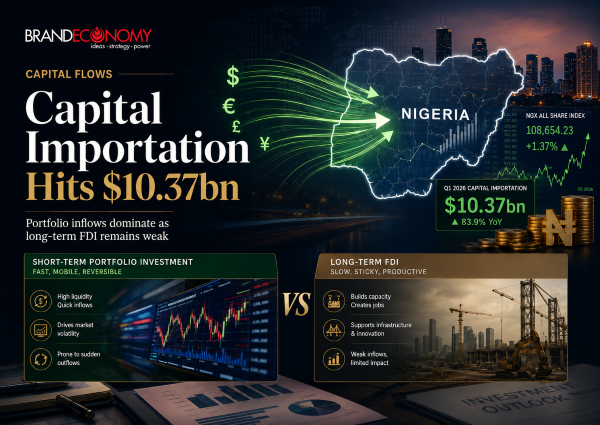
Data from the National Bureau of Statistics showed that total capital importation rose to $10.37 billion in Q1 2026, compared with $5.64 billion in the corresponding period of 2025. The figure also represented a 60.97 per cent increase over the $6.44 billion recorded in Q4 2025.



On paper, the numbers suggest renewed international investor appetite for Nigeria. But beneath the headline growth lies a more cautious story.
Portfolio investment accounted for $9.86 billion, representing 95.09 per cent of total capital importation. Other Investment followed with $374.48 million, or 3.61 per cent, while Foreign Direct Investment stood at just $135.08 million, representing only 1.30 per cent of the total.
That composition matters. Portfolio inflows typically move into stocks, bonds and money-market instruments. They can boost market liquidity and strengthen reserves temporarily, but they are also highly mobile. They come in quickly when yields and valuations are attractive, and they can leave just as quickly when risk perception changes.
By contrast, FDI is patient capital. It goes into factories, infrastructure, services, logistics, technology, agriculture, energy and real-sector expansion. It creates jobs, transfers knowledge, deepens productivity and broadens the tax base.
That is why the Q1 numbers should be read with both optimism and caution.
Unegbu: Investors Are Chasing Capital-Market Gains
Former President of the Chartered Institute of Bankers of Nigeria, Okechukwu Unegbu, said the surge was driven largely by investors seeking short-term capital gains in Nigeria’s rising stock market.
According to him, global investors are moving funds from lower-return markets into economies where they can make quicker gains from equities and other financial assets.
“What has happened is that the stock market is on the upswing globally and investors are moving funds from areas with lower returns to places where they can make more money,” Unegbu said.
He noted that the Nigerian equities market has shown strong momentum, attracting foreign investors interested in taking advantage of capital appreciation.
But he warned that such inflows are not the same as long-term confidence in the economy.
“From my analysis, the investments were largely short-term. Investors came in to take advantage of the gains available in the capital market and then move out with their profits,” he said.
His argument is difficult to dismiss. When portfolio investment accounts for more than 95 per cent of total inflow and FDI accounts for just 1.3 per cent, the signal is clear: Nigeria is attracting money, but not enough long-term commitment.
The Real-Economy Disconnect
Unegbu argued that the inflows have not translated into meaningful improvement in the lives of ordinary Nigerians.
“If the inflows were making a significant impact, we would expect improvements in employment, inflation and other economic indicators,” he said.
That is the heart of the matter. Capital importation should not be celebrated only as a statistical victory. Its true value lies in whether it improves output, employment, infrastructure, productivity and living standards.
Nigeria can attract billions of dollars into portfolio assets and still struggle with unemployment, inflation, weak manufacturing output and low household purchasing power. That is because capital-market gains do not automatically become real-sector transformation.
A booming equity market can enrich investors, strengthen corporate valuations and deepen liquidity. But unless capital flows into production, energy, logistics, agriculture, exports and industrial capacity, the broader economy may feel little direct relief.
Policy Implications: Stability Must Replace Speculation
The data reinforces the need for policies that convert investor curiosity into long-term confidence.
Unegbu identified insecurity as one of the biggest barriers to durable foreign investment. He said no serious investor would commit long-term capital in an environment where kidnapping, banditry, killings and uncertainty remain major concerns.
Security is therefore not only a law-and-order issue. It is an investment variable.
Foreign investors assess risk across multiple layers: physical security, currency stability, policy consistency, inflation, interest rates, regulatory clarity, infrastructure and ease of repatriation. Where these risks remain elevated, investors prefer liquid instruments they can exit quickly.
To improve FDI, government must stabilise inflation, reduce policy uncertainty, strengthen security, improve power supply, protect contracts and make doing business easier. Nigeria must become a place where investors can build, not just trade.
Investor Relevance
For investors, the Q1 2026 numbers show that Nigeria remains attractive as a high-yield, high-opportunity market. Equities, fixed income and short-term instruments may continue to attract capital where returns compensate for risk.
However, the dominance of portfolio flows also highlights vulnerability. Any shock to exchange rates, interest rates, security conditions or investor sentiment could trigger reversals.
Long-term investors will continue to watch the fundamentals: inflation direction, naira stability, fiscal discipline, security improvements, corporate earnings, infrastructure policy and reform credibility.
Nigeria has the market size. It has population scale. It has sectors with deep growth potential. What it still needs is confidence that capital can stay, mature and earn sustainable returns.
Brand and Market Implications
Nigeria’s investment brand is improving in one area: the country is again visible to global capital. But visibility is not the same as trust.
A strong investment brand must show more than market rallies. It must show safety, predictability, governance, policy seriousness and real-sector opportunity.
For the capital market, the inflows are positive. They support liquidity, valuation and trading activity. For the broader economy, the challenge is to channel confidence from financial markets into productive sectors.
Nigeria must now move from being a speculative opportunity to becoming an investment destination.
BRANDECONOMY Insight
Capital Is Coming In — But Is It Coming to Build?
Nigeria’s $10.37 billion capital-importation figure for Q1 2026 is encouraging, but the structure of the inflow is revealing.
Portfolio money is useful. It improves liquidity, supports the stock market and can strengthen investor sentiment. But it is not the same as factories, roads, technology hubs, agro-processing plants, power projects or export platforms.
The real question is not whether capital is entering Nigeria. The real question is whether capital is staying long enough to build Nigeria.
A market dominated by hot money remains fragile. It can rise quickly and reverse quickly. Nigeria needs a deeper mix of capital: portfolio inflows, yes, but also FDI, infrastructure finance, private equity, venture capital, development finance and domestic institutional capital.
The policy lesson is clear. Investors will trade Nigeria when returns are attractive. They will build in Nigeria when risk becomes manageable.
That means security, stable rules, lower inflation, credible institutions, reliable power, efficient ports and policy consistency are not optional. They are the foundation of serious investment.
Nigeria has regained attention. Now it must earn commitment.