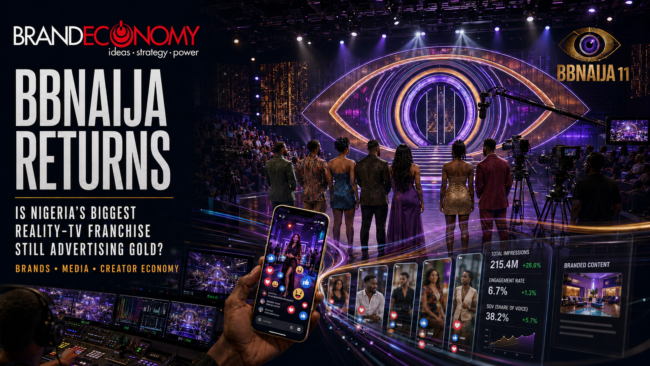
BBNaija Returns: Is Nigeria’s Biggest Reality-TV Franchise Still Advertising Gold?

 BBNaija Season 11 arrives with a record ₦160 million prize package, ten weeks of continuous exposure and a powerful sponsor roster. But in a market increasingly dominated by TikTok, YouTube, creators and streaming, BBNaija must now prove more than popularity—it must deliver measurable business value.
 BBNaija Season 11 arrives with a record ₦160 million prize package, ten weeks of continuous exposure and a powerful sponsor roster. But in a market increasingly dominated by
 At 7 p.m. tonight, the familiar doors of Big Brother Naija will open again.
Season 11 begins a ten-week run across Africa Magic, a dedicated 24-hour DStv and GOtv channel and the broadcasters’ streaming platforms. The winner will receive a record ₦160 million package, comprising ₦100 million in cash, a new sport utility vehicle and other prizes.



The headline sponsor is betPawa, while Guinness returns as Gold Sponsor and Minimie joins as Associate Sponsor.
These are the visible numbers and names. The more important commercial question, however, is whether BBNaija remains one of Nigeria’s most valuable advertising properties—or whether its dominance is being eroded by fragmented audiences, short-form video, creator communities and increasingly measurable digital media.
The verdict is nuanced.
BBNaija is still advertising gold. But brands can no longer mine that gold with logos, branded tasks and television spots alone.
The Attention Machine Nigeria Built
BBNaija’s enduring strength is not merely the number of people watching at any given moment. It is the intensity, frequency and duration of the attention it generates.
Most campaigns struggle to hold consumer interest for several seconds. BBNaija occupies popular conversation for approximately ten weeks.
Its commercial architecture includes launch night, daily highlights, diary sessions, sponsored tasks, parties, nominations, evictions, fan voting, controversies, fashion, memes, commentary programmes and the finale. Every significant incident can become content for television, X, Instagram, TikTok, YouTube, blogs, podcasts and WhatsApp groups.
That makes BBNaija less a television programme than an integrated cultural operating system.
A sponsor is not buying a single commercial break. It is potentially entering a continuously renewed national conversation in which viewers watch, argue, vote, imitate, defend, condemn and create content.
Historical figures demonstrate that power. MultiChoice previously reported 950 million votes during the 2020 season and approximately 13.6 million social-media mentions around the following edition. A 2023 media-intelligence analysis estimated reach at more than 23 million, with digital media responsible for the overwhelming majority of recorded engagement.
Those numbers were produced through different methodologies and should not be treated as directly comparable. Collectively, however, they reveal the franchise’s central advantage: BBNaija does not end when the television is switched off.
Fragmentation Is a Threat—and an Opportunity
Nigeria’s audience has changed dramatically.
TikTok’s advertising tools indicated a potential Nigerian adult audience of 47.8 million by late 2025, while YouTube’s advertising reach stood at approximately 30.5 million. Young consumers increasingly discover entertainment through short clips, reaction videos, livestreams and individual creators rather than scheduled television.
PwC projects that digital channels could account for 84 per cent of Nigerian advertising revenue by 2029.
This appears to threaten a television-led franchise. Yet BBNaija possesses something many digital platforms lack: a single narrative capable of organising fragmented audiences around common characters and events.
TikTok may capture enormous viewing time, but its attention is distributed among millions of creators. BBNaija concentrates conversation around one house, one competition and a limited number of personalities.
Its future therefore lies not in defending television against digital media, but in using television to manufacture moments that digital communities distribute.
The television house provides the raw material. Social platforms supply amplification. Creators interpret the drama. Fans provide unpaid distribution. Brands convert the resulting attention into commercial action.
Why Traditional Sponsorship Metrics Are No Longer Enough
For years, BBNaija sponsorship could be justified through reach, frequency, logo prominence, branded tasks and share of conversation.
Those indicators remain important, but marketing accountability has advanced.
A sponsor should now be able to answer:
- How many people did the programme reach who were not already reachable through the brand’s existing media?
- Did viewers remember the brand without prompting?
- Did sponsorship improve consideration, preference or trust?
- How many searches, app installations, enquiries, trial purchases or sales resulted?
- Which tasks and housemates generated the strongest positive response?
- Did exposure reach the intended demographic—or merely produce noise?
- What was the cost per meaningful engagement compared with creator campaigns, paid social media and other entertainment properties?
A viral moment is not automatically a profitable one. A million mentions can include ridicule, controversy or hostility.
The new standard must be attention quality, not attention volume alone.
The Power—and Danger—of Branded Tasks
BBNaija’s branded challenges remain one of its strongest advertising formats because they embed products inside entertainment.
A well-designed task can demonstrate how a product works, introduce a new proposition and generate content that lives beyond the broadcast. Housemates become temporary storytellers, while audiences become commentators and distributors.
Poorly designed tasks achieve the opposite. They feel like lengthy commercials, force unnatural brand references and interrupt the programme’s emotional rhythm.
The best sponsorship activations should be:
- Simple enough for audiences to understand immediately.
- Connected to the product’s genuine benefit.
- Entertaining without humiliating contestants.
- Capable of producing short, reusable digital content.
- Linked to a measurable consumer action.
Brands should own memorable experiences, not merely occupy screen space.
The Contestant Is Now a Startup
BBNaija’s economic impact increasingly extends beyond the ultimate winner.
A contestant can leave the house with a substantial following, a recognisable personality and immediate access to endorsement opportunities. The strongest participants turn attention into businesses across fashion, beauty, music, film, food, fitness, events and digital content.
But visibility is not the same as a sustainable career.
Many former contestants experience an initial surge of bookings and brand deals before public attention moves to the next season. Those who endure usually possess a defined proposition, professional management, disciplined content production and a commercially useful audience.
Contestants should therefore treat the programme as a startup accelerator. They require:
- A clear personal-brand position;
- Competent legal and talent representation;
- Ownership and protection of intellectual property;
- Proper contracts and endorsement exclusions;
- Accounting and tax compliance;
- Audience data beyond follower counts; and
- A post-show product or career strategy.
The creator economy rewards relevance, consistency and community—not fame alone.
Brand Safety Has Become Central
BBNaija’s spontaneity is a major attraction, but it also creates reputational risk.
Sponsors cannot fully control housemate behaviour, online fan conflicts or the controversies that develop around the programme. Alcohol-related partnerships, betting sponsorships and other age-restricted categories require especially careful safeguards because the show attracts a broad youth audience.
Season 11’s lead partnership with a betting brand makes responsible communication, age-gating and regulatory compliance particularly important. Sponsorship should never blur the boundary between entertainment exposure and inducement directed at underage audiences.
Every advertiser needs a crisis protocol covering harmful statements, misinformation, offensive conduct and unsafe fan behaviour. Contracts should define where brand association begins and ends.
The objective is not to eliminate spontaneity. It is to ensure that commercial enthusiasm does not outrun social responsibility.
Market and Investor Implications
For MultiChoice and its Canal+-controlled future, BBNaija is more than a popular programme. It is evidence that premium African local content can still create appointments-to-view in an era of declining linear television loyalty.
The franchise supports subscription retention, advertising revenue, platform engagement, local production employment, music licensing, fashion, events and the wider creator ecosystem.
That value is especially important after the closure of Showmax demonstrated how difficult and expensive African streaming economics can become. BBNaija provides what international streaming libraries often struggle to manufacture: immediacy, interactivity and culturally specific conversation.
For entertainment investors, the lesson is significant. Africa’s strongest content properties will not necessarily resemble conventional films or television series. They may be expandable ecosystems combining broadcasting, social video, commerce, live experiences, licensing, gaming-style participation and creator development.
Brand Implications: How to Win in Season 11
Brands should approach BBNaija as a ten-week customer journey.
Before the show, sponsors should establish awareness benchmarks and define measurable commercial objectives. During the season, they should integrate television exposure with social listening, creator partnerships, retail promotions, searchable content and first-party data capture.
After the finale, they should measure brand lift, incremental sales and customer acquisition—and retain only those former contestants whose audiences align authentically with the brand.
A sponsor seeking awareness should design differently from one seeking app installations. A food brand pursuing trial should not use the same activation model as a financial-services company building trust.
The strategic question is not: “How visible can we become?”
It is: “What should consumers think, feel or do after seeing us?”
BRANDECONOMY Insight
BBNaija remains advertising gold because it can still perform a rare commercial feat: create mass attention, emotional attachment and continuous conversation around one African entertainment property.
But the gold is no longer found only on television.
It is distributed across clips, memes, searches, fan communities, creator pages, branded experiences, retail activity and the future commercial lives of contestants.
Season 11 will therefore test whether BBNaija can evolve from Nigeria’s most talked-about reality programme into its most measurable integrated-media platform.
For advertisers, the winning formula is no longer sponsorship by presence. It is sponsorship by purpose—supported by cultural intelligence, real-time optimisation, responsible targeting and credible performance measurement.
BBNaija is not invulnerable. Economic pressure is shrinking discretionary spending. Digital platforms are multiplying entertainment choices. Audiences are more sceptical of forced advertising, while controversies can overwhelm carefully planned campaigns.
Yet few Nigerian properties still possess its combination of scale, frequency, emotion and cultural influence.
The franchise remains golden.
The harder question is whether each advertiser knows how to refine that attention into enduring brand value.