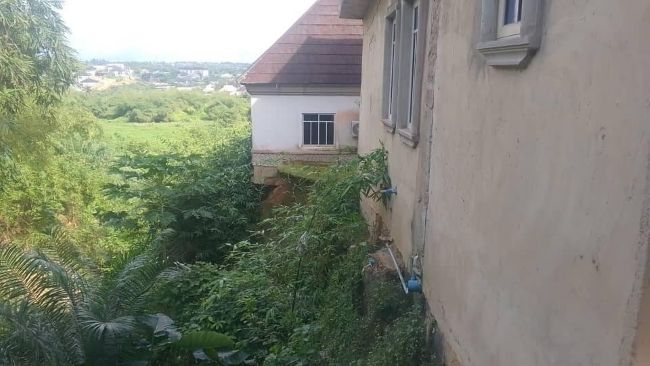
 For residents of Akai Effa in Calabar Municipality, erosion is no longer a seasonal inconvenience. It has become a slow-moving economic emergency—destroying homes, consuming productive assets and pushing already vulnerable families towards displacement.
Henrietta Effa-Akpere, Clan Head of Akai Effa, raised the alarm after leading community elders on an inspection of two major erosion sites on Tuesday. She said the problem began about five years ago but had continued to worsen despite repeated reports to relevant intervention agencies.




Her warning is stark: unless decisive action is taken, more residents could lose their homes as rainfall intensifies and the gullies advance.
The damage already extends beyond residential property. According to Effa-Akpere, flooding associated with the erosion channels has destroyed fish farms, poultry operations and other community investments. Some residents living along the erosion corridors have been displaced, while affected households are struggling to secure food and temporary shelter.
This makes Akai Effa more than an environmental story. It is a case study in how delayed infrastructure intervention can erase household wealth, weaken local enterprise and convert a manageable ecological threat into a humanitarian and fiscal liability.
Five Years of Inaction, Rising Costs
Erosion rarely becomes catastrophic overnight. It develops through repeated cycles of uncontrolled runoff, inadequate drainage, soil degradation and delayed maintenance. Each rainy season deepens the damage, raises the engineering cost of remediation and expands the number of people requiring compensation or resettlement.
Akai Effa’s experience is particularly troubling because the threat has reportedly been brought to the attention of intervention agencies over several years. The critical governance question is therefore not simply whether officials were informed, but what happened to the reports, which institutions assumed responsibility and why emergency stabilisation measures were not deployed.
Cross River State’s own statistical records have identified Akai Effa among the erosion-degraded locations in Calabar Municipality. The community’s distress call should consequently trigger more than another inspection. It requires a published technical assessment, an emergency-response timetable and clear institutional ownership.
Effa-Akpere has appealed to the Federal Government to work with the Cross River State Government to halt the destruction. She also urged Governor Bassey Otu to mobilise support from public- and private-sector stakeholders.
That appeal is reasonable, but private-sector participation must complement—not replace—the statutory obligations of government. Controlling major gullies requires coordinated drainage, catchment management, engineering works, land-use enforcement and continuing maintenance. Charity or corporate social responsibility cannot substitute for a properly funded resilience programme.
When Erosion Destroys Local Balance Sheets
The destruction of fish and poultry farms carries important economic consequences. These are income-producing assets that support food supply, employment and household cash flow. When floodwater wipes them out, the loss is not limited to physical structures or livestock. It also includes future earnings, customer relationships and the capital required to restart operations.
Many small enterprises operate without adequate insurance. Owners may have financed their farms from personal savings, cooperative contributions or informal loans. Once those assets disappear, affected entrepreneurs can fall into debt while lenders lose confidence in financing businesses located within exposed communities.
Property values may also decline as buyers, tenants and financial institutions begin to price in environmental risk. Buildings located near expanding gullies become difficult to sell, insure or use as collateral. In this way, erosion progressively destroys the wealth stored in land and housing—often the largest assets owned by Nigerian families.
For investors, Akai Effa illustrates why environmental risk must form part of site selection, property valuation and infrastructure due diligence. Roads, housing estates, farms and commercial facilities cannot be evaluated independently of the drainage and watershed systems surrounding them.
Technology Must Support Engineering Action
The first priority should be to protect lives, provide temporary accommodation and deliver immediate relief to displaced households. That must be followed by geotechnical and hydrological studies to establish the scale, causes and direction of the erosion.
Drone surveys, satellite imagery, geographic information systems and rainfall-runoff modelling can help authorities map exposed buildings and monitor the rate at which the gullies are expanding. Early-warning systems can also alert residents when heavy rainfall creates an immediate threat.
Technology, however, is not a replacement for physical intervention. Data must lead to properly designed drainage channels, slope stabilisation, water-control structures, vegetation restoration and the removal of developments obstructing natural waterways. The works must also be subjected to transparent procurement and independent engineering supervision.
Nigeria’s previous erosion and watershed programmes demonstrated the value of combining civil works with community participation, environmental safeguards and catchment-level planning. Akai Effa requires the same integrated approach rather than an isolated project that merely shifts stormwater—and the danger—to another neighbourhood.
Market and Brand Implications
Calabar’s identity has long been connected to environmental appeal, tourism, hospitality and relative urban order. Uncontrolled erosion undermines that positioning. A city cannot credibly market itself as an attractive destination for residents, tourists and investors while communities watch their homes and livelihoods disappear into preventable gullies.
For the Bassey Otu administration, the crisis presents both a governance risk and an opportunity. A slow or opaque response would weaken public trust and reinforce perceptions that communities must wait until disaster becomes fatal before government acts.
A swift, transparent intervention could produce the opposite effect. Publishing the technical assessment, project budget, contractor obligations, completion milestones and progress updates would demonstrate that environmental resilience is being treated as economic infrastructure.
Investor Relevance
A credible intervention programme would create legitimate opportunities for civil-engineering firms, geospatial-technology providers, environmental consultants, insurers, development-finance institutions and agricultural recovery partners.
Financiers should nevertheless insist on measurable outcomes. Funding should be linked to stabilised land, protected households, restored access roads and reduced exposure—not merely the volume of money spent or earth moved.
BRANDECONOMY Insight
Akai Effa exposes the expensive consequences of treating erosion as a seasonal environmental complaint instead of a threat to human security, productive capital and municipal competitiveness.
The immediate test is whether government can move from sympathy and inspection to engineering and accountability. Authorities should publish a rapid-risk assessment, stabilise the most dangerous corridors, provide relief for displaced residents and establish a fully funded remediation schedule.
Every delayed rainy season increases the eventual bill. The strongest economic policy is therefore prevention: protecting homes before they become compensation claims, saving enterprises before they require recovery grants and controlling gullies before they become permanent monuments to institutional neglect.