
Africa Can Mobilise $1.43tn Domestically With Reforms, AfDB Says

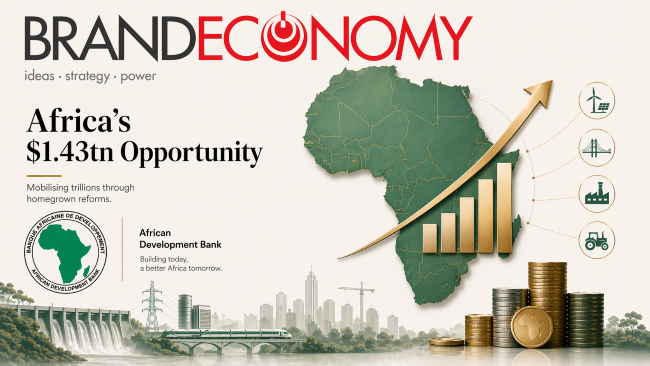 Africa’s development challenge is often described as a shortage of money. The African Development Bank is making a more provocative argument: the bigger problem may be the continent’s inability to organise, retain and deploy the capital it already has. At a virtual pre-2026 Annual Meetings briefing, AfDB Chief Economist and Vice President for Economic Governance and Knowledge Management, Kevin Urama, said Africa could mobilise as much as $1.43 trillion annually from domestic resources if the right policy, institutional and governance reforms are put in place.
That figure is striking not only for its scale, but for what it implies. A continent often framed as overly dependent on aid, volatile foreign direct investment and expensive external borrowing may in fact possess far more internal financing power than its current development story suggests. Yet that potential remains trapped behind weak public finance systems, leakages, fragmented institutions and the uneven quality of economic governance. Urama’s point, in essence, is that Africa’s financing gap is not just external. It is also administrative, political and structural.


A continent rich in resources, poor in mobilisation
The paradox is by now familiar. Africa sits on abundant natural wealth, rising urban markets and a growing demographic base, yet still struggles to finance its own transformation at scale. Urama said the continent faces vast and overlapping funding demands: about $1.3 trillion to meet the Sustainable Development Goals, roughly $184 billion to $221 billion a year for infrastructure, and more than $200 billion annually to close climate financing gaps. Against that backdrop, the argument for stronger domestic resource mobilisation becomes less academic and more urgent.
This is happening in a world that is becoming less generous and more fragmented. Official development assistance is under pressure. Foreign investment flows are increasingly volatile. Geopolitical rivalry is reordering priorities and weakening the reliability of traditional financing channels. The result is that Africa must now think more seriously about sovereignty in financial terms: not isolation from the world, but reduced vulnerability to it.
The reform agenda beneath the headline number
The AfDB message is not that money will somehow appear if governments simply wish hard enough. The bank’s position is more disciplined than that. Domestic resource mobilisation depends on better tax policy, stronger institutions, improved public financial management, more efficient administration and a determined effort to curb leakages in both tax and non-tax revenue systems. Urama has also highlighted the need for reforms that bring more economic activity into visible, governable and investable channels.
That matters because Africa’s financing problem is not only about raising more money. It is about raising it more credibly. Investors, citizens and development partners respond differently when public systems look capable of collecting and allocating capital with discipline. In that sense, revenue reform is not merely fiscal housekeeping. It is a confidence-building exercise.
Why the 2026 Annual Meetings matter
The AfDB 2026 Annual Meetings, scheduled for 25 to 29 May in Brazzaville, Republic of the Congo, will unfold under the theme, “Mobilising Africa’s Development Financing at Scale in a Fragmented World.” That framing is apt. It captures the reality that Africa’s development agenda now sits at the intersection of shrinking external certainty and growing domestic necessity. The meetings are expected to bring together governors from the Bank’s 81 member countries, along with heads of government, development partners and private-sector actors to review operations, shape resolutions and debate the financial architecture needed for the next phase of continental growth.
Chioma Onukogu, speaking for the Office of the Secretary General, has emphasised that the meetings will feature governors’ dialogue, knowledge events and broader conversations on capital mobilisation, financial systems, demographics and natural resource wealth. In other words, this is not just another institutional gathering. It is intended as a strategic forum for rethinking how Africa funds itself in a harsher global climate.
From dependence to design
Urama’s intervention also points to a broader intellectual shift. For years, Africa’s financing debate has often been conducted as though the continent were mainly a recipient waiting for external rescue. The AfDB is trying to redirect that conversation toward design: how to build domestic systems capable of converting savings, taxes, natural-resource rents, digital finance and blended structures into long-term development capital. Innovative instruments such as climate finance, blended finance and digital finance were all identified as part of that broader toolkit.
That is the more serious question now confronting African policymakers. Not whether the need is large — that is already obvious — but whether the institutional imagination exists to match the scale of the challenge.
BRANDECONOMY Insight
The AfDB’s $1.43 trillion proposition should be read less as a promise of easy money and more as a test of African state capacity.
The headline number is powerful because it reframes the development narrative. Africa’s core problem is not only scarcity. It is under-mobilisation. Too much capital remains weakly taxed, poorly intermediated, insufficiently captured or ineffectively deployed. That has implications far beyond public budgets. It affects infrastructure, industrial policy, climate resilience and the political legitimacy of reform itself.
Three issues stand out.
First, domestic resource mobilisation is becoming the new frontline of economic sovereignty. In a fragmented world, countries that cannot finance a larger share of their own priorities will remain exposed to the policy moods of others.
Second, institutional reform now matters more than rhetorical ambition. The gap between what Africa could mobilise and what it currently mobilises is, in large measure, a governance gap.
Third, this debate is not anti-external capital. It is about bargaining power. The stronger Africa’s domestic financial base, the better positioned it will be to negotiate, attract and deploy external resources on its own terms.
In short, the continent’s financing future according to the AfDB may depend less on discovering new wealth than on governing existing wealth better.