

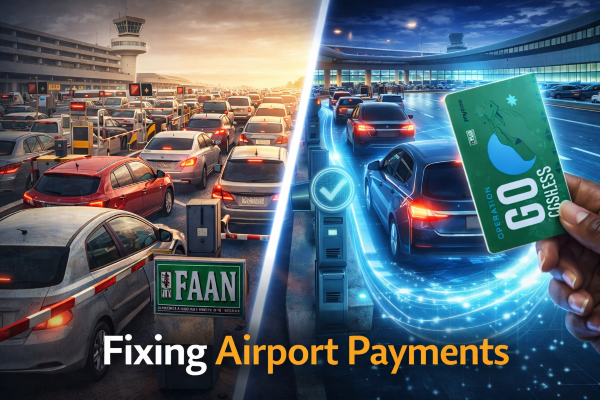
 President Bola Ahmed Tinubu has directed the suspension of the newly introduced cashless payment system at airport toll gates across Nigeria following widespread complaints of gridlock and delays affecting travellers.
The decision was announced by the Minister of Aviation and Aerospace Development, Festus Keyamo, after a meeting of the Federal Executive Council at the Presidential Villa in Abuja.




According to Keyamo, the president instructed the ministry to “go back to the drawing board” and redesign the system to ensure smoother operations that do not place undue pressure on airport users.
The minister explained that the suspension became necessary after travellers reported long queues and severe traffic congestion at major airports, particularly in Lagos and Abuja, causing some passengers to risk missing their flights.
Hybrid Payment System Introduced Temporarily
While the government works on improving the FAAN Cashless Payment System , a temporary hybrid payment model will be introduced.
Under the arrangement:
- Travellers with existing FAAN prepaid cards will continue using them
- Cash payments will temporarily be allowed
- New electronic payment systems will be redesigned with private sector participation
Keyamo said the president’s directive was motivated by concern for citizens rather than opposition to the broader cashless reform.
“Mr President was concerned about the welfare of Nigerians and the fact that some travellers were missing their flights because of the gridlock,” he said.
Private Sector May Help Redesign System
The aviation minister revealed that the government may invite private sector operators to help design a more efficient electronic toll collection system for airports.
He noted that the long-standing cash-based toll collection model — which has existed for more than five decades — had historically been vulnerable to revenue leakages and corruption.
However, the rushed rollout of the new electronic payment system created operational bottlenecks.
“We will engage private sector operators to devise a system that eliminates cash without causing disruption,” Keyamo said.
FAAN Chief Summoned for Review
Shortly after announcing the suspension, President Bola Ahmed Tinubu met with the Director-General of the Federal Airports Authority of Nigeria (FAAN), Dr Olubunmi Kuku, at the Presidential Villa.
Officials said the meeting was connected to the operational challenges surrounding the policy implementation.
The airport authority had earlier introduced a nationwide cashless toll system, requiring motorists to use prepaid “Go Cashless” cards to access airport facilities.
At the Nnamdi Azikiwe International Airport alone, more than 10,000 cards had reportedly been registered before the policy triggered congestion at toll gates.
Authorities now plan to redesign the payment architecture to ensure seamless access to airport facilities without disrupting traffic flow.
BRANDECONOMY Insight
The suspension of the FAAN Cashless Payment System underscores a recurring challenge in Nigeria’s public sector reforms: policy design versus operational readiness.
The reform itself reflects a legitimate objective — eliminating cash handling in public infrastructure systems. However, execution failures exposed deeper institutional weaknesses.
Three structural lessons emerge.
1. Digital Infrastructure Requires Operational Testing
Cashless payment ecosystems demand robust payment networks, user onboarding systems and redundancy mechanisms. Without these, even well-intended reforms can disrupt essential services.
2. User Behaviour and Adoption Lag
Many airport users had not obtained prepaid cards despite months of sensitisation. Policy transitions must account for real-world behavioural adoption patterns, especially in a mixed digital–cash economy.
3. Public–Private Collaboration Is Critical
The president’s directive to involve private operators signals recognition that technology-driven public services often perform better when built with private-sector expertise.
If redesigned successfully, Nigeria’s airport toll payment system could evolve into a modern digital infrastructure model that improves transparency, revenue collection and passenger experience.
However, the episode also highlights the importance of pilot testing and phased implementation in national reform programmes.