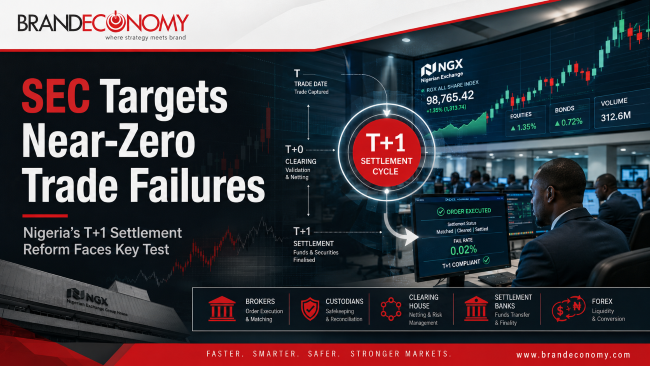
 The Securities and Exchange Commission has set its sights on sustaining a near-zero trade-failure rate under Nigeria’s new T+1 settlement cycle, as the capital market regulator moves to demonstrate that faster settlement can work efficiently for both domestic and foreign investors.
The Director-General of the SEC, Dr Emomotimi Agama, disclosed the objective in a document made available in Abuja, describing clean settlement performance as a major priority for the second half of the year.




Under the T+1 system, securities transactions are completed one business day after the trade date. This replaces a longer settlement window and requires brokers, custodians, banks, investors and the Central Securities Clearing System Plc to exchange securities and funds within a tighter timeframe.
Agama said the commission would focus on full delivery-versus-payment discipline across market institutions. Delivery versus payment reduces settlement risk by ensuring that ownership of securities changes only when the corresponding payment is completed.
Early evidence since the transition in June had been encouraging, he said, but the commission now wants to demonstrate at least one full quarter of consistently clean settlement data.
That record will be crucial to proving that Nigeria’s market infrastructure can support faster trading without creating liquidity problems, operational failures or avoidable investor losses.
Foreign investors face a tougher funding clock
The compressed cycle presents a particular challenge for foreign portfolio investors, who must convert currencies, move funds into Nigeria, complete documentation and fund transactions within one business day.
Agama said international investors should be able to execute foreign-exchange conversion and funding within the shortened cycle without being forced to pre-fund trades.
The SEC is therefore working with the Central Bank of Nigeria, custodians and settlement banks to achieve same-day foreign-exchange execution and confirmation for portfolio transactions.
“The Certificate of Capital Importation process must be fully electronic, timely and predictable, so that entry and exit are seamless,” Agama said.
The commission has formally engaged the CBN on modernising the CCI process to align it with T+1 realities.
The CCI is important to foreign investors because it provides evidence that capital entered Nigeria through approved channels and supports the future repatriation of dividends and investment proceeds.
For global fund managers, uncertainty around foreign-exchange access or capital documentation can outweigh attractive stock valuations. Making the process faster and more predictable could therefore strengthen foreign participation and improve liquidity on the Nigerian Exchange.
FTSE scrutiny puts execution in focus
Agama said FTSE Russell’s decision to observe the Nigerian market during the T+1 transition represented standard index-governance practice when a market introduces a structural reform of this scale.
The index provider is expected to assess whether the shortened settlement process works as effectively in practice as regulators and market operators expect, especially for international investors.
FTSE Russell announced in April 2026 that Nigeria would return to Frontier market status, increasing the importance of reliable trading, settlement and foreign-exchange access to the country’s international investment proposition.
A consistently low trade-failure rate would strengthen the case that Nigeria possesses the operational discipline required by global portfolio investors. Persistent failures, by contrast, could damage confidence and increase the perceived cost of trading in the market.
Equities may consolidate after strong first half
On the outlook for the second half, Agama said equities, fixed-income securities and alternative investments would remain constructive, although investors were likely to become more selective.
After a 47.4 per cent advance in the first half, he said some consolidation would be natural and healthy.
The underlying drivers, according to the SEC chief, remain supportive. Recapitalised banks are expected to deploy fresh capital, new listings are being prepared, foreign participation is improving and half-year corporate earnings should remain broadly resilient.
A period of consolidation would allow investors to reassess valuations after the strong rally. It could also distinguish companies with sustainable earnings, credible governance and productive expansion plans from those lifted mainly by wider market momentum.
Fixed income remains attractive
Agama said the fixed-income market would continue to offer attractive opportunities as disinflation progresses and yields remain elevated.
Positive real returns across parts of the yield curve could sustain investor interest in federal, state and corporate debt instruments.
The SEC expects vibrant issuance by sovereign, subnational and private-sector borrowers, including infrastructure bonds and green instruments.
For companies and governments, the opportunity lies in converting investor appetite into long-term funding for productive assets. For investors, the central considerations will remain credit quality, inflation, interest-rate direction and the credibility of each issuer’s repayment structure.
ISA 2025 expands investor protection
Agama identified the Investments and Securities Act 2025 as a defining reform that modernised Nigeria’s capital-market legal framework, brought digital assets more clearly within regulatory oversight and strengthened the SEC’s enforcement powers.
The Act expressly defines and prohibits Ponzi and pyramid schemes, giving regulators a firmer statutory basis for enforcement against fraudulent investment operations.
The SEC has continued to warn that unregistered online schemes frequently display characteristics associated with prohibited or Ponzi-style operations.
Before year-end, Agama said investors should expect further implementation of the Capital Market Liquidity Roadmap, continued recapitalisation of market operators, stronger sustainability and environmental, social and governance disclosures, and expanded technology-driven supervision.
The commission also plans to admit more regulated digital-asset operators, an area in which it has established rules covering offering platforms, custodians, virtual-asset service providers and digital exchanges.
Market and investor implications
A successful T+1 transition could make Nigeria’s capital market faster, more efficient and more attractive to institutional investors.
Shorter settlement reduces the period during which counterparties remain exposed to one another. It can also free capital more quickly and improve the efficiency of securities transactions.
But the benefits depend on strong technology, adequate liquidity, accurate data and disciplined coordination among brokers, custodians, clearing institutions and banks.
Foreign-exchange access remains the critical bridge between market reform and increased international participation.
Brand implications
For the SEC, near-zero settlement failures would strengthen its reputation as a modern, credible and technology-driven regulator.
For the Nigerian capital market, T+1 is also a brand statement. It signals that the market wants to compete internationally on speed, transparency and operational reliability.
Market operators must support that promise with competent staff, secure systems and prompt communication when problems arise.
BRANDECONOMY Insight
T+1 is not simply a faster timetable. It is a stress test of Nigeria’s entire investment infrastructure.
The SEC can set the rule, but brokers, banks, custodians, the CSCS and foreign-exchange institutions must make it work together.
Near-zero trade failures would tell global investors that Nigeria’s market is not only capable of generating strong returns—it can also deliver operational certainty.
The transition will ultimately be judged by three outcomes: whether transactions settle cleanly, foreign investors can fund and repatriate seamlessly, and stronger regulation translates into deeper investor trust.