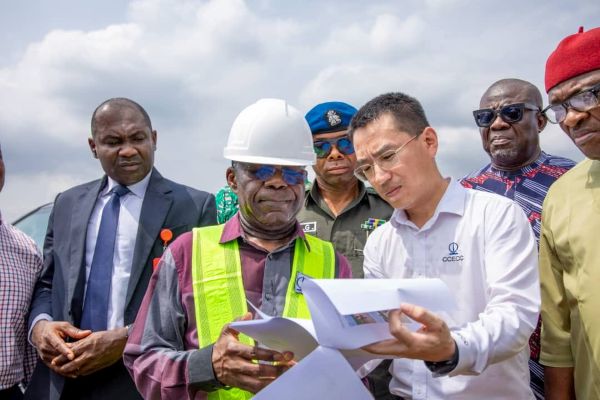
Abia State Governor Alex Otti has pledged to accelerate construction at the Abia Industrial Innovation Park (AIIP), renewing the government’s commitment to a project intended to convert the state’s oil and gas resources into investment, employment and wider industrial development.




The assurance was conveyed on Tuesday during a visit to the project site at Owaza, Ukwa West Local Government Area. Otti was represented by his Chief of Staff, Dr Caleb Ajagba, who accompanied the park’s new Managing Director, Ms Sandra Ivonye-Ntofon, on an assessment of the work ahead.
The governor said construction would intensify in the coming weeks and months, with attention shifting towards translating interest from companies and organisations into project execution.
That shift is the central economic issue. An industrial park becomes valuable when enterprises can commit capital, install equipment and operate competitively within it. Investor enquiries are encouraging, but the development dividend arrives through functioning infrastructure and sustained production.
New leadership faces a delivery mandate
Speaking on Otti’s behalf, Ajagba said the visit would help the new managing director understand the work required to meet the expectations of the state government, Abia residents and the international business community.
He reaffirmed the administration’s determination to complete the initiative and make the industrial park operational. Several companies and organisations had expressed interest, he said, and the immediate task was to move those expressions towards execution.
Ivonye-Ntofon pledged her commitment to completing the project, expressing confidence that the facility would become a source of pride for the host community, the government and the people of Abia.
Her appointment creates an opportunity to strengthen coordination between the public infrastructure programme and the requirements of prospective tenants. The practical challenge is to establish which projects are ready to proceed, what each needs and who is responsible for delivering it.
The latest assurance did not set out a firm completion date, a detailed financing schedule or the identities and investment commitments of interested companies. Those disclosures would help stakeholders distinguish a growing pipeline of enquiries from projects approaching construction or operation.
Oil and gas must translate into commercial value
Abia’s Commissioner for Petroleum, Prof. Joel Ogbonna, said the Abia Industrial Innovation Park would help harness the state’s oil and gas resources for economic development.
He identified a planned modular refinery and compressed natural gas facility as projects expected to generate employment and stimulate economic activity. Access-road construction and the completion of necessary processes had laid groundwork for development, he said.
The economic rationale is to retain more value locally through processing, energy services and related industrial activity. Such facilities could create demand for engineering, maintenance, transport, storage and other business services.
Their viability nevertheless depends on more than proximity to petroleum resources. A modular refinery requires dependable crude supply, appropriate technology, sufficient financing and buyers for its output. Refining margins also depend on feedstock costs, operating efficiency and prevailing product prices.
Similarly, a CNG facility needs reliable gas supply and a market capable of using its output. Transport demand may require supporting distribution, refuelling access and suitable vehicles.
These are commercial conditions to be established, rather than benefits that can be guaranteed by announcing a facility. Local refining also does not automatically produce cheaper fuel: costs and market conditions remain decisive.
Shared infrastructure is the industrial advantage
The Abia Industrial Innovation Park development ambition predates the latest visit. At its 2023 groundbreaking, the Nigerian Content Development and Monitoring Board highlighted the importance of shared infrastructure in reducing manufacturing costs.
The Board’s then Executive Secretary, Engr. Simbi Kesiye Wabote, explained how providing power, roads, water and waste-treatment services could allow businesses to concentrate on manufacturing rather than constructing their own support systems. Nigerian Content Development & Monitoring Board
That principle remains relevant to AIIP’s execution. A cluster can offer an advantage when firms share dependable services and obtain useful access to suppliers, skilled workers and customers.
It can lose that advantage if tenants must still provide most utilities independently or if service charges become unpredictable. Infrastructure quality and management therefore matter as much as the availability of industrial land.
Access roads are an important foundation. The next assessment must consider whether the infrastructure required by the first operating businesses can be delivered together, maintained and priced sustainably.
Host-community support is an economic asset
Mr Godwin Adiele, who represents Ukwa West State Constituency in the Abia State House of Assembly, commended Otti for locating the park in the area.
He also urged faster implementation so residents could benefit from its anticipated economic impact. The park, he said, was conceived to accommodate several industries, generate jobs and promote development in Ukwa West and neighbouring communities.
Adiele encouraged residents to sustain their cooperation, describing the people as peace-loving.
The traditional Prime Minister of Igiriukwu Autonomous Community of Owaza, Chief Uche Nwele, likewise pledged community support. He acknowledged compensation paid by the state government and other development steps, expressing appreciation for the Abia Industrial Innovation Park initiative.
Those assurances are significant. Industrial development requires a durable relationship with communities whose land, environment and livelihoods may be affected.
Compensation can support that relationship, but continuing engagement is equally important. Clear grievance procedures, transparent recruitment, local supplier opportunities and environmental safeguards would help ensure that community expectations remain aligned with project realities.
Market implications and investor relevance
If delivered effectively, AIIP could create opportunities for contractors, logistics companies, equipment suppliers, energy-service providers and businesses supplying its tenants. The scale and durability of those opportunities will depend on actual occupancy and production.
For smaller local enterprises, the development benefit could come through supply contracts and services rather than direct tenancy. Connecting them to procurement requirements and relevant skills development would strengthen the park’s wider economic contribution.
Investors should distinguish the prospects of the industrial estate from the economics of each proposed business within it. Government backing does not establish the profitability of a refinery, CNG operation or manufacturing venture.
Assessment should focus on land rights, infrastructure obligations, financing, feedstock arrangements, customer demand and operating costs. Clear agreements on service delivery and responsibility for delays would make investment decisions more credible.
Phased implementation could help match infrastructure spending with committed demand. It would also allow early operational results to demonstrate the park’s commercial proposition before wider expansion.
Brand implications for Abia
AIIP has the potential to strengthen Abia’s reputation as an investment destination, particularly if the state demonstrates that project commitments translate into reliable operating conditions.
That reputation will be shaped by how quickly legitimate applications are processed, how consistently agreements are honoured and how promptly operational problems are resolved.
Ivonye-Ntofon’s ambition to make the park a source of pride is therefore connected to a practical brand challenge. Investors and residents will judge the initiative through visible progress and dependable performance.
Regular disclosure of construction milestones, committed tenants and infrastructure readiness would give the state’s investment narrative greater substance.
BRANDECONOMY Insight
Otti’s renewed assurance identifies the right priority: converting interest into execution. For Owaza and Abia, the decisive transition will be from a promising location to an industrial environment in which businesses can operate and communities can see economic benefits.
That requires coordination across infrastructure, project finance, energy supply and community relations. Accelerating one element while others remain unresolved could leave assets waiting for the conditions necessary to use them.
The strongest next step would be a publicly understandable delivery programme identifying initial operating projects, essential infrastructure, responsible parties and measurable milestones.
AIIP will strengthen Abia’s economic standing when its tenants produce competitively, its services work reliably and its host communities participate in the opportunities created. Each delivered commitment would then become evidence supporting the next investment.