The Nigerian Communications Commission is urging buyers to verify phones and other SIM-enabled devices before purchase, strengthening a regulatory push that could reshape consumer protection and competition in Nigeria’s device market.
Speaking at a media roundtable in Abuja on Tuesday, Edoyemi Ogoh, the NCC’s Director of Technical Standards and Network Integrity, urged buyers to question sellers and independently confirm devices meet the Commission’s requirements.




The advice covers phones, tablets, modems and other equipment connecting through a SIM. Ogoh said consumers could call 315, a toll-free support number, for assistance.
Behind the purchasing advice lies an economic question: can Nigeria create a more dependable device market without making digital access harder for households and small businesses?
 What verification actually establishes
 What verification actually establishes
The NCC’s enhanced Type Approval compliance framework seeks to ensure that communications equipment sold and used in Nigeria meets applicable technical and regulatory standards.
Ogoh said network integrity depends on both telecommunications infrastructure and the quality, safety and compliance of connected devices. The programme is intended to improve electronic checks, regulatory oversight and the identification of non-compliant, cloned and counterfeit equipment.
The Commission’s guidance distinguishes approval of a device model from verification of the particular device for network use. Both matter when checking a prospective purchase.
A successful result is not a comprehensive guarantee of physical condition, repair history, software or every component. Buyers still need credible sellers and clear warranty terms. NCC
Verification can reduce uncertainty about regulatory status. It cannot replace every aspect of consumer due diligence.
Existing obligations meet digital enforcement
Ogoh linked the initiative to the Nigerian Communications Act, 2003, citing Section 132(2), which requires relevant licensed providers, equipment manufacturers and suppliers to obtain Type Approval before communications equipment is sold or used.
The framework strengthens enforcement of an existing obligation rather than making buyers responsible for securing technical approval.
After issuing Type Approval Business Rules in August 2024, the NCC undertook stakeholder engagements, market studies and consultations across the device supply chain.
Participants included original equipment manufacturers, importers, dealers, service providers, government agencies and industry associations. Ogoh said their contributions shaped implementation.
The Commission worked with the Nigeria Customs Service and other stakeholders to onboard existing stock and ensure newly imported devices were verified and authenticated.
That transition matters commercially. Dealers need clear procedures for stock already purchased, while importers need predictable processing to avoid delays.
NCC guidance says devices connected before October 7, 2026 were automatically verified. Consumers buying used devices should nevertheless check their status before paying. NCC
Who ultimately pays?
The regulator’s case rests on consumer protection and fairer competition. Legitimate businesses face a disadvantage when rivals sell equipment that bypasses applicable requirements.
More consistent enforcement could strengthen compliant distribution channels and make regulatory status easier for consumers to assess.
However, implementation may also involve administrative work, inventory reconciliation and adjustments to supply-chain systems. Whether businesses absorb these costs or pass them to buyers will depend on efficiency, competition and pricing decisions.
The briefing did not establish a quantified increase in handset prices or itemise new consumer charges. Higher prices should therefore be investigated as a possibility, not reported as an established outcome.
Affordability also extends beyond the purchase price. A cheaper device that fails prematurely or cannot operate as expected may cost its owner more through replacement, repairs and interrupted business.
The appropriate comparison is lifetime value: purchase cost, durability, support and dependable connectivity.
For a trader receiving digital payments or a student accessing online lessons, device reliability affects participation in the economy. Effective regulation should protect that participation while keeping legitimate entry-level products accessible.
Privacy requires precise assurances
Ogoh said the system was designed for device identification and regulatory compliance, rather than surveillance.
It uses identification information, including International Mobile Equipment Identity numbers. He said the Commission does not gain access to users’ financial information or personal content through the framework.
That distinction matters. Device identifiers are data, even though they are different from messages, photographs and financial records stored on a handset.
Public confidence will depend on clear explanations of the information collected, authorised access, retention practices and routes for correcting errors.
The NCC’s commitment to privacy should therefore be supported by understandable procedures and responsive assistance. Consumers need to know what verification does without being encouraged to dismiss legitimate questions about data governance.
Market, brand and investor implications
For handset manufacturers and authorised distributors, the framework offers an opportunity to make demonstrable compliance part of their market proposition.
Retailers can strengthen credibility by enabling checks before payment, keeping reliable supplier records and explaining after-sales support. A verification result should complement accurate claims about a product’s condition and origin.
Brands also need to prevent regulatory approval from becoming an exaggerated marketing promise. Compliance establishes a necessary foundation; customer experience determines whether confidence lasts.
Investors assessing device distribution, retail or connected-service businesses should examine sourcing controls, inventory exposure and the ability to resolve verification problems.
Potential beneficiaries include compliant businesses combining dependable products with competitive prices. Outcomes will depend on implementation, rather than the announcement alone.
Nnenna Ukoha, Director of the NCC’s Public Affairs Department, described Device Verification checking and Type Approval as measures supporting safety, network quality and consumer protection.
She linked the initiative to Nigeria’s ambition for a trillion-dollar digital economy. That ambition requires affordable devices that work reliably, alongside infrastructure, skills and services that generate economic value.
BRANDECONOMY Insight
The NCC’s Device Verification intervention addresses a trust gap between what a seller promises and what a buyer can independently establish.
Its value will be measured through fewer problematic purchases, clearer compliance and dependable access to legitimate devices. Registration activity alone cannot demonstrate those outcomes.
The commercial challenge is to strengthen accountability without creating avoidable friction that excludes affordable products or confuses consumers.
Responsibility should remain visible throughout the supply chain, with manufacturers, importers and sellers meeting their obligations before asking customers to pay.
A trusted device market emerges when regulation, competitive pricing and reliable service reinforce one another. Nigeria’s digital ambitions depend on making that relationship work.
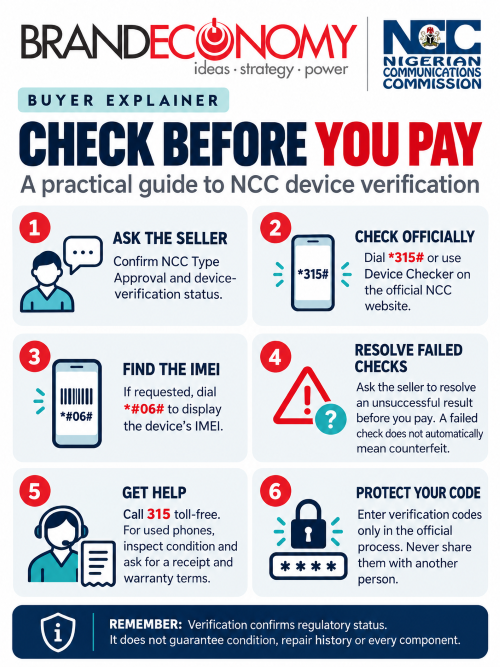
Buyer Explainer: Check Before You Pay
- Ask the seller to confirm both NCC Type Approval and device-verification status.
- Dial *315# and follow the prompts, or use Device Checker on the official NCC website.
- If requested, obtain the device’s 15-digit IMEI by dialling *#06#.
- If verification fails, ask the seller to resolve it before payment. Failure does not automatically prove counterfeiting.
- Call 315 toll-free for assistance. For used phones, inspect condition and request a receipt and warranty terms.
- Enter verification codes only within the official process; never disclose them to another person. NCC