Why a Mining Ban Won’t Solve Nigeria’s Security Crisis — Industry Leaders Warn

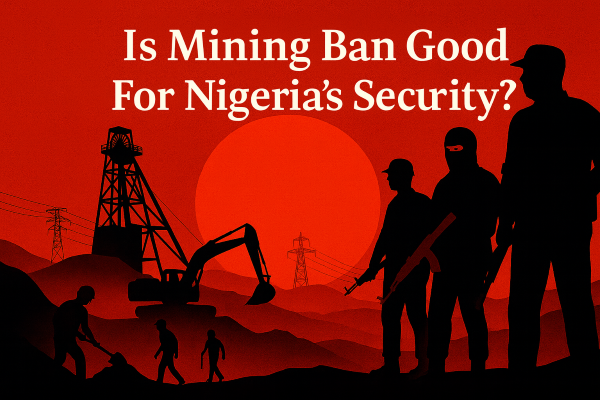
Nigeria Faces A Critical Policy Crossroads
As insecurity escalates across northern Nigeria — from mass abductions to rural terror and worsening banditry — the Northern States Governors’ Forum (NSGF) has proposed a six-month suspension of all mining activities.
Their argument: illegal mining is fuelling terrorism.
Their solution: shut down mining nationwide pending a full audit of licences.




But the Miners Association of Nigeria (MAN), representing legitimate operators powering the country’s $700bn mineral potential, is pushing back hard.
In a strongly worded statement, MAN warns that a blanket mining ban will not halt criminality — it will deepen it.
The Central Argument: “Legal Mining Is Not The Problem — Illegal Mining Is”
MAN President Dele Ayankale and National Secretary Sulaiman Liman draw a sharp line:
✔ Illegal mining = money laundering, terrorism financing, weapons trade
✔ Legal mining = jobs, tax revenues, community development
According to MAN:
“Stigmatising legitimate mining as the cause of insecurity is a misnomer.”
The association insists that licensed operators follow environmental, labour, and security protocols, while illegal miners work freely in remote terrains with no regulation, no oversight, and direct links to violent networks.
A Failed Strategy: The Zamfara Example
Nigeria has tried mining bans before — and the results were catastrophic.
In 2019, the Federal Government suspended mining in Zamfara to curb terrorism.
Instead of peace, the region witnessed:
- Expansion of terrorist camps
- Higher frequency of mass kidnappings
- Spread of violence into Katsina, Kaduna, Niger, Kebbi
MAN argues the facts speak for themselves:
❌ A mining ban does NOT stop terrorism
❌ It strengthens the illegal mineral–arms exchange
❌ It destroys legitimate livelihoods and investment pipelines
In effect, a ban hands mineral fields to criminals, because illegal groups are mobile, armed, and well-funded — while legal miners are the only ones who obey shutdown directives.
Security Reality Check: Why Illegal Miners Thrive
Illegal mining flourishes not because legal miners exist, but because:
- Government enforcement logistics are weak
- Security agencies are overstretched
- Mineral sites are vast and unmonitored
- Terrorist networks use minerals as currency
As MAN bluntly puts it:
“Unfettered access to minerals empowers criminals as they exchange resources for arms and ammunition.”
A ban, therefore, becomes a strategic gift to terrorists, not a deterrent.
ECONOMIC IMPLICATIONS: JOB LOSSES, POVERTY, INVESTOR PANIC
A national mining shutdown would:
🔻 Wipe out thousands of legal mining jobs
🔻 Drive up multidimensional poverty in rural regions
🔻 Scare away new foreign investments
🔻 Undermine the Federal Government’s solid minerals reform agenda
The sector has only recently begun attracting serious foreign capital following reforms by the Ministry of Solid Minerals Development.
A ban sends the opposite signal: policy uncertainty and regulatory risk.
Constitutional Dimension: Who Really Controls Minerals?
The NSGF’s call for licence revalidation touches a politically sensitive nerve.
Under Nigeria’s Constitution, mineral resources fall under the:
Exclusive Legislative List
Meaning:
✔ Only the Federal Government regulates mining
✔ States cannot unilaterally influence mineral licensing
✔ Any attempt to do so edges toward “resource control” activism
MAN stresses that such manoeuvres undermine constitutional order and federal economic cohesion.
The Industry’s Counter-Proposal: Targeted Security, Not A Blanket Ban
Rather than shutting down the sector, MAN advocates:
✔ Stronger Mining Marshals
✔ Specialised security funds from state governments
✔ Technology-driven surveillance of mining hot spots
✔ Stricter intelligence coordination between security agencies
✔ Community policing partnerships
✔ Crushing illegal supply chains, not legal operators
Legal miners, they say, already collaborate closely with security agencies — and are critical stakeholders in rural stability and development.
The Larger Danger: A Ban Could Create More Terrorist Recruits
With unemployment soaring in mining communities, MAN warns the consequences are predictable:
Idle youth + lost income + insecurity = rapid recruitment into criminal groups
In essence, the policy meant to reduce terrorism could end up expanding it.
BRANDECONOMY Verdict: Ban Is A Blunt Tool For A Complex Problem
Nigeria’s mineral economy is too valuable — and too fragile — for broad-stroke policymaking.
The real enemy is illegal mining networks, not regulated operators.
Solutions must be intelligence-driven, technology-backed, and constitutionally anchored.
Any policy, such as the proposed mining ban, that empowers criminals while weakening legitimate players is not just ineffective — it is dangerous.