
Another Grid Collapse: Why Nigeria’s Power System Keeps Failing Businesses and Households

When Darkness Becomes Policy Failure
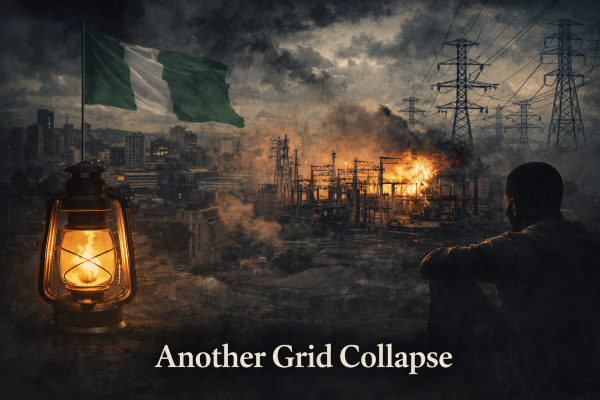
Yet again, Nigeria’s national electricity grid has collapsed—plunging homes, factories, hospitals and digital businesses into darkness, uncertainty and avoidable losses. The latest system failure, which briefly reduced nationwide electricity supply to near-zero levels, underscores a sobering reality: despite years of reforms, restructuring and rhetoric, Nigeria’s power sector remains dangerously fragile.
According to the Nigerian Independent System Operator (NISO), power supply has since been restored and system stability “normalised.” But for millions of Nigerians and thousands of businesses, the damage—economic, operational and psychological—was already done.




This was not merely a technical glitch. It was another costly reminder that Nigeria’s electricity crisis has evolved into a structural economic risk.
A Collapse by the Numbers
At the peak of the disturbance, electricity distributed nationwide reportedly fell to about 50 megawatts—a fraction of what is required to power even a single large Nigerian city. Only two distribution companies recorded any load at all, while major urban and industrial hubs were effectively switched off.
Such a collapse is not an anomaly. It follows a disturbing pattern of repeated grid failures that continue to erode confidence in the Nigerian Electricity Supply Industry (NESI).
What Went Wrong This Time?
Preliminary findings from NISO point to a familiar combination of triggers:
- Tripping of multiple generating units
- Failure along critical 330kV transmission lines
- Persistent gas supply disruptions, worsened by pipeline vandalism
The vandalisation of the Lagos–Escravos Gas Pipeline, a key artery feeding power plants, once again exposed the tight coupling between Nigeria’s gas infrastructure and electricity generation. When gas fails, the grid follows.
Although parts of the Delta generation complex reportedly operated on “island mode,” supplying limited power to select substations, the broader national system proved unable to absorb the shock.
The Economic Cost of Darkness
Grid collapses are not abstract engineering problems—they are economic emergencies.
Nigeria already loses tens of billions of dollars annually to unreliable power supply. Each nationwide outage compounds:
- Business shutdowns and spoiled inventory
- Rising production costs, driven by diesel and petrol generators
- Job losses, especially among SMEs
- Supply-chain disruptions, from cold storage to logistics
- Higher inflation, as energy costs are passed on to consumers
According to business economists and private-sector advocates such as the Centre for the Promotion of Private Enterprise, prolonged outages—even over 24 hours—can trigger losses running into billions of naira across commerce, manufacturing and services.
Why Festive-Period Collapses Are Especially Alarming
What makes this latest failure particularly troubling is timing. Electricity demand is typically lower during festive periods, when many factories and offices shut down. In theory, reduced load should ease pressure on the grid.
That the system still collapsed under lighter demand raises red flags about:
- Aging transmission infrastructure
- Poor system redundancy
- Weak operational coordination
- Inadequate investment in grid resilience
As energy analysts note, a grid that cannot remain stable under low load conditions is structurally unfit for industrial-scale growth.
Governance Gaps and Accountability Questions
Notably, as the collapse unfolded, there was no immediate public briefing from the Transmission Company of Nigeria or the Federal Ministry of Power. This communication vacuum fuels public frustration and undermines confidence in sector governance.
It also revives scrutiny of unmet performance benchmarks—particularly the widely publicised but unrealised target of delivering significantly higher megawatt capacity within the year.
The Social Toll Nigerians Rarely Quantify
Beyond economics, grid failures inflict deep social costs:
- Hospitals face life-threatening power gaps
- Water supply systems shut down
- Students and remote workers lose productivity
- Food security is compromised as cold chains fail
- Public safety deteriorates without street lighting and traffic systems
For many Nigerians, electricity is no longer a utility—it is a daily gamble.
Why the Grid Keeps Failing: The Structural Roots
At its core, Nigeria’s grid crisis is driven by:
- Decades of under-investment
- Aging, overstretched infrastructure
- Gas supply insecurity and vandalism
- Weak redundancy and system automation
- Policy inconsistency across administrations
Until these fundamentals are addressed—not patched—collapses will remain a feature, not a bug, of the system.
What Must Change—Now
If Nigeria is serious about economic growth, industrialisation and investor confidence, the power sector must move beyond reactive fixes. Priority actions include:
- Hardening gas and transmission infrastructure
- Accelerating grid automation and redundancy
- Enforcing accountability across NESI institutions
- Aligning policy promises with operational reality
- Treating electricity stability as a national economic security issue, not a routine inconvenience
BRANDECONOMY Verdict
Nigeria’s electricity grid is not just failing—it is holding the economy hostage. Every collapse reinforces a costly paradox: Africa’s largest economy remains powered by some of its weakest infrastructure.
Until grid stability becomes non-negotiable national policy, darkness will continue to undermine productivity, confidence and prosperity.