The headline VAT rate is not changing. What could change is more consequential: which products attract tax, which qualify for relief, which businesses recover their input costs—and which households eventually absorb them through higher prices.
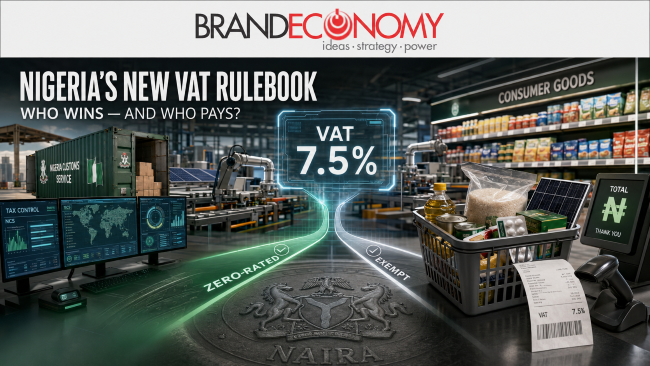 The headline VAT rate is not changing. What could change is more consequential: which products attract tax, which qualify for relief, which businesses recover their input costs—and which
 Nigeria has begun writing the operating manual for one of the most important—and least understood—parts of its new tax regime.
The Federal Government has inaugurated an inter-ministerial committee to develop the 2026 Value Added Tax Modification Order. The committee, established on July 24 and given six weeks to complete its assignment, must produce a draft order, detailed schedules of exempt and zero-rated supplies, corresponding Harmonised System codes, implementation notes, a stakeholder-consultation report and recommendations for any necessary legislative amendments.




On paper, this appears to be a technical classification exercise.
In practice, it could influence the prices of food, medicines, energy equipment, transport, agricultural inputs and thousands of imported or locally manufactured products. It will affect corporate cash flow, consumer purchasing power, investment decisions and the revenues shared by Nigeria’s governments.
The crucial question is therefore not merely what the committee will classify.
It is who benefits from each classification—and who ultimately pays for it.
The VAT Rate Is Not the Story
Nigeria’s standard VAT rate remains 7.5 per cent under the Nigeria Tax Act 2025, which took effect on January 1, 2026.
The new order cannot casually rewrite that statutory rate. Its immediate significance lies in interpreting and implementing the law: defining exempt and zero-rated supplies, connecting product descriptions to customs codes, resolving ambiguities and identifying areas where legislation may need amendment.
This distinction matters because uncertainty itself has become a business cost.
A manufacturer that cannot determine whether its product is taxable may price defensively, delay investment or face assessments after goods have entered the market. Importers may encounter conflicting classifications at the ports. Tax administrators may apply the same rule differently. Consumers eventually pay for this uncertainty through higher prices, reduced availability or weaker competition.
The order will succeed only if it makes tax treatment predictable before a transaction—not after an audit.
Zero-Rated and Exempt Are Not the Same
Two products may both appear “VAT-free” to the consumer yet produce very different consequences for the businesses supplying them.
A zero-rated product is still within the VAT system, but tax is charged at zero per cent. The supplier may recover or request a refund of VAT paid on eligible inputs used in producing that supply.
An exempt product attracts no output VAT, but the supplier will generally be unable to recover VAT attributable to the exempt supply. VAT paid on machinery, logistics, professional services, packaging and other taxable inputs can therefore become an embedded business cost.
That cost does not disappear. It enters the product’s price or reduces the producer’s margin.
For manufacturers, zero-rating is therefore often more commercially valuable than exemption. For government, however, zero-rating can create refund liabilities and reduce net revenue more significantly.
This is why the coming debate will not simply be about which sectors receive relief. It will be about the quality of that relief.
The Existing Winners
The Nigeria Tax Act already zero-rates major categories of socially and economically important supplies. These include basic food items, medicines and pharmaceutical products, educational materials, fertilisers, specified locally produced agricultural inputs, medical equipment and services, tuition, non-oil exports, electricity supplied through defined parts of the national value chain, electric vehicles and components for their assembly.
The law separately exempts products and activities including baby products, locally manufactured sanitary products, shared passenger road transportation, agricultural tractors and ploughs, assistive devices, land and buildings, money and securities, and approved supplies within free-trade zones.
If the new order clarifies these categories and assigns accurate HS codes, food processors, pharmaceutical companies, hospitals, schools, agricultural businesses, exporters and electric-vehicle investors could gain considerably.
The immediate consumer benefit would be protection from a direct 7.5 per cent charge. The deeper industrial benefit would come where zero-rated businesses can recover VAT on production inputs, reducing hidden costs and improving competitiveness.
The Industries Likely to Seek Protection
The committee has not yet published a definitive register of stakeholder requests. Claims about named companies or final sectoral concessions would therefore be premature.
The likely pressure points are nevertheless visible in the legislation.
Food manufacturers will want clarity on the boundary between basic food and discretionary processed products. Bread, grains, cooking oils, milk, meat, fish, vegetables and specified staples fall within the protective framework—but flavouring, packaging, processing and product combinations can complicate classification.
Healthcare companies will seek certainty covering medicines, medical devices, laboratory equipment and emerging health technologies. Agricultural businesses will want unambiguous treatment of seeds, fertilisers, animal feeds, machinery and chemicals.
Renewable-energy investors will closely watch the treatment of solar, wind, storage and related equipment. The Eleventh Schedule permits the suspension or delayed commencement of VAT on renewable-energy equipment, petroleum products, compressed natural gas, liquefied petroleum gas and other gaseous hydrocarbons.
CNG and LPG conversion businesses have an especially strong interest because the law permits ministerial classification of conversion equipment, infrastructure and installation services as exempt or zero-rated.
Exporters will want a refund system capable of making zero-rating commercially real. Transport companies will examine whether relief for shared passenger road transport adequately reflects the modern mobility economy. Technology businesses will seek definitions that keep pace with digital products, platforms and incorporeal assets.
The committee must hear these sectors without allowing the process to become a competition in which the strongest lobby secures the broadest concession.
Who Could End Up Paying?
The first potential losers are consumers whose products fall outside protected definitions.
A basic staple may be zero-rated while a closely related processed product attracts 7.5 per cent. If the distinction is poorly drafted, consumers could face arbitrary price differences between products serving essentially similar needs.
The second group is businesses placed in the exempt category when zero-rating would be more appropriate. They may charge no VAT at the point of sale but remain unable to recover input VAT, converting tax into an invisible production cost.
SMEs could also lose if the order becomes a dense catalogue requiring expensive professional interpretation. An elaborate relief that small businesses cannot confidently apply is not genuine relief.
Government carries another cost. VAT collections reached approximately ₦2.42 trillion in the first quarter of 2026, reinforcing the tax’s importance to public revenue. Every new concession has a fiscal price eventually borne through reduced public spending, higher borrowing or greater taxation elsewhere.
The objective cannot therefore be to exempt everything considered desirable. A VAT base riddled with special treatments becomes difficult to administer, vulnerable to abuse and less capable of generating stable revenue.
The real choice is not between taxpayers and government. It is between intelligent relief and indiscriminate relief.
HS Codes: Where Policy Meets the Port
The instruction to attach Harmonised System codes to the schedules may be the committee’s most important technical responsibility.
Without precise codes, attractive policy language can collapse during customs clearance. A solar component, pharmaceutical ingredient, agricultural machine or food preparation may be described one way by a ministry and classified differently by Customs.
The final order must reconcile plain-language product descriptions with trade classifications. It should also address composite goods, replacement parts, accessories, packaging, bundled services and products capable of both qualifying and non-qualifying uses.
A searchable digital classification database would be more useful to businesses than a static gazette alone.
The Refund Test
Zero-rating succeeds only when input-VAT credits and refunds work.
A producer may sell at zero per cent while paying VAT on equipment, services and other inputs. If refunds are delayed for months, the business effectively finances government. Large companies may survive that burden. SMEs may increase prices, reduce production or abandon the relief altogether.
The order should therefore be accompanied by clear documentation requirements, processing timelines, electronic tracking, risk-based verification and interest or other remedies for unreasonable delays.
Nigeria should judge the new system not by the number of products receiving zero-rating, but by how reliably qualified businesses obtain the relief promised by law.
Market, Brand and Investor Implications
For markets, the order could alter pricing, margins and competitive advantage across consumer goods, pharmaceuticals, agriculture, energy, transport and industrial production.
For brands, VAT classification will become part of value positioning. Companies benefiting from lower tax costs will face public pressure to reflect the relief in prices rather than quietly retain the entire gain. Businesses that communicate tax-driven price increases inaccurately risk reputational damage.
For investors, predictability may matter more than generosity. A stable 7.5 per cent charge is easier to model than an ambiguous exemption vulnerable to retrospective interpretation. Investors will examine the scope of relief, refund reliability, implementation dates, transition rules and protection against sudden reclassification.
The best VAT system is not necessarily the one with the most exemptions. It is the one in which legitimate relief is clear, narrow, administrable and dependable.
What the Final Order Must Deliver
The committee should produce:
- A definitive schedule of exempt, zero-rated and temporarily suspended supplies.
- Corresponding HS codes and plain-language product descriptions.
- Worked examples for borderline and composite products.
- Clear commencement and transitional rules without retroactive surprises.
- A reliable refund framework for zero-rated businesses.
- Consistent treatment across the Nigeria Revenue Service and Customs.
- A published estimate of the revenue cost and social benefit of major concessions.
- A rapid dispute-resolution channel for classification disagreements.
- Periodic review provisions capable of responding to innovation and changing consumption.
- A public explanation of stakeholder submissions accepted or rejected.
BRANDECONOMY Insight
Nigeria’s VAT debate has too often been reduced to the headline rate. The 2026 Modification Order shows why the deeper issue is the architecture beneath the number.
The decisive economic questions are which goods enter the tax base, which are exempt, which are zero-rated, which inputs remain recoverable and how quickly legitimate refunds are paid.
A poorly designed order could create relief on paper while embedding costs inside production, multiplying classification disputes and rewarding businesses with the strongest lobbying power.
A well-designed order could protect essential consumption, strengthen food and health security, support exports, encourage cleaner energy, reduce manufacturing costs and give investors the certainty required to commit capital.
Government must resist two temptations: treating every exemption as social protection and treating every taxable product as easy revenue.
Exemptions can hide costs. Taxation can suppress demand. Zero-rating can stimulate production but create refund exposure. Every decision produces a bill—and somebody must pay it.
Nigeria’s new VAT rulebook should therefore be judged by three tests: Can ordinary businesses understand it? Can tax officials administer it consistently? And does the relief reach consumers and productive enterprises rather than disappearing into bureaucracy?
The six-week assignment may sound technical.
Its eventual consequences will be visible in factory accounts, investment models, government revenues—and household shopping baskets.