

Maritime Lawyers Seek Standalone Law for National Single Window Project

 The legal argument is simple but consequential: Nigeria’s National Single Window may promise faster cargo clearance and cleaner trade documentation, but without a clear statutory foundation, the reform could be slowed by institutional rivalry, legal uncertainty and agency resistance.
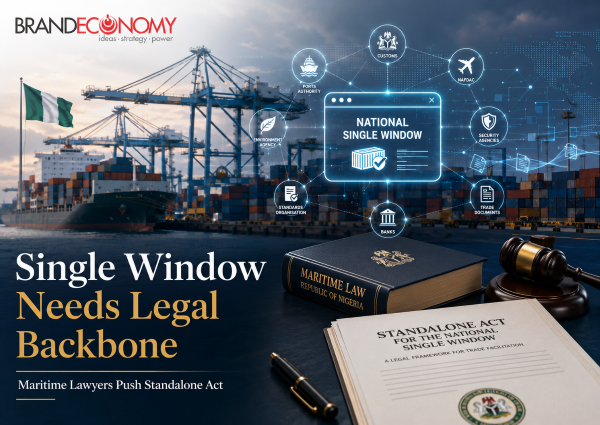 The legal argument is simple but consequential: Nigeria’s National Single Window may promise faster cargo clearance and cleaner trade documentation, but without a clear statutory foundation, the reform could be slowed by institutional rivalry, legal uncertainty and agency resistance.
Maritime lawyers have urged the Federal Government to give the National Single Window project a firmer legal foundation, warning that one of Nigeria’s most important trade-facilitation reforms could face avoidable implementation disputes if it is not backed by a clear and dedicated legal framework.
The call was made by the President of the Nigeria Maritime Law Association, Mike Igbokwe, SAN, during the association’s fourth breakfast meeting in Lagos, themed “Regulatory Reforms: The National Single Window Project.”




Igbokwe said the National Single Window should either be supported by a standalone Act of the National Assembly or incorporated more explicitly into the Business Facilitation Act through amendment. His argument is that the project requires more than executive enthusiasm and administrative coordination; it needs a statutory framework that defines authority, responsibilities, data-sharing obligations, operational procedures and dispute-resolution mechanisms.
“There should be a legal framework specifically for the NSW process, either through amendment or a standalone Act of the National Assembly,” he said.
According to him, without such legal backing, implementation could be challenged by agencies questioning the authority behind the platform or resisting the surrender of operational control to a unified digital system.
That concern goes to the heart of Nigeria’s port-reform challenge. The country has spent years trying to reduce bottlenecks at its seaports, yet importers, exporters, freight forwarders and shipping operators still face overlapping checks, fragmented documentation, agency duplication and high transaction costs. The National Single Window is designed to reduce this friction by connecting relevant public and private stakeholders through one electronic trade platform.
But as Igbokwe warned, digital reform without legal clarity can quickly become institutional confusion.
Why the Legal Framework Matters
The National Single Window is meant to serve as a central electronic gateway through which importers, exporters and logistics actors submit trade-related information once, after which relevant agencies can access and process the data according to their mandates.
Properly executed, it should reduce duplication, shorten clearance time, improve transparency, lower cargo dwell time and strengthen revenue assurance. It should also help Nigeria compete better with neighbouring ports by reducing the delays and costs that have long encouraged cargo diversion to other West African gateways.
However, Igbokwe said existing legal references are not enough. While some laws may provide indirect support for the project, he argued that no agency has been clearly designated by statute as the institution responsible for driving and coordinating implementation.
That gap could become dangerous in a system where port agencies often protect their mandates aggressively. Customs, terminal operators, standards regulators, health and drug-control agencies, plant quarantine officials, security agencies and revenue authorities all play roles in cargo processing. If their powers, data responsibilities and obligations under the Single Window are not clearly defined, implementation may be slowed by bureaucratic contestation.
In the language of maritime commerce, uncertainty is cost. When laws are unclear, cargo waits, operators hedge, investors delay and agencies improvise.
The Port Bottleneck Problem
Igbokwe identified overlapping responsibilities among port agencies as one of the major causes of delay in Nigerian trade operations. Multiple inspections, repeated document submissions and parallel checks by sister agencies have continued to raise costs for importers and exporters.
The outcome is familiar: cargoes remain longer at the ports, demurrage accumulates, terminal charges rise, trucks are delayed, production timelines suffer and consumers ultimately pay more for imported goods.
Igbokwe warned that the rising cost of imported goods is partly linked to these multiple port charges and lengthy clearance procedures. He also noted that some importers now route cargoes through neighbouring countries, denying Nigeria valuable customs revenue, port activity and logistics business.
This is why the National Single Window is not merely a technology project. It is a competitiveness reform. It is about whether Nigeria can make its ports faster, cheaper, more predictable and more attractive as trade gateways.
A Case for Urgency
The maritime law association believes the required legislation can be enacted quickly if backed by strong political will. Igbokwe described the Single Window as a major presidential priority and argued that such importance should translate into swift legal action.
“The project is Mr President’s baby, so it can be done swiftly if there is commitment from the authorities,” he said.
His urgency is understandable. Once a major digital trade platform is deployed without complete legal clarity, correcting institutional gaps later can become more complicated. Agencies may already have adopted positions. Stakeholders may have adjusted processes. Legal challenges may arise. Operators may be caught between old procedures and new requirements.
A dedicated law could establish the platform’s governance structure, clarify institutional roles, compel agency integration, define user obligations, protect data integrity, regulate fees, set service timelines and specify penalties for non-compliance.
For a reform expected to alter the architecture of trade documentation, those details matter.
Government’s Position: Existing Law Is Sufficient, Regulations Needed
Responding to the call, Tola Fakolade, Director and Project Head of the National Single Window, said existing laws already provide authority for the initiative.
He explained that provisions under the Nigeria Revenue Service Act empower the establishment of a single window platform. However, he acknowledged that additional regulations are needed to define operational details more clearly.
“There is already an existing law, but we need regulations that will clearly define the operations of the National Single Window,” Fakolade said.
He added that import permits from agencies such as the Standards Organisation of Nigeria and the National Agency for Food and Drug Administration and Control are already being processed on one platform, suggesting that integration is underway.
According to him, what is now required is a more detailed regulatory framework derived from the Nigeria Revenue Service Act to strengthen the system and guide implementation.
This position reflects the government’s preference for regulatory elaboration rather than fresh primary legislation. The question, however, is whether regulations alone will be enough to bind all agencies, resolve mandate overlaps and protect the project from future legal disputes.
The Real Issue: Law, Authority and Institutional Discipline
The exchange between the NMLA and the National Single Window project office reveals a familiar Nigerian reform dilemma.
Government wants speed. Lawyers want legal certainty. Operators want efficiency. Agencies want to protect jurisdiction. Importers and exporters want fewer delays. The economy needs all of these interests to be reconciled into one workable system.
A National Single Window can only succeed if every participating agency accepts that the platform is not optional. It must not become another digital layer sitting on top of the old manual culture. It must replace duplication, not digitise it.
That requires legal authority strong enough to compel cooperation and operational discipline strong enough to enforce timelines.
Without that, the Single Window could become a noble reform undermined by the same institutional habits it was designed to cure.
Why This Matters for the Blue Economy
Nigeria’s maritime economy is central to trade, industrial supply chains, consumer markets and government revenue. Ports are not merely points of cargo arrival; they are economic arteries.
When port systems are slow, the entire economy feels it. Manufacturers pay more for inputs. Retailers pay more for inventory. Exporters lose competitiveness. Shipping lines price in delays. Consumers face higher prices. Government loses cargo to neighbouring ports.
A functioning National Single Window could improve Nigeria’s blue economy by reducing cargo dwell time, improving port-user confidence, strengthening trade data, cutting informal costs and making customs and regulatory processes more transparent.
But technology alone cannot deliver this. The maritime sector needs a legal and institutional operating environment that supports the platform.
The legal debate is therefore not an academic distraction. It is part of the reform itself.
BRANDECONOMY Insight
Nigeria’s Single Window Needs More Than Software — It Needs Legal Certainty
The National Single Window is one of Nigeria’s most consequential trade reforms. If properly implemented, it could reduce port delays, simplify documentation, improve revenue assurance and help reposition Nigeria as a more competitive maritime gateway in West Africa.
But the warning from maritime lawyers is timely: major reforms fail when legal foundations are weak.
A platform that seeks to harmonise Customs, SON, NAFDAC, quarantine, port authorities, terminal operators, shipping lines, freight forwarders and other stakeholders cannot rely only on goodwill. It requires enforceable obligations. It requires clarity on who leads, who complies, who shares data, who pays, who regulates, and what happens when an agency refuses to integrate.
The government may be right that existing law provides a foundation. But the lawyers are right to insist that operational certainty must be strengthened before full implementation deepens. Whether through a standalone Act or detailed regulations, the objective should be the same: remove ambiguity before ambiguity becomes litigation.
Nigeria’s trade system has suffered for too long from overlapping mandates, slow clearance, duplicated checks and costly discretion. The Single Window offers a chance to change that culture. But to succeed, it must be anchored in law, powered by technology and enforced through institutional discipline.
A digital port-reform project without legal certainty is like a ship without a clear chart. It may move, but it may not arrive where the economy needs it to go.