

 Nigeria’s long-articulated ambition to diversify away from crude oil is often debated at the policy level. But its real test lies at operational trade gateways such as the Lilypond Export Command — where containers move, documentation clears, and export proceeds enter the economy. lilypond export command
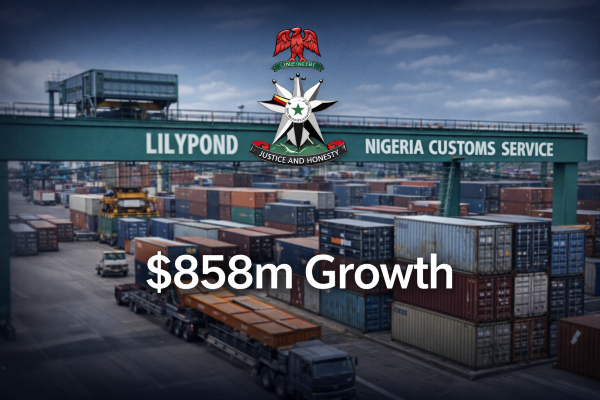
In the fourth quarter of 2025, the Lilypond Export Command (LEXC) of the Nigeria Customs Service delivered a measurable signal of progress: $858.1 million (₦1.12 trillion) in export value, representing a 9.56% year-on-year growth.




Beyond the headline figure, the deeper story is structural — rising container throughput, improved processing timelines, export diversification, and increasing institutional efficiency.
The Numbers: Volume, Value and Velocity
Comptroller Samuel Ariyibi, Customs Area Controller of LEXC, disclosed that export value rose from $783.2 million in Q4 2024 to $858.1 million in Q4 2025, reflecting an increase of $74.89 million.
Even more telling was the surge in logistics activity:
- Export containers processed: 14,756
- Q4 2024 comparison: 11,070 containers
- Growth rate: 24.26%
This suggests that export momentum was driven not only by pricing effects but by tangible volume expansion and improved trade flow management.
Export Composition: Agriculture Leads, Manufacturing Rises
Exports processed at Lilypond were categorised into:
- Agricultural products
- Manufactured goods
- Solid and extractive minerals
- Others
Agriculture: Still the Backbone
Agricultural exports remained dominant, valued at $568.2 million, up from $542.9 million in Q4 2024.
This reinforces agriculture’s central role in Nigeria’s non-oil export narrative, particularly commodities such as cocoa, sesame, cashew, and other agro-produce.
Manufacturing: The Quiet Upside
Manufactured goods exports surged significantly to $240.4 million, compared with $134.6 million in the corresponding period.
This near-doubling suggests incremental progress in value-added production — a critical pivot if Nigeria is to shift from raw commodity dependence to industrial competitiveness.
Solid Minerals: A Volatile Segment
Exports of solid and extractive minerals declined sharply to $35.59 million, down from $87.50 million.
Comptroller Ariyibi attributed the drop to output constraints, market volatility, and operational challenges — highlighting persistent structural issues in Nigeria’s mining value chain.
Revenue and Regulatory Framework
Export surcharge collections under the Nigeria Export Supervision Scheme rose to ₦208.5 million, reflecting a modest increase year-on-year.
The surcharge mechanism serves as a statutory compliance and monitoring instrument, reinforcing export legitimacy and documentation integrity.
LEXC operates under the consolidation directive of Comptroller-General of Customs Bashir Adeniyi, with a mandate to process containerised exports efficiently and reduce procedural bottlenecks.
Ariyibi noted that export documentation is now processed in less than 24 hours, positioning Lilypond as a competitive non-oil export hub.
He also highlighted the role of the B’Odogwu digital platform, which has strengthened operational transparency and coordination.
Institutional Collaboration and Compliance
The command maintains active collaboration with:
- NDLEA
- SON
- NAQS
- NAFDAC
- The Police
This inter-agency coordination enhances regulatory oversight while facilitating legitimate trade.
Stakeholder compliance currently stands at approximately 95%, reflecting improved adherence to export regulations.
Strategic Implications for Nigeria’s Economy
1️⃣ Non-Oil Revenue Diversification
Rising export value supports FX inflows and reduces structural vulnerability to oil price volatility.
2️⃣ Trade Facilitation as Growth Catalyst
Sub-24-hour processing enhances Nigeria’s competitiveness under AfCFTA and global trade frameworks.
3️⃣ Manufacturing Expansion Signal
The sharp rise in manufactured goods exports suggests early gains in value-chain upgrading.
4️⃣ Mining Sector Reform Imperative
The mineral export decline underscores the need for structural reforms in the extractive segment.
Forward Outlook: 2026 and Beyond
If container growth momentum sustains and digital platforms deepen transparency, Lilypond could solidify its position as:
- Nigeria’s leading non-oil export consolidation hub
- A model for customs digitisation reform
- A gateway for export-led industrial policy
However, sustained success will depend on:
- Infrastructure reliability
- Mining sector stabilisation
- Export financing support
- Continued compliance discipline
BRANDECONOMY Insight
The Lilypond Export Command’s performance is more than a quarterly statistic — it is a practical demonstration that trade facilitation reforms yield measurable economic dividends.
Three structural lessons emerge:
- Efficiency drives export growth.
- Manufacturing value-add is rising but still fragile.
- Digital customs reform is becoming a competitive advantage.
Nigeria’s diversification strategy cannot rely solely on policy declarations. It must be anchored at ports, platforms, and processing centres.
Lilypond’s $858 million quarter suggests that the non-oil export engine, while still evolving, is gaining traction.