

LBIC Profit Rises 43% to ₦1.66bn, Targets Digital Growth
Preparing a sharper digital push

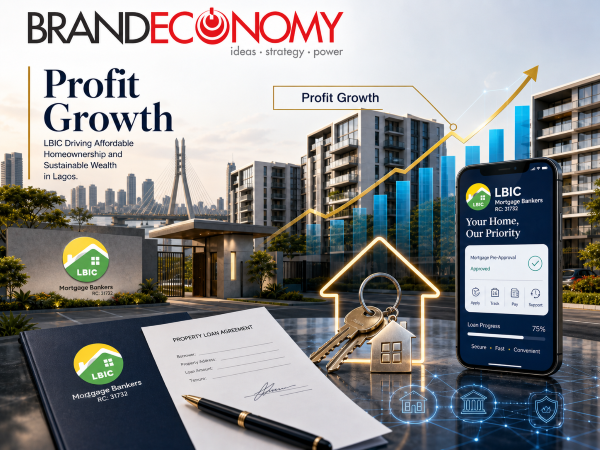 Lagos Building Investment Company Plc has reported a strong 2025 performance, posting a 43 percent increase in profit before tax to ₦1.655 billion, supported by growth in gross earnings, customer deposits and mortgage portfolio expansion. The mortgage institution is now preparing a sharper digital push, including mobile banking, internet banking, biometric access, AI-driven credit scoring and faster mortgage processing, as it seeks to make homeownership more accessible to Lagos residents.
A Stronger Year for Lagos’ Housing Finance Institution
The Lagos Building Investment Company Plc has closed the 2025 financial year on a stronger note, reporting profit before tax of ₦1.655 billion, a 43 per cent increase over the previous year.




The company announced the results at its 21st Annual General Meeting in Lagos, where the Board Chairman, Mr Hakeem Ogunniran, said the performance reflected LBIC’s resilience despite macroeconomic pressures, rising costs and the wider strain in Nigeria’s housing finance market.
The numbers show a mortgage institution gaining traction at a difficult time.
Gross earnings rose by 41 per cent to ₦3.565 billion in 2025, compared with ₦2.537 billion in 2024. The mortgage portfolio expanded by an impressive 161 per cent to ₦2.072 billion, while customer deposits increased by 17 per cent to ₦13.314 billion. Total assets stood at ₦20.614 billion, shareholders’ funds reached ₦5.431 billion, and capital adequacy was reported at a strong 37 per cent.
For a housing finance institution operating in one of Africa’s most pressured urban property markets, these are important indicators. Lagos has a deep housing deficit, a large informal workforce, rising rents, expensive land, high building costs and an affordability crisis that puts formal homeownership beyond the reach of many residents.
LBIC’s 2025 results therefore matter beyond corporate performance. They speak to the role of specialised mortgage institutions in unlocking access to housing finance.
Dividend Signal and Asset Quality Discipline
The board proposed a dividend of 6.8 kobo per share, amounting to about ₦263.98 million, which Ogunniran described as a reaffirmation of the company’s commitment to rewarding shareholder confidence.
Dividend payment is an important confidence signal, especially for a publicly owned institution operating in a sector where capital must be preserved for growth. It tells investors that management believes earnings are strong enough to support both expansion and shareholder reward.
Even more striking is the company’s reported zero per cent non-performing loan ratio as of December 2025. In mortgage finance, asset quality is critical. Housing loans are long-tenured, economically sensitive and vulnerable to income shocks. A clean loan book suggests disciplined underwriting, conservative risk selection and effective portfolio management.
The real test, however, will come as the company scales. Rapid mortgage expansion must not weaken risk controls. A 161 per cent rise in mortgage portfolio is impressive, but growth in housing finance must always be matched by repayment discipline, collateral documentation, legal clarity and income verification.
The Digital Mortgage Agenda
LBIC’s Managing Director, Mr Olusola Faleye, said the company’s performance was driven by disciplined execution and prudent management. He also outlined a major digital transformation agenda aimed at improving efficiency and customer experience.
The company has completed E-Tax integration to improve transparency and compliance in property-related transactions. Its core banking system upgrade is nearing completion, with expected improvements in real-time processing and service delivery. LBIC is also finalising its mobile app and internet banking platforms, with planned features such as biometric login, loan tracking and instant alerts.
Most importantly, the company is implementing automated mortgage loan processing, including AI-driven credit scoring, which is expected to reduce approval time by up to 60 per cent.
This could be transformative if properly executed.
Mortgage delays are a major obstacle in Nigeria’s property market. Applicants often face documentation burdens, slow approvals, opaque processes and uncertainty. A digital mortgage system that improves speed, transparency and tracking could make housing finance more accessible and less intimidating.
But technology must not simply digitise old bottlenecks. It must redesign the process.
A “One-Click Mortgage Approval System,” as Faleye described it, will only work if data, identity verification, income assessment, property documentation, credit evaluation and legal checks are integrated into a reliable digital workflow.
Capital Expansion for Growth
LBIC is also preparing to increase its issued share capital from ₦3.88 billion to ₦4.40 billion through the creation of 517.6 million additional ordinary shares of ₦1 each. The Company Secretary, Ms Oladunni Ogunsulire, said the new shares would rank equally with existing shares and that the Memorandum of Association would be amended accordingly.
This capital move is strategically important.
Housing finance requires patient capital. Mortgage institutions must maintain liquidity, meet regulatory requirements, support long-tenor lending and absorb market risks. Strengthening the capital base should give LBIC more room to expand mortgage access, deepen retail lending and support digital infrastructure.
The company’s 2026 priorities include digital capability, mortgage and retail lending expansion, deposit mobilisation, prudent risk management, partnerships and revenue diversification.
Housing as Social Need and Economic Engine
Lagos State Governor Babajide Sanwo-Olu, represented by Housing Commissioner Moruf Akinderu-Fatai, commended LBIC’s board for maintaining the institution’s founding purpose of expanding housing finance.
The governor’s message was significant: housing is not only a social need; it is an economic driver.
That is exactly the point. Housing construction creates demand for cement, steel, roofing, tiles, paint, furniture, labour, transport, legal services, finance and infrastructure. Mortgage growth can deepen the financial system, support household wealth creation and reduce rental pressure.
But the public sector cannot solve Lagos’ housing challenge alone. The scale of demand requires stronger partnerships among government, mortgage institutions, developers, fintechs, investors and communities.
LBIC sits at that intersection.
BRANDECONOMY Insight
LBIC’s 2025 performance is encouraging because it shows that a specialised housing finance institution can grow profitably while preparing for digital transformation in a difficult market.
The company’s numbers are strong: profit before tax up 43 per cent, gross earnings up 41 per cent, deposits up 17 per cent, mortgage portfolio up 161 per cent and capital adequacy at 37 per cent. But the bigger story is not merely financial. It is strategic.
Lagos needs a new mortgage economy.
For too long, homeownership has remained out of reach for many residents because incomes are strained, property prices are high, mortgage processes are slow, and informal workers struggle to meet traditional documentation requirements. If LBIC can use digital platforms, AI-driven credit scoring and fintech partnerships to widen access without weakening credit discipline, it could become a more powerful housing-finance engine.
The zero per cent non-performing loan ratio is impressive, but it must be protected as the business expands. Mortgage growth without risk management can quickly become dangerous. The balance LBIC must strike is clear: more access, faster approvals, stronger data, better customer experience and disciplined underwriting.
The opportunity is also broader than mortgages. A digitally stronger LBIC can support developers, estate buyers, public housing schemes, informal-sector homeowners and first-time buyers. It can help Lagos move from housing as aspiration to housing as structured finance.
The real test for 2026 will be execution. Will the mobile app work smoothly? Will AI scoring reduce approval delays? Will mortgage access expand meaningfully? Will partnerships unlock new customer segments? Will dividends remain sustainable?
If LBIC gets this right, it could become one of Lagos’ most important institutional tools for turning housing demand into investable, bankable and inclusive homeownership.