
FirstBank Drives AI Adoption as SME Digital Lending Surpasses ₦1 Trillion in Nigeria

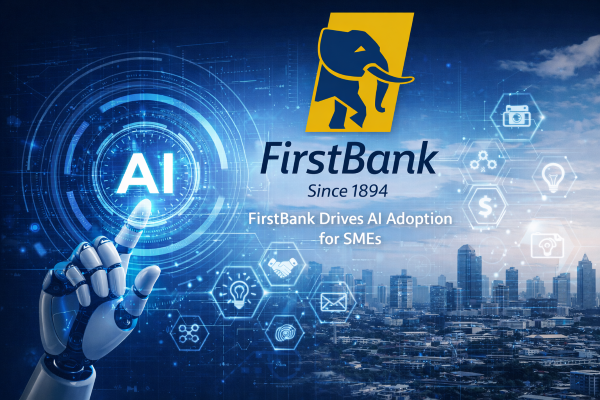 In Nigeria’s fast-evolving digital economy, the contest for small business relevance is no longer defined by access to capital alone—but by access to intelligence. In that shifting landscape, First Bank of Nigeria is making a decisive bet: Artificial Intelligence (AI) will be the defining force behind the next wave of SME growth.
At a recent SMEConnect webinar in Lagos, the bank unveiled a strategy that goes beyond conventional banking—positioning itself as both financier and digital enabler for Nigeria’s vast small business ecosystem. The headline figure was striking: over ₦1 trillion in digital loans disbursed, much of it powered by AI-driven credit models.




But beneath the numbers lies a deeper transformation—one that could reshape how Nigerian businesses operate, scale, and compete.
From Capital Access to Intelligent Growth
For decades, Nigeria’s SMEs—responsible for a significant share of employment and economic activity—have operated within structural constraints: limited access to credit, weak financial documentation, and inefficient manual processes. AI is now emerging as a powerful equaliser.
At the centre of FirstBank’s push is a shift from traditional lending models to data-driven financing, where transaction histories, behavioural patterns, and digital footprints increasingly determine creditworthiness.
According to Ibidun Adedewe, the bank’s AI-enabled platforms have already channelled substantial financing across sectors, with a significant portion reaching traders and informal businesses—segments historically excluded from formal banking.
This marks a fundamental redefinition of collateral:
data, not assets, is becoming the new basis for trust.
AI as the SME Operating System
Beyond financing, the bank is pushing AI deeper into business operations. Through over 19 AI-powered platforms, SMEs now have access to tools that integrate:
- Automated payments and payroll
- Real-time financial tracking
- Customer engagement systems
- Fraud detection and security analytics
For Temitope Odude of Microsoft, the implications are immediate and practical.
AI, he argued, allows SMEs to:
- Work faster and smarter
- Respond dynamically to market changes
- Make data-informed decisions
- Unlock new revenue streams
Crucially, these tools are no longer the preserve of large corporations. Many are affordable, user-friendly, and deployable without deep technical expertise—lowering the barrier to entry for Nigeria’s entrepreneurial base.
The 14-Day Transformation Cycle
Perhaps the most compelling aspect of the initiative is its simplicity. Rather than pushing complex digital overhauls, FirstBank advocates a phased, rapid adoption model:
- Identify operational gaps
- Deploy simple AI tools
- Integrate into workflows
- Measure outcomes within 7–14 days
This “quick-win” approach reflects a nuanced understanding of SME realities—where speed, cost-efficiency, and tangible results matter more than long-term theoretical transformation.
Banks Become Platforms
The broader implication of FirstBank’s strategy is structural: banks are evolving from lenders into technology platforms.
By embedding AI into credit scoring, payments, and customer analytics, the bank is building an ecosystem where financial services and business operations converge. SMEs are no longer just clients—they are participants in a data-driven network.
Abednego Ugwueke noted that AI is also strengthening fraud detection and improving service personalisation—two critical areas in a market where trust and security remain central.
Discipline Before Scale
Yet, technology alone is not enough. FirstBank’s advisory also emphasised foundational business discipline—particularly the separation of personal and business finances.
This seemingly simple step has profound implications: it enhances transparency, improves credit profiling, and enables SMEs to scale more sustainably.
In effect, AI may accelerate growth—but structure determines whether that growth endures.
BRANDECONOMY Insight
Nigeria’s SME economy is undergoing a quiet but consequential shift—from informality to intelligence.
FirstBank’s AI push reflects three deeper transformations:
1. Credit is Being Democratised
AI-driven lending is dismantling traditional barriers, bringing millions of informal businesses into the financial system. This could unlock unprecedented levels of economic participation.
2. Productivity is Becoming the New Currency
In an environment shaped by inflation, currency volatility, and rising costs, SMEs must optimise every process. AI provides the tools to do exactly that—at scale.
3. The Future of Banking is Embedded
Banks are no longer just financial institutions; they are becoming digital infrastructure providers. The institutions that win will be those that integrate seamlessly into the daily operations of businesses.
However, the transition also introduces a divide. SMEs that embrace AI will gain efficiency, access to capital, and market responsiveness. Those that do not risk marginalisation in an increasingly data-driven economy.
The strategic question is no longer whether AI will transform Nigerian SMEs—but how quickly they can adapt to it.