

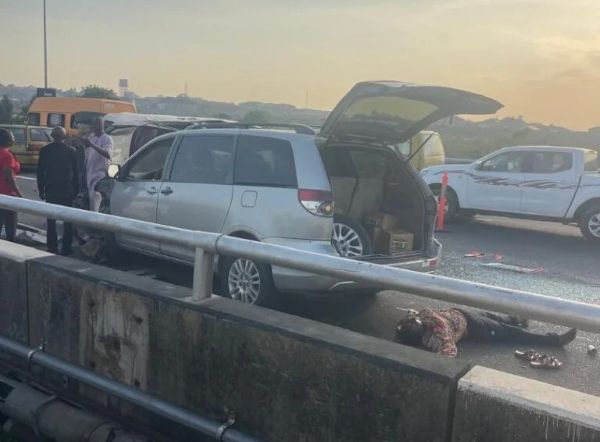
 A fatal road accident on the Third Mainland Bridge in Lagos on Tuesday claimed the life of one female passenger and left four others seriously injured after two Toyota Sienna commercial vehicles collided near Iyana-Iworo.
The Lagos State Emergency Management Agency confirmed the incident, saying the crash occurred in the early hours of the day and involved two fully loaded commercial vehicles.

The Head of Public Affairs of LASEMA, Mr Olawale Afolabi, said preliminary findings indicated that reckless driving by one of the Toyota Sienna drivers triggered the accident, resulting in a head-on collision between the two vehicles.
According to him, the injured passengers were quickly evacuated to a nearby trauma centre for urgent medical attention, while the deceased adult female passenger was recovered from the scene.
Afolabi said LASEMA’s Tiger Squad from the C3 Command was activated at about 7:26 a.m. and arrived at the accident location around 8:00 a.m. to coordinate rescue and recovery operations.
He added that LASEMA responders worked with officers of the Nigeria Police Force and the Lagos State Traffic Management Authority to secure the scene, manage traffic flow and remove the damaged vehicles from the bridge.
The accident caused concern among commuters using the busy bridge, one of Lagos’ most important transport corridors linking the mainland to the island. Emergency officials moved quickly to prevent further traffic build-up and reduce the risk of another crash around the accident point.
The Permanent Secretary of LASEMA, Dr Olufemi Oke-Osanyintolu, described the crash as preventable and urged motorists to obey traffic regulations at all times.
He warned that excessive speed, dangerous overtaking and poor lane discipline remain major causes of avoidable accidents on Lagos roads, especially on bridges and expressways where drivers have limited room for error.
Oke-Osanyintolu also called on commercial drivers to exercise greater caution, noting that they carry the responsibility of protecting passengers whose lives depend on their judgement behind the wheel.
He advised motorists to cooperate with traffic managers and emergency responders during rescue operations, stressing that prompt access to accident scenes can help save lives and prevent further disruption.
The Third Mainland Bridge carries heavy daily traffic and remains a critical link for workers, traders, students and residents moving between Lagos Island and the mainland. Its high volume of vehicles makes reckless driving especially dangerous.
Tuesday’s crash again highlights long-running concerns about commercial vehicle safety, driver discipline and enforcement of traffic rules on major Lagos highways.
Transport safety experts have often warned that head-on collisions are among the most dangerous types of road crashes because of the force generated when two moving vehicles collide directly. Such accidents frequently result in serious injuries, fatalities and major traffic disruption.
The latest incident has renewed calls for tighter monitoring of commercial vehicles, regular driver education, stronger enforcement against speeding and dangerous overtaking, and improved safety culture among road users.
For many Lagos commuters, the crash is another painful reminder that impatience on the road can have devastating consequences.
LASEMA said rescue and recovery operations had been concluded, while the injured passengers were receiving medical attention.
The agency urged all motorists to treat road safety as a shared responsibility, adding that most serious crashes can be avoided when drivers obey traffic rules, maintain lane discipline and drive with caution.
Tuesday’s accident leaves one family bereaved, four passengers injured, and Lagos once again confronting the heavy human cost of reckless driving on one of its busiest transport routes.
BRANDECONOMY Insight
The Third Mainland Bridge crash is not merely another traffic incident. It is a painful reminder that Lagos’ transport system is only as safe as the behaviour of the drivers who use it.
The bridge is one of Nigeria’s busiest mobility arteries, carrying thousands of commuters daily between the mainland and the island. On such a high-volume route, reckless driving is not a private risk; it is a public danger. One driver’s impatience can produce fatalities, serious injuries, traffic paralysis and emotional devastation for several families.
The reported head-on collision between two fully loaded commercial Toyota Siennas raises familiar concerns: excessive speed, dangerous overtaking, poor lane discipline and weak commercial-driver safety culture. These are not new problems. They remain persistent because enforcement is often reactive rather than preventive.
Lagos needs a stronger bridge-safety regime. This should include stricter surveillance on major bridges, heavier penalties for reckless commercial drivers, routine vehicle fitness checks, compulsory retraining for public transport operators, and more visible traffic enforcement at known risk points.
But government action alone will not be enough. Transport unions, fleet owners and commercial drivers must treat passenger safety as a business obligation. A commercial vehicle is not merely a source of daily income; it is a moving responsibility.
For commuters, the tragedy reinforces the need to demand safer conduct from drivers and report dangerous behaviour where possible. Silence inside a reckless vehicle can be costly.
The lesson is clear: Lagos cannot build a modern transport economy on careless driving. Roads, bridges and traffic agencies matter. But discipline behind the wheel matters even more to avoid yet another needless crash and preserve lives and property.