

 One person has died and two others were injured after separate early-morning crashes on Kara Bridge, along the Lagos-Ibadan Expressway, triggered a severe traffic gridlock that stranded hundreds of motorists, disrupted commuter movement and temporarily paralysed commercial activity on one of Nigeria’s most important transport corridors.
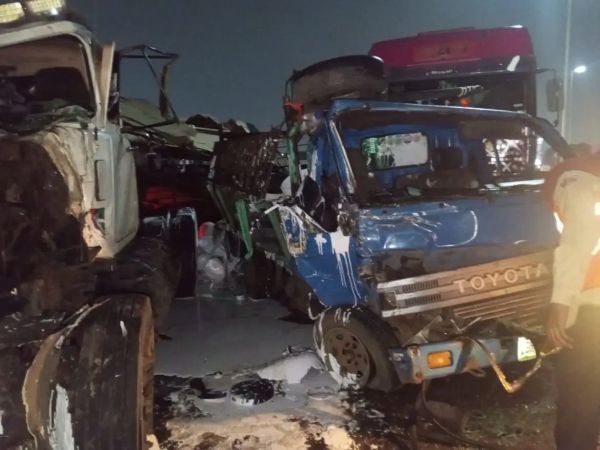
The first crash occurred at about 12:05 a.m. on the outbound carriageway towards Ibadan and involved five articulated trucks and a Toyota Sienna vehicle, according to the Lagos Sector Command of the Federal Road Safety Corps.

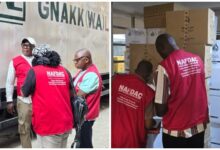

The Sector Public Education Officer, Elizabeth Jayeola, said preliminary findings indicated that excessive speed and loss of control caused the multiple-vehicle collision.
Seven adult males were involved in the accident. One person died, another sustained injuries, while five escaped without physical harm.
The Kara Bridge crash incident immediately triggered a complex rescue and recovery operation because of the number and size of the articulated vehicles involved.
However, while emergency officials were still working to clear the outbound carriageway, a second crash occurred at about 3:15 a.m. on the inbound lane towards Lagos.
The second incident involved a Mazda commercial bus and was attributed to brake failure.
Jayeola said the driver sustained serious injuries but was promptly rescued by the FRSC emergency response team and taken to the Lagos State Accident and Emergency Centre for treatment.
Emergency teams battle to restore movement
Officials of the Lagos State Traffic Management Authority, FRSC, Lagos State Emergency Management Agency and the Nigeria Police were deployed to the accident scene.
Tow trucks were also brought in to remove the damaged vehicles and reopen the affected carriageways.
The scale of the recovery operation reflected the vulnerability of the corridor to major disruption whenever articulated vehicles crash or break down around Kara Bridge.
By the time emergency personnel arrived in sufficient numbers, traffic had already built up across a wide section of the expressway.
The gridlock stretched towards Otedola Bridge and beyond, while adjoining roads and communities—including the Isheri-Olowora axis and Ogunusi Road—also experienced severe congestion.
Motorists heading into and out of Lagos remained trapped for hours. Some commuters abandoned vehicles and continued their journeys on foot, while others turned to commercial motorcycles in an effort to bypass the traffic.
Articulated trucks, buses, private cars and commercial vehicles were seen at a standstill along the usually busy road.
LASTMA introduces temporary one-way traffic
In an attempt to ease movement, LASTMA temporarily opened one-way traffic from Berger to the OPIC Turning area.
The traffic-management intervention provided limited relief while recovery teams continued efforts to evacuate the vehicles involved and restore normal traffic flow.
The FRSC also advised motorists to avoid the Kara–Ojodu Berger corridor where possible until the operation was completed.
Travellers heading out of Lagos towards Ibadan were encouraged to consider the Ikorodu–Sagamu route.
Those travelling into Lagos were advised to explore alternative entry routes through the Lekki–Epe Expressway or the Ikorodu–Sagamu corridor.
The agency’s advisory highlighted the difficulty of managing disruption on the expressway. Although alternative routes exist, many are significantly longer and may be unable to absorb the full volume of traffic diverted from the Lagos-Ibadan corridor.
More than a traffic accident
The crash produced consequences that extended far beyond the immediate loss of life and injuries.
The Lagos-Ibadan Expressway is one of Nigeria’s most economically significant highways. It connects Lagos, the country’s largest commercial centre, to Ogun, Oyo and other parts of the South-West, while also serving as a major gateway to the North and other regions.
Every day, the route carries workers, traders, students, manufacturers, haulage operators, food suppliers and interstate travellers.
When movement on the corridor is disrupted, the consequences spread rapidly through supply chains.
Delivery trucks miss schedules. Perishable goods spend longer in transit. Workers arrive late or fail to reach their places of employment. Transport operators consume more fuel while idling, and businesses lose productive time.
For commuters paid daily or operating within the informal economy, several hours lost in traffic can translate directly into reduced income.
The wider cost of such disruption is rarely captured in official accident statistics. Yet the cumulative economic loss from recurring crashes, breakdowns and gridlocks on Nigeria’s major roads is substantial.
Kara Bridge’s recurring safety challenge
The latest crash adds to a long history of serious incidents around Kara Bridge and the adjoining Berger corridor.
The area regularly experiences a dangerous combination of high traffic volume, articulated trucks, speeding vehicles, sudden lane changes and mechanical failures.
The presence of tankers and heavy-duty trucks increases the difficulty of clearing accident scenes and raises the risk of secondary collisions.
The latest incidents appear to illustrate two recurring road-safety problems: excessive speed and poor vehicle maintenance.
Speed reduces the time available to react to hazards, particularly at night or on congested road sections. Brake failure, meanwhile, often reflects inadequate maintenance, overloaded vehicles, ageing parts or weak compliance with roadworthiness standards.
While enforcement against reckless driving remains necessary, accident prevention must include stronger inspection of commercial vehicles, driver education, rest requirements and penalties for operators who deploy unsafe vehicles.
Market and business implications
The disruption underscores the importance of transport infrastructure to Nigeria’s competitiveness.
Manufacturers and distributors depend on predictable delivery times. Logistics companies price their services according to fuel consumption, vehicle wear, journey duration and accident risk.
Recurring gridlocks increase each of these costs.
When transport expenses rise, companies pass part of the burden to consumers through higher prices. Road inefficiency therefore contributes indirectly to inflation, especially for food, building materials and consumer goods moved over long distances.
The incident also strengthens the economic case for diversifying freight movement away from excessive dependence on roads.
Greater use of rail for containerised and bulk cargo could reduce the number of heavy-duty vehicles competing with commuters along major highways.
Investor relevance
For investors in manufacturing, retail, agriculture, logistics and real estate, reliable transport links are critical to operational planning.
Repeated disruption on strategic routes can weaken the attractiveness of industrial and warehousing locations, even where they are geographically close to Lagos.
At the same time, the problem creates investment opportunities in vehicle inspection, fleet-management technology, emergency towing, road monitoring, logistics parks and rail-linked freight systems.
Private investment, however, must be supported by effective regulation and public infrastructure.
Brand implications
The Lagos-Ibadan Expressway is not merely a road; it is a highly visible part of Nigeria’s economic brand.
For businesses, visitors and investors arriving through Lagos, recurring gridlock and serious crashes reinforce perceptions of weak logistics, poor safety enforcement and fragile infrastructure management.
For transport and haulage companies, vehicle condition and driver conduct are also brand issues.
A company whose trucks are repeatedly involved in crashes risks regulatory scrutiny, commercial liability and reputational damage.
Road safety must therefore become part of corporate governance—not just a driver-level responsibility.
BRANDECONOMY Insight
The Kara Bridge tragedy reveals how quickly one road incident can become a human, commercial and national productivity crisis.
The immediate priority is to save lives, clear the road and restore movement. The more enduring responsibility is prevention.
Nigeria needs stricter enforcement of speed limits, dependable vehicle inspections, more effective monitoring of articulated trucks and faster emergency-response systems on major corridors.
It also needs a transport strategy that reduces the pressure placed on highways by moving more freight through rail and other alternatives.
The victim who died must not become another entry in a long and quickly forgotten accident record.
Every recurring crash on Kara Bridge is evidence that road safety is not only a transportation issue. It is a public-health, economic-productivity and national-governance imperative.