
Ikogosi Resort’s ₦513m Energy Savings Signal New Era for Sustainable Tourism

 By cutting diesel dependence through solar power, Ikogosi Resort is showing how renewable energy can transform hospitality economics, improve destination competitiveness and reposition tourism assets for long-term profitability.
 By cutting diesel dependence through solar power, Ikogosi Resort is showing how renewable energy can transform hospitality economics, improve destination competitiveness and reposition tourism assets for long-term profitability.
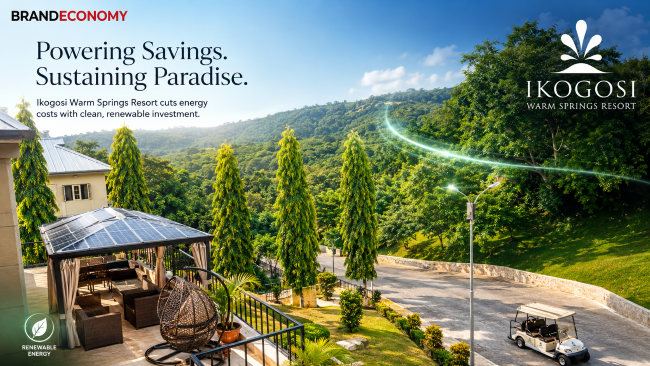
Ikogosi Warm Springs Resort in Ekiti State has recorded more than ₦513 million in energy-cost savings through its investment in renewable energy, underscoring how clean power is becoming a serious business tool for Nigeria’s hospitality and tourism sector.
Ikogosi Resort, operated by Glocient Hospitality, the hospitality arm of Cavista Holdings, disclosed that its solar-energy investment has significantly reduced dependence on diesel generators while improving operational efficiency across the property.




Glocient Hospitality serves as operator, investor and development manager of the resort under a concession arrangement with the Ekiti State Government. Its mandate is to revive and reposition Ikogosi as a sustainable, profitable and experience-led destination through infrastructure renewal, improved hospitality management, destination branding and environmental stewardship.
The General Manager of Glocient Hospitality, Olanrewaju Balogun, said the company had invested close to $200,000 in solar infrastructure, enabling the resort to run substantially on renewable energy for about 12 hours daily.
According to him, internal analysis showed that when benchmarked against diesel-powered generator operations, the renewable-energy system had produced annual savings of more than half a billion naira.
“The savings we are making with the benchmark of our 500kVA generator running for 10 hours is over half a billion naira in a year,” Balogun said.
For a destination asset such as Ikogosi, the implication is powerful: every naira saved on diesel becomes potential capital for guest experience, facility upgrades, expansion and community-linked growth.
From Power Cost Burden to Competitive Advantage
Energy cost remains one of the most punishing operating expenses in Nigeria’s hospitality sector. Hotels, resorts, restaurants and event destinations often rely heavily on diesel generators because of unstable grid supply.
This makes energy not just a utility issue, but a profitability issue.
High diesel consumption raises room costs, reduces margins, weakens service quality and limits reinvestment. In a competitive tourism market, energy instability also affects guest satisfaction. Travellers want comfort, safety and uninterrupted service. When power fails, destination value falls.
Ikogosi’s renewable-energy transition therefore offers an important model. The resort is not treating solar as a decorative sustainability badge. It is using it as operating infrastructure.
The Facility Manager, Okon John, said the solar system powers the resort during the day, supported by battery storage that can run for several hours at night depending on load. The backup generator activates automatically when battery levels drop, allowing guests to enjoy uninterrupted power.
That combination of solar, batteries and smart backup power is increasingly becoming the future of serious hospitality operations in Nigeria.
Sustainability Beyond Energy
The resort’s sustainability strategy extends beyond electricity.
The Communications and Community Engagement Manager, Stephen Ademiluwa, said nearly 300 tree species had been identified within the resort’s forest park. These will be tagged with botanical, local and economic descriptions to support conservation, learning and eco-tourism.
This is important because Ikogosi Resort is not an ordinary resort. Its strongest asset is nature — the famous warm and cold springs, forest environment, landscape and cultural identity.
A destination built around nature must protect nature. If the ecosystem is degraded, the brand loses authenticity.
Ademiluwa said redevelopment accelerated after Glocient Hospitality took over the facility in December 2022, with major renovation works restoring several guest rooms and improving the visitor experience within a short period.
He added that the transformation involved rebuilding guest facilities, landscaping, preserving mature trees, planting new species and creating recreational assets to strengthen the resort’s appeal.
Jobs, Women and Local Community Impact
Balogun said more than 230 people have been employed at the resort, with nearly 70 per cent women and more than 60 per cent recruited from surrounding communities.
This gives the project wider development significance.
Tourism is valuable not only because visitors spend money. It is valuable because it creates jobs across hospitality, security, food supply, transport, culture, entertainment, facility management, landscaping, farming and retail.
A well-run resort can become an economic anchor for its host community. It buys food, employs locals, attracts visitors, promotes small businesses and improves the image of the destination.
For Ekiti, Ikogosi can become a proof point that tourism is not merely culture and scenery. It can be structured as a serious development economy.
Policy Implications: Tourism Needs Power, Roads and Partnerships
Ikogosi’s progress highlights three policy lessons.
First, tourism assets require reliable power. Renewable energy should become a central part of destination-development policy, especially for resorts, conservation parks, heritage sites and rural hospitality clusters.
Second, state governments must treat tourism concessions as long-term investment partnerships, not short-term revenue arrangements. Private investors will commit capital when there is clarity, security, access and policy consistency.
Third, destination access matters. Balogun noted that security concerns were often exaggerated on social media and added that Ekiti’s accessibility had improved, with airports in Aso and Akure located within reasonable travel distance of Ikogosi.
For tourism to scale, transport links, road quality, safety perception and digital visibility must improve together.
Brand Implications: Ikogosi as a Sustainability Destination
Ikogosi’s renewable-energy savings strengthen its brand positioning.
In modern tourism, travellers increasingly value destinations that combine comfort, authenticity and sustainability. A resort powered significantly by solar energy, embedded in a forest environment and linked to community employment has a stronger story than one offering only rooms and scenery.
For Glocient Hospitality and Cavista Holdings, the Ikogosi project creates a brand narrative around revival, sustainability, local impact and disciplined asset management.
For Ekiti State, it strengthens the possibility of positioning Ikogosi as a premium eco-leisure destination and a flagship asset in Nigeria’s domestic tourism market.
Investor Relevance and Market Consequences
For investors, the Ikogosi case shows that renewable energy can materially improve hospitality economics.
The reported ₦513 million savings demonstrates that clean-energy investment can deliver measurable operating benefits, not just environmental goodwill. Lower energy costs improve margins, strengthen cash flow and expand reinvestment capacity.
This has implications for hotels, resorts, hospitals, schools, malls, industrial parks and agricultural processing facilities across Nigeria.
The wider market consequence is clear: businesses that continue to depend fully on diesel will face rising cost pressure, while those that build efficient hybrid power systems may gain a competitive advantage.
For Nigeria’s tourism market, Ikogosi also shows that dormant public assets can be revived through credible private-sector management, patient capital and clear destination strategy.
BRANDECONOMY Insight
Ikogosi Shows That Sustainability Can Pay for Itself
Ikogosi Warm Springs Resort’s renewable-energy savings make one point unmistakable: sustainability is no longer only about environmental responsibility. It is now a business-performance strategy.
For years, Nigerian hospitality operators have treated diesel as an unavoidable cost of doing business. But diesel dependence drains margins, inflates guest prices and limits reinvestment. Ikogosi’s solar investment shows that the right energy strategy can unlock savings large enough to fund expansion, improve service and strengthen destination competitiveness.
This is the new tourism economics.
A modern resort must not only have beautiful scenery. It must have reliable power, strong service culture, environmental credibility, community participation and a compelling brand story.
Ikogosi Resort has the natural advantage. The challenge now is to convert that advantage into a scalable tourism economy for Ekiti — one that attracts families, corporate retreats, eco-tourists, schools, wellness travellers and diaspora visitors.
The bigger lesson for Nigeria is that tourism assets should be managed like investment platforms. With the right operator, renewable infrastructure and brand discipline, dormant destinations can become engines of jobs, local enterprise and state revenue.
Ikogosi is showing that green power can power profit.