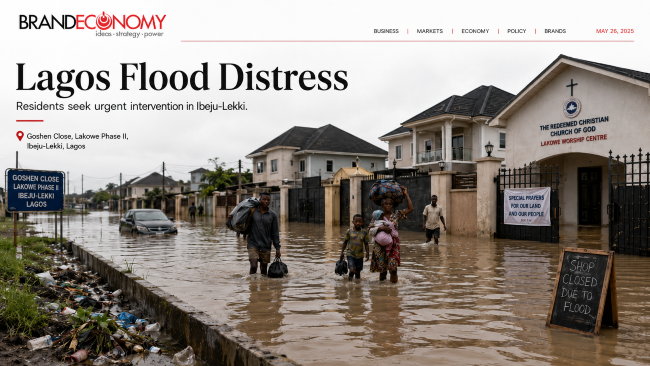
 Residents of Goshen Close, Lakowe Phase II, say persistent rainfall has submerged homes, disrupted worship, halted businesses and forced families out of their houses. Their appeal to Ibeju-Lekki LCDA and the Lagos State Government is more than a cry for relief; it is a warning that fast-growing communities need drainage, planning discipline and climate-ready infrastructure before disaster becomes routine.
Residents of Goshen Close, Lakowe Phase II, in the Ibeju-Lekki area of Lagos State, have appealed for urgent government intervention after heavy and persistent rainfall triggered severe flooding in the community.


The residents called on the Chairman of Ibeju-Lekki Local Council Development Area, Mr Abdullahi Olowa, and the Lagos State Government to act quickly as floodwater continues to threaten homes, livelihoods and community life.
They said the rainfall had left buildings and valuables submerged, making movement difficult and forcing some businesses to suspend operations.
For a rapidly developing corridor such as Ibeju-Lekki, the warning should be taken seriously. The Lekki axis is low-lying and bordered by water bodies, including the Lagos Lagoon and Lekki Lagoon, making drainage planning, wetland protection and flood-control infrastructure especially important as urban development accelerates.
Homes Under Water
Mr Chuks Amadi, a community development executive, said the rainfall caused massive flooding that swept away valuables and submerged several buildings.
According to him, floodwater rose nearly halfway up many houses, leaving residents unable to move freely and disrupting daily economic activity.
“The disaster has made it difficult for residents to move freely, while many business owners have been forced to suspend their daily activities due to the persistent flooding,” Amadi said.
He described the situation as alarming, warning that the flooding now poses a serious threat to lives, property and livelihoods.
Amadi urged the LCDA, the state government, emergency management agencies and other relevant authorities to assess the damage immediately and provide lasting solutions through better drainage, flood-control measures and relief support for affected families.
Worship Disrupted
For Mr David Amira, a pastor in the community, the flood has also disrupted religious and social life.
“Our worship centre has been flooded for days. We can’t even gather to worship,” he said.
That detail matters.
Flooding is often reported as a physical event: water on roads, water in houses, damaged furniture, submerged vehicles. But its real impact spreads wider. It stops commerce. It interrupts worship. It displaces families. It weakens social life. It creates anxiety every time the sky darkens.
A recent report on Lagos flooding described how repeated floods are causing financial distress, displacement and growing emotional strain for residents in vulnerable communities. It also cited warnings from the Nigeria Hydrological Services Agency that more than 14,000 communities across Nigeria face high flood risk this season.
Families Displaced
Another resident, Ms Anne Etuok, said her family home had been taken over by floodwater, forcing them to seek refuge with a relative in a nearby community.
She appealed for urgent government action to prevent the situation from worsening into a broader humanitarian and environmental crisis.
Her experience reflects the hidden cost of urban flooding.
When families leave their homes, they do not only lose comfort. They lose routine, safety, privacy, access to work, school continuity and sometimes the documents, household equipment and savings built up over years.
For tenants, flooding raises questions about rent value and habitability. For landlords, it raises questions about building approvals, drainage responsibility, asset protection and long-term property value.
The Planning Failure
The Goshen Close flooding should not be treated as an isolated inconvenience.
It points to a deeper urban-planning challenge in Lagos: development is expanding faster than drainage capacity, infrastructure maintenance and environmental enforcement.
Across fast-growing areas, houses, estates, worship centres and commercial facilities often appear before roads, stormwater channels, retention ponds, waste systems and emergency access are fully in place.
That sequence creates risk.
A community may look developed during dry weather, but fail its real test when intense rainfall arrives.
In planning terms, floodwater usually exposes what approval papers and marketing brochures hide: blocked drainage, inadequate outfall channels, poor road levels, weak estate planning, unprotected wetlands, insufficient culverts and poor maintenance culture.
Ibeju-Lekki’s Growth Test
Ibeju-Lekki has become one of Lagos State’s most watched growth corridors.
The area’s appeal is linked to residential expansion, land banking, proximity to major industrial and logistics investments, tourism potential and its position within the wider Lekki development corridor. Ibeju-Lekki is also known for lagoon and ocean-front assets, which increase its appeal for tourism and real estate.
But growth without environmental discipline can become expensive.
If communities flood repeatedly, property values become uncertain. Insurance risks rise. Businesses hesitate. Residents lose trust. Developers face reputational pressure. Government credibility suffers.
The lesson is simple: a growth corridor must also be a resilience corridor.
Beyond Emergency Pumping
Residents are asking for urgent intervention, and that is necessary.
But Lagos must go beyond temporary relief.
Emergency visits, pumps, sandbags and palliatives may reduce immediate suffering, but they cannot replace proper drainage engineering.
A durable response should include:
- Rapid assessment
Government engineers and emergency agencies should inspect the flooded area, identify blocked channels, assess building exposure and map the flow path of the water. - Drainage audit
The community needs a technical review of existing drains, culverts, discharge points and road levels. - Desilting and clearing
Blocked drains and channels should be cleared urgently, especially where waste, sand or construction debris has reduced flow capacity. - Outfall correction
Drainage must lead somewhere. If water cannot discharge into a safe and functional outfall, local drains will only move water from one house to another. - Development control
Authorities must check whether buildings or fences are sitting on drainage paths, setbacks or natural water channels. - Relief support
Displaced families and affected businesses need immediate support, especially where water has damaged household items, stock, documents and electrical systems. - Long-term flood plan
Lakowe Phase II and surrounding communities require a proper stormwater-management plan tied to future land-use approvals.
Waste and Water
Flood control is also a civic responsibility.
Residents, developers, landlords, traders and estate associations must stop the dumping of refuse into drains and canals.
Blocked drainage channels are often created one plastic bag, one discarded bottle and one unregulated construction heap at a time.
But government must also enforce.
A drainage system cannot work if it is turned into a refuse dump. A master plan cannot work if violations are tolerated. A community cannot stay safe if people build across water channels and expect the rain to negotiate.
West African cities, including Lagos, are facing heavier rainfall stress, and flooding has been linked to climate change, rapid urban growth, poor waste management and unplanned expansion that strain already weak infrastructure.
Market Implications
The flooding at Goshen Close has implications for Lagos real estate, construction, retail, insurance and local enterprise.
For real estate, drainage is no longer a minor infrastructure detail. It is now a property-value determinant.
For developers, climate resilience must become part of project design, marketing and delivery.
For banks and mortgage lenders, flood exposure should increasingly influence collateral assessment.
For insurers, repeated flooding will sharpen the case for better risk pricing, clearer policy language and stronger public awareness around property protection.
For small businesses, flooding can destroy stock, cut access to customers and interrupt daily income.
The economic message is clear: poor drainage is not cheap. It simply transfers cost to residents, businesses and government later.
Brand Implications
For Lagos State, flooding is now part of the city brand conversation.
Lagos wants to be seen as Africa’s leading commercial, innovation and investment hub. But investors, residents and visitors also judge a city by its livability, infrastructure reliability and climate readiness.
A city that floods repeatedly sends a troubling message about planning, enforcement and infrastructure capacity.
For Ibeju-Lekki, the stakes are even higher. The corridor is widely marketed as a future-facing investment zone. But that future must be supported by roads, drains, waste systems, environmental controls and emergency-response capacity.
For developers, the brand promise must change from “buy land before prices rise” to “buy into a planned, safe, serviced and resilient community.”
Investor Relevance
Investors should pay close attention to flood risk in Lagos growth corridors.
Before investing in land, housing, retail projects, hotels, schools, warehouses or worship facilities, they should ask:
- Is there a functional drainage network?
- Where does stormwater discharge?
- Has the area flooded before?
- Is the property on a natural water path?
- Are roads elevated properly?
- Are there wetlands nearby?
- Are approvals valid and aligned with planning standards?
- Is there insurance cover?
- What is the emergency access route during heavy rain?
Flood risk is no longer only an environmental concern. It is an investment-risk factor.
What Government Must Do Now
The residents of Goshen Close need visible government response.
The LCDA and the Lagos State Government should:
- send emergency and environmental assessment teams
- support affected households
- clear blocked drains and channels
- inspect illegal structures on drainage paths
- publish a remediation plan for the community
- engage residents on waste disposal and local drainage protection
- integrate Lakowe Phase II into a wider Ibeju-Lekki flood-control plan
The goal should not be to wait for the next rain and respond again. The goal should be to reduce the chance of recurrence.
BRANDECONOMY Insight
The flooding at Goshen Close, Lakowe Phase II, is a local story with a metropolitan message.
Lagos cannot build its future on land sales, estates and infrastructure promises while drainage and environmental planning lag behind.
In a climate-stressed city, water will always find the weak points: blocked drains, poor road levels, unprotected wetlands, illegal structures and planning shortcuts.
The lesson for government, developers, investors and residents is urgent.
Flood control is not an afterthought.
It is economic infrastructure.