
Data: Globacom Made Every Second Count, Can it Lead Nigeria’s Second Telecom Revolution?

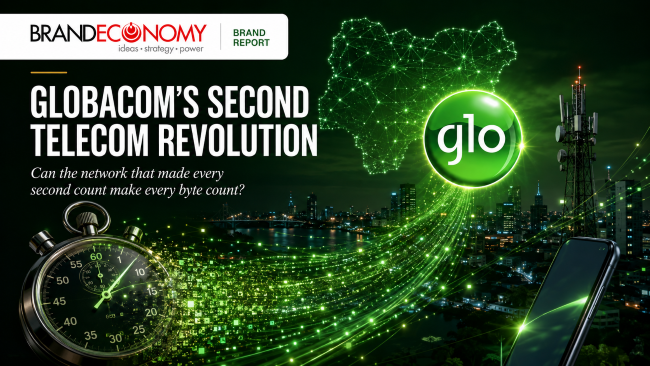
 Twenty-three years after it disrupted Nigeria’s telecom market with per-second billing and dramatically cheaper SIM cards, Globacom’s new data-subscription momentum has revived an important question: can the proudly Nigerian challenger turn a promising comeback into sustainable industry leadership?
 Twenty-three years after it disrupted Nigeria’s telecom market with per-second billing and dramatically cheaper SIM cards, Globacom’s new data-subscription
 In 2003, Nigerians often paid for telephone time they did not use. A call lasting only a few seconds could be charged as a full minute, while the cost of acquiring a SIM card was still high enough to exclude millions of households.
MTN and Econet (Now Airtel) had performed the difficult and transformative work of launching mass mobile telephony in 2001. But with M-Tel unable to exert meaningful competitive pressure, the market had begun to resemble an effective duopoly. Access was expanding, yet the economics of access still favoured operators more than consumers. Globacom also known as Glo became the ultimate game-changer.



Then Globacom arrived—and altered the rules.
Its introduction of per-second billing converted the second hand of a clock into an instrument of consumer power: use 12 seconds, pay for 12 seconds. Its aggressive reduction of SIM-card prices helped turn mobile connectivity from a status symbol into a mass-market utility. Its tariffs compelled the established operators to respond.
That was Globacom’s first great achievement. It did not merely win subscribers; it improved market conditions for almost every Nigerian mobile user. The brand built its insurgency on three simple principles: fairness, affordability and competition.
When “Proudly Nigerian” Meant Commercial Audacity
Globacom’s Nigerian identity gave the disruption emotional force. The green brand, “Glo With Pride”, cultural sponsorships, entertainment partnerships and extensive use of Nigerian ambassadors placed the company inside the country’s popular imagination.
But this was more than sentimental nationalism. Glo linked indigenous ownership to visible commercial courage. It challenged multinational incumbents on pricing, products, infrastructure and scale. The Glo-1 submarine cable, connecting West Africa to Europe, amplified the symbolism: a privately owned Nigerian company was willing to undertake strategic infrastructure of continental significance.
That heritage is a formidable asset—and a demanding inheritance. A brand celebrated for changing an industry cannot live indefinitely on the memory of its first revolution.
The Market Moved from Access to Experience
Nigeria’s telecom contest has fundamentally changed. The decisive competitive unit is no longer the SIM card or the voice minute. It is the dependable gigabyte.
Customers now judge a network by whether a bank transfer completes, a video streams, an online class continues, a business application remains connected and an urgent call goes through. Many Nigerians carry multiple SIMs, but reserve their most important digital activities for the network they trust most. Presence in the handset is no longer the ultimate prize; primary-SIM preference is.
In this experience economy, Globacom’s generous-data reputation has sometimes collided with concerns about coverage consistency, speed and reliability. The uncomfortable consumer question became: what is the value of cheaper data if it cannot be used dependably when and where it matters?
The company that once forced the market to accelerate had to confront a market moving faster than its public reputation.
The 2024 subscriber-data reconciliation reinforced that reality. Following NIN–SIM enforcement and the Nigerian Communications Commission’s review of active-line reporting, Globacom’s published active base fell from more than 62 million in March 2024 to about 19.1 million by September.
This did not mean that more than 40 million commercially active subscribers suddenly abandoned Glo. Much of the correction reflected the removal of inactive or non-compliant lines. Nevertheless, it exposed the danger of confusing distributed SIMs and legacy records with active, valuable customer relationships.
Paradoxically, that painful reset may have given Globacom a more credible foundation for recovery.
The 2026 Data Surge: Signal, Not Yet Verdict
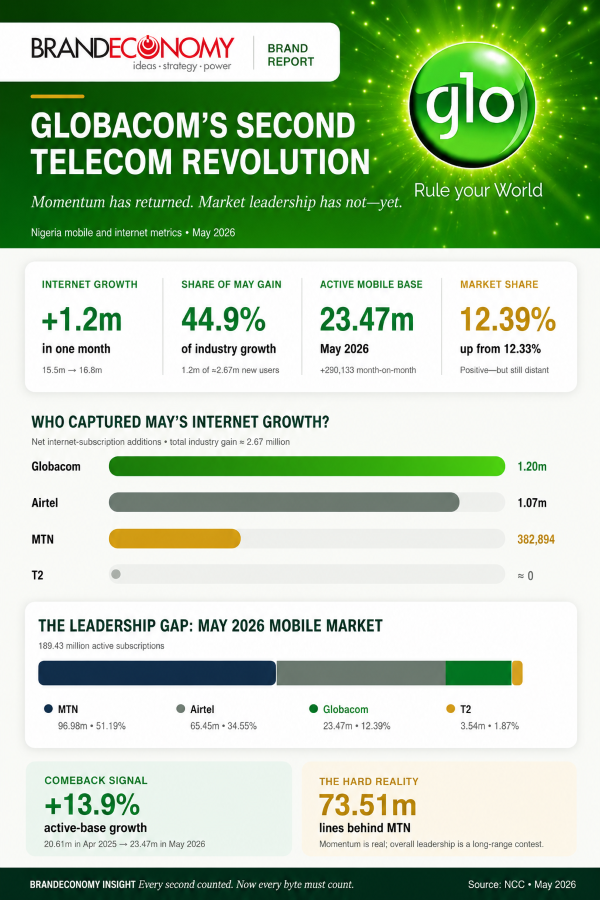
From 20.61 million active subscriptions in April 2025, Globacom advanced to 23.18 million by April 2026. In May, its base rose again to approximately 23.47 million.
The more striking development came from data. Glo’s internet subscriptions increased from roughly 15.5 million in April 2026 to about 16.8 million in May—a gain of approximately 1.2 million and close to half of the industry’s net monthly expansion. It outpaced Airtel’s gain of about 1.07 million and MTN’s increase of fewer than 400,000.
Glo also recorded the largest net addition to the broader active mobile base among the three operators that month, adding 290,133 subscriptions, against MTN’s 267,634 and Airtel’s 202,882.
These figures are a genuine comeback signal. They are not yet a comeback verdict.
One month of superior acquisition does not establish sustainable leadership. The harder questions begin after activation. Did these customers remain active, renew bundles, deepen usage and adopt Glo as their primary data network—or simply activate a promotional second SIM?
These are not cynical questions. They distinguish subscriber acquisition from franchise recovery.
MTN remains the scale and performance benchmark. Its subscriber base, capital expenditure, data traffic, revenue and profitability demonstrate the size of the system Globacom must challenge. Industry quality assessments have also continued to place MTN ahead on important technical measures, while indicating that Glo still has substantial room to improve network stability.
Globacom should therefore avoid declaring quality leadership too early. A more credible and powerful proposition would be:
Nigeria’s fastest-improving major network, on a mission to become its most dependable.
The Glo Comeback Dashboard
| Indicator | Latest reading | Movement | Strategic meaning |
| Active mobile subscriptions | 23.47m, May 2026 | +290,133 in one month | Largest May gain among Nigeria’s three biggest operators |
| GSM market share | 12.39% | Up from 12.33% in April | Improving, but still substantially behind MTN and Airtel |
| Internet subscriptions | About 16.8m | +1.2m month-on-month | Nearly 45% of the industry’s May internet additions |
| Active-base recovery | 20.61m to 23.47m | +2.86m, or about 13.9%, since April 2025 | Growth is coming from a cleaner post-reconciliation base |
| Gap to market leader | 73.51m active lines | MTN had 96.98m in May | Momentum is real; overall leadership remains a long-range contest |
The Modern Equivalent of Per-Second Billing
Globacom’s route back to national leadership cannot be another complicated bonus or celebrity campaign. Its next defining innovation must be as simple, relevant and disruptive as per-second billing.
The opportunity is to make reliability and accountability into products.
A Glo Experience Guarantee could establish clear standards for network availability, data transparency, complaint resolution and automatic redress for verified service failures. Customers should be able to understand how their data is consumed, receive intelligent usage notifications, report problems easily and recover value when the network fails to deliver an eligible service.
Glo could pair this with a Productive Data Platform connecting affordable connectivity to education, healthcare, business tools, payments, cloud storage and the creator economy. Students need education bundles; SMEs need affordable combinations of mobile data, fibre, payments, cybersecurity and cloud applications; creators need upload-friendly plans; underserved communities need shared connectivity and agent networks.
The first telecom revolution democratised voice. The second must democratise dependable digital productivity. The brand that made every second count must now make every byte count.
What Globacom Must Do to Become No. 1
First, the product must become the campaign. Globacom should concentrate investment in priority cities, economic corridors, universities, markets, transport routes and industrial clusters until it achieves independently verified experience leadership. Consistency, indoor coverage, latency, call completion and recovery time matter more to customers than isolated peak-speed claims.
Second, Glo must convert secondary SIMs into primary relationships. Distribution and marketing incentives should reward sustained usage, bundle renewal, retention, customer value and primary-SIM preference—not merely SIM activations.
Third, customer care should become a competitive weapon. AI-assisted diagnostics, human accountability, proactive outage notifications, faster escalation and published resolution standards can turn service recovery into a differentiator.
Fourth, Globacom must fully monetise Glo-1, domestic fibre and enterprise infrastructure. The company should position itself not simply as a mobile operator, but as an integrated Nigerian digital-infrastructure platform serving banks, manufacturers, governments, cloud providers, media companies and SMEs.
Fifth, management must restore the challenger culture that produced per-second billing. Founder-led decisiveness can be a competitive advantage, but it must be supported by institutional depth, measurable accountability, faster product development and transparent performance systems.
Finally, “Proudly Nigerian” must evolve from sentiment into shared value.
Globacom remains privately held, giving it strategic freedom and preserving Mike Adenuga’s long-term control. But private ownership also limits disclosure, market valuation and Nigerians’ ability to participate directly in the wealth created by one of their most important indigenous brands.
A controlled minority public offer—potentially combining existing shares with fresh capital—deserves serious consideration. Properly structured, it could preserve founder control while raising patient, naira-denominated funding for 4G densification, selective 5G deployment, rural coverage, fibre expansion, data centres, energy resilience and customer-experience systems. Preferential access for customers, employees and dealers could convert brand loyalty into shareholder advocacy.
Listing alone cannot repair service gaps. But it could broaden ownership, strengthen governance, improve transparency and give Nigerians a deeper stake in Globacom’s success. The first Glo democratisation gave citizens access to communication; a second could give them access to telecommunications wealth.
BRANDECONOMY Insight: Leadership Must Be Earned Across the Scorecard
Globacom cannot become Nigeria’s No. 1 telecom brand by proclamation or subscriber arithmetic alone. Leadership must be measured across network quality, customer trust, active data usage, revenue, profitability, enterprise relevance, innovation, brand preference, governance and national impact.
The May 2026 surge has reopened the door, but it has not erased the distance to the market leaders. Globacom’s opportunity is not to imitate MTN. It is to recover the strategic courage that once made MTN respond to it.
If Glo can unite its indigenous heritage, infrastructure assets, improving data momentum, customer-value credentials and fresh capital behind an independently measured transformation, it can again become the competitive force Nigeria needs.
The first revolution made every second count. The second must make every byte—and every customer experience—count.