


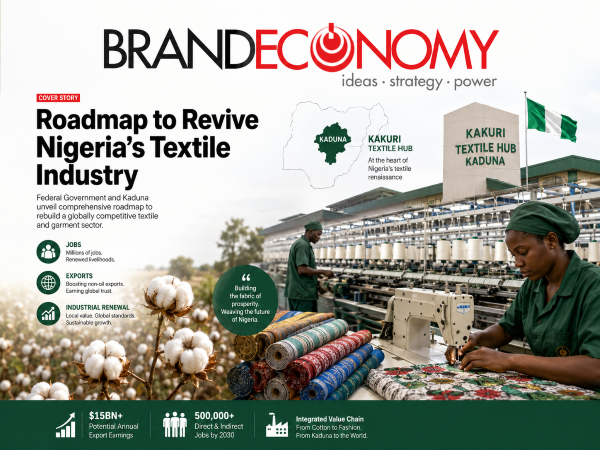
 The Federal Government and the Kaduna State Government have unveiled a roadmap to revive Nigeria’s cotton, textile and garment industry, with a focus on restoring idle production assets, creating large-scale employment, reducing import dependence and rebuilding export capacity.
The roadmap was presented on Friday during a stakeholders’ engagement on the National Cotton, Textile and Garment Industrial Transformation Programme in Kaduna.




Mrs Eme Bassey, Special Adviser on Cotton, Textile and Garments, disclosed the plan on behalf of the Federal Ministry of Industry, Trade and Investment.
Bassey said the roadmap had identified strategic textile assets for revitalisation, including the Kakuri textile hub in Kaduna, once one of the most important centres of Nigeria’s industrial economy.
According to her, the initiative is designed to restore abandoned facilities, stimulate domestic production and reposition the textile sector for sustainable growth.
The programme also seeks to create jobs across the value chain, reduce Nigeria’s reliance on imported fabrics and garments, and improve the country’s capacity to export locally produced textiles.
Textile policy under review
Bassey said the ministry was reviewing the 2015 national textile policy to introduce new fiscal, financial, regulatory and skills-development incentives.
The revised framework is expected to support investment across cotton farming, ginning, spinning, weaving, dyeing, garment production, logistics and retail.
“The government’s role is to create policies that attract investment and support industry growth,” she said.
The review is important because Nigeria’s textile decline has been driven by a combination of high production costs, weak infrastructure, limited access to finance, inconsistent policy support, smuggling and intense competition from cheaper imported products.
A credible policy must therefore go beyond offering broad incentives. It must create a commercially viable environment in which domestic producers can compete on price, quality, scale and reliability.
Bassey said the industrial transformation programme would be implemented in four phases.
The first phase is focused on policy reform, while subsequent stages will address production expansion, infrastructure, institutional capacity and financing.
Focus on cotton quality and supply
The Federal Government is also working with research institutions, development partners and relevant agencies to improve local cotton production.
Bassey said the collaboration would address persistent problems affecting cotton quality, yield and supply to manufacturers.
The strength of any textile industry begins at the farm. Manufacturers require predictable access to cotton of consistent quality and sufficient volume. Where local supply is unreliable, factories are forced to import raw materials, weakening the economic benefits of domestic production.
Improved seeds, extension services, irrigation, mechanisation, access to finance and stronger links between farmers and manufacturers will therefore be essential to the industry’s revival.
The programme could also restore a reliable market for farmers across cotton-producing states and improve rural incomes.
Affordable financing for manufacturers
Bassey disclosed that the ministry was holding discussions with the Bank of Industry and the Bank of Agriculture on affordable financing for manufacturers, particularly small and medium-sized enterprises.
Access to long-term and reasonably priced capital remains one of the biggest obstacles confronting Nigerian manufacturers.
Textile production requires significant investment in machinery, working capital, energy systems, raw materials and skills. Conventional commercial-bank loans, often structured at high interest rates and short tenors, are poorly suited to industrial recovery.
Targeted financing could help viable operators restart factories, upgrade equipment and expand production. However, funds must be allocated transparently and linked to measurable production, employment and repayment outcomes.
Smuggling and counterfeit products
The Federal Government is also addressing textile smuggling and counterfeit goods through an existing inter-agency task force.
Illegal imports have for years weakened domestic manufacturers by allowing cheaper products to enter the market without the full burden of tariffs, taxes and regulatory compliance.
Smuggling also deprives the government of revenue and undermines businesses that invest in local factories and formal employment.
Enforcement will be necessary, but it must be combined with improved competitiveness. Border controls alone cannot sustain an industry whose products remain more expensive or less attractive than imported alternatives.
Local manufacturers will need to improve design, quality, branding, distribution and consumer relevance.
Energy remains a major hurdle
Bassey identified high electricity costs as a major constraint and said increased use of gas could reduce energy expenses for manufacturers.
Kaduna State Commissioner for Agriculture, Murtala Dabo, expressed optimism that the Ajaokuta–Kaduna–Kano gas pipeline would lower industrial energy costs and support the sector’s revival.
Reliable and affordable power is critical to spinning, weaving, dyeing and garment production. Manufacturers that depend heavily on diesel generators face costs that weaken their ability to compete with producers in countries where industrial power is cheaper and more stable.
Dabo described the Federal Government’s initiative as a lifeline for cotton farmers, many of whom lost reliable markets after the collapse of textile factories.
He recalled that Kaduna was once Nigeria’s leading textile production centre, with the capacity to supply domestic and regional markets.
Kaduna seeks return to textile leadership
The Permanent Secretary in the Kaduna State Ministry of Business, Innovation and Technology, Malam Waheed Musa, said the state remained Northern Nigeria’s natural textile hub.
Musa said more than 10 textile industries had closed in recent years because of operational difficulties.
He said the Kaduna Government was collaborating with the Federal Government to restore the industry and was developing power infrastructure to improve electricity supply to industrial operators.
Musa urged investors to take advantage of Kaduna’s business environment, agricultural base, labour pool and extensive textile value chain.
Market and investor implications
A successful revival could unlock opportunities in agriculture, industrial machinery, logistics, fashion, retail, packaging, energy and export services.
Investors will, however, assess whether government can deliver affordable power, policy consistency, access to finance, security and protection against illegal imports.
The industry’s recovery will also depend on domestic demand. Public procurement policies could support local producers if uniforms, hospital fabrics, military materials and other government textile needs are sourced transparently from qualified Nigerian manufacturers.
Brand implications
For Kaduna, the initiative offers an opportunity to restore its identity as a major industrial and textile centre.
For Nigerian manufacturers, revival must be accompanied by stronger branding. Local products must compete not only on patriotic appeal, but on design, durability, affordability and consistent quality.
A new generation of Nigerian textile and fashion brands could create stronger links between industrial production, cultural identity and global markets.
BRANDECONOMY Insight
Nigeria’s textile industry will not be revived by policy announcements alone.
The roadmap must connect cotton farms to functioning factories, affordable energy, patient capital, skilled workers and reliable markets.
The opportunity is enormous. Textile and garment production can absorb large numbers of workers, stimulate agriculture and strengthen exports.
But revival requires disciplined execution. Idle factories must return to production. Financing must reach credible operators. Smuggling must be reduced, and local products must earn consumer trust.
If government and investors get the fundamentals right, Kaduna can once again become the heartbeat of Nigeria’s textile economy—and the sector can become a major engine of jobs, industrialisation and export growth.