

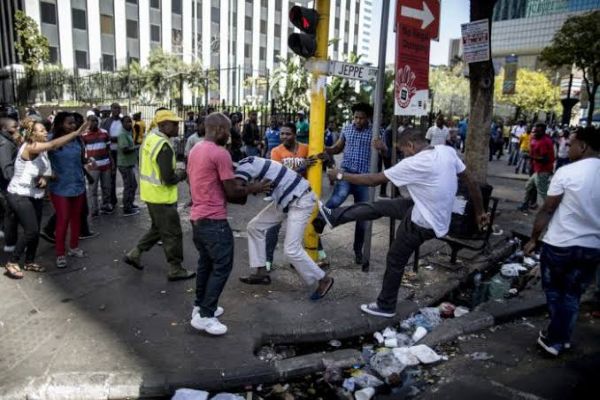
 The Federal Government has condemned the killing of two Nigerians in South Africa and called for a thorough, transparent and urgent investigation into the circumstances surrounding their deaths.
The Ministry of Foreign Affairs made the demand in a statement issued at the weekend in Abuja by its spokesperson, Mr Oluwafemi Adeniyi.




The statement followed reports of the recent deaths of two Nigerian nationals, Bishop Taiwo Fakunle and Mr James Uchechukwu Nwankwo.
According to the ministry, Fakunle was murdered at his residence in Kensington, Johannesburg, on September 4, while Nwankwo was killed on September 5 in Somerset, Cape Town.
The ministry expressed concern that the killings occurred at a time when foreigners, particularly Africans, continue to face the damaging impact of xenophobic and Afrophobic attacks in South Africa.
It said the incidents raised fresh questions about the safety of foreigners in the country and the commitment of South African authorities to preventing targeted attacks.
The ministry also described as deeply troubling reports that some law enforcement practices had worsened an already sensitive situation through interrogation methods that had allegedly resulted in the deaths of foreigners.
“Nigeria views these incidents with grave concern and condemns the killings of Bishop Fakunle and Mr Nwankwo in the strongest terms possible,” the statement said.
The Federal Government urged the relevant South African authorities to immediately begin a transparent investigation aimed at identifying those responsible and ensuring that they are brought to justice under the law.
“Nigeria expects that this matter would be accorded the attention and urgency required,” the ministry said.
It added that Nigeria remained committed to constructive dialogue in resolving differences and had consistently adopted that approach in its engagement with South Africa over the recurring concerns of xenophobia and Afrophobia.
The government, however, expressed concern that a proposed mechanism to help both countries respond more effectively to emerging threats had not been fully implemented.
According to the ministry, Nigeria has already signed a Memorandum of Understanding on the Establishment of an Early Warning Mechanism, which emerged from bilateral engagements between both countries.
“It is yet to be signed by South Africa,” the statement said.
The ministry recalled that Nigeria had formally taken the recurring waves of xenophobic and Afrophobic attacks in South Africa before the Authority of Heads of State and Government of ECOWAS.
It added that Nigeria’s formal complaint had also been placed before the Assembly of Heads of State and Government of the African Union.
“As a follow-up to these diplomatic steps, the Government of Nigeria is actively considering other concrete measures to secure the cooperation of the South African authorities on this matter,” the ministry said.
The Federal Government extended condolences to the families of the late Fakunle and Nwankwo, and prayed for the peaceful repose of their souls.
It also prayed that their families, friends and the wider Nigerian community in South Africa would find the strength to bear the painful loss.
BRANDECONOMY Insight
The fresh killings again test the strength of Nigeria-South Africa relations, especially at a time when both countries need deeper economic cooperation, regional leadership and people-to-people trust. For Nigeria, the central issue is protection of citizens abroad. For South Africa, the issue is credibility: whether its institutions can reassure African migrants, investors and communities that justice, safety and the rule of law apply equally.