

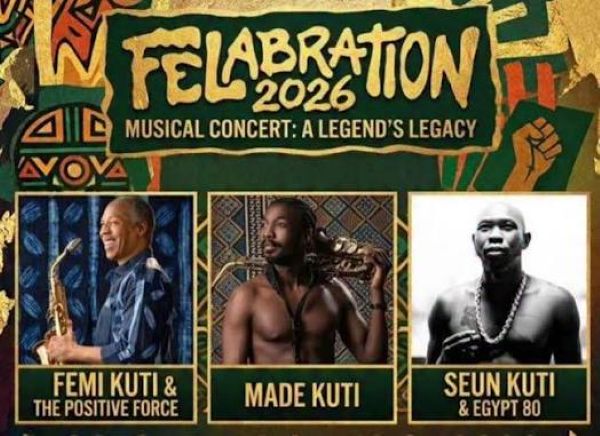
 The New Afrika Shrine became the pulsating centre of Nigeria’s cultural economy on Sunday night as Femi Kuti, Kcee and Sean Tizzle brought Felabration 2026 to a high-energy close in Ikeja, Lagos.
The grand finale, which continued into the early hours of Monday, capped a week-long celebration of Fela Anikulapo-Kuti’s music, activism and cultural influence. Under the theme “Who Are You?”, this year’s festival combined entertainment with a deeper interrogation of identity, artistic freedom and Nigeria’s place in the world.




Femi Kuti anchored the night in the horn-driven, politically conscious Afrobeat tradition established by his father. Kcee and Sean Tizzle expanded the musical palette with crowd-friendly songs drawn from contemporary Nigerian popular culture.
That combination was more significant than a conventional festival line-up. It connected Afrobeat—the distinctive musical form pioneered by Fela—with Afrobeats, the broader contemporary pop movement that has taken Nigerian music into clubs, charts and arenas around the world.
Femi Kuti sustains the musical inheritance
For many in the audience, Femi Kuti’s performance represented the emotional centre of the finale.
His presence at the Shrine offered continuity between Fela’s original musical rebellion and a younger generation experiencing the legacy through performance, recordings and digital culture. Femi has developed his own artistic identity, but the discipline of live instrumentation, extended arrangements and social commentary remains recognisably connected to the Afrobeat foundation.
Charles Amoebi, an attendee at the concert, described the performance as an affirmation of Fela’s continuing influence. For him, watching Femi carry the music forward gave the celebration an authenticity that could not be manufactured by staging alone.
That authenticity is one of Felabration’s most important assets. Unlike commemorative events built entirely around nostalgia, the festival remains connected to a functioning musical institution, an iconic venue and members of the Kuti family who continue to create and perform.
Kcee and Sean Tizzle widen the audience
Kcee brought a more overtly celebratory energy to the night, drawing the audience into familiar songs and dance routines. Folabi Adeoye said the performance created one of the evening’s liveliest moments, with the crowd responding enthusiastically.
Sean Tizzle provided another bridge to Nigeria’s contemporary pop audience. Ayodele Badejo said his performance reinforced Felabration’s ability to bring different generations of music lovers into the same cultural space.
The presence of these artists reflects the festival’s evolution. Felabration is rooted in Fela’s music and political consciousness, but it cannot remain relevant by speaking exclusively to listeners already committed to the Afrobeat tradition.
Its long-term value lies in functioning as a meeting point: between memory and modernity, live instrumentation and digital production, political expression and popular entertainment.
The challenge is to maintain that openness without allowing the festival’s philosophical substance to disappear beneath celebrity appearances.
“Who Are You?” asks a larger question
The 2026 theme was more than decorative festival branding. “Who Are You?” turned the spotlight towards identity—personal, artistic and national.
Fela repeatedly used music to question power, social conformity and post-colonial identity. In contemporary Nigeria, those questions remain urgent. Young people are building global careers while negotiating unemployment, migration pressures, political distrust and the tension between local identity and international aspiration.
Felabration therefore occupies a space larger than entertainment. Its debates, art exhibitions, dance contests and fashion programmes allow participants to interpret Fela’s legacy through multiple creative disciplines.
This multi-format structure helps the festival avoid becoming merely an annual concert. It also increases its commercial potential by creating distinct platforms for sponsors, broadcasters, creators, educators, fashion businesses and cultural institutions.
Felabration as an entertainment-economy asset
A major festival generates value far beyond the performance stage. Artists, instrumentalists, dancers, sound engineers, lighting technicians, security personnel, vendors, transport operators, hospitality businesses and digital-content creators all participate in its economic ecosystem.
For Lagos, Felabration strengthens the city’s reputation as a destination for music, nightlife and African cultural expression. Visitors spend on transportation, accommodation, food, fashion and entertainment, while the international visibility reinforces Lagos’s soft power.
Yet Nigeria still struggles to measure the full economic impact of major cultural events. Attendance, visitor spending, employment supported, media reach and tourism conversion should be tracked more systematically.
Reliable data would help organisers negotiate stronger sponsorships, demonstrate value to government and attract investors interested in Nigeria’s expanding creative economy.
Brand implications
Felabration possesses what many corporate brands spend decades trying to build: a distinctive identity, emotional loyalty, cultural authenticity and international recognition.
That equity must be protected. Commercial partnerships should support the experience without neutralising Fela’s history as a critic of power and inequality. Sponsors whose conduct conflicts sharply with the festival’s values could weaken trust and provoke accusations of opportunism.
The strongest brand partnerships would invest in live-music development, creative education, cultural preservation, artist discovery, sustainability or audience access. They should add capacity rather than merely purchase visibility.
The “Who Are You?” theme also offers a useful brand lesson: enduring institutions must know what they represent. Felabration can evolve musically, but it cannot afford to become culturally generic.
Investor relevance
Felabration has commercial possibilities across broadcast rights, global licensing, merchandising, tourism packages, digital archives, branded content and diaspora editions.
Its official licensing model offers a pathway for approved editions outside Lagos, potentially extending the festival into a global Afrobeat network. Expansion, however, requires strong quality control so that the name is not diluted by inconsistent production or unauthorised exploitation.
Investors should view Felabration not simply as an event but as intellectual property supported by music, history, fashion, activism and place. With professional governance and transparent commercial structures, it could become one of Africa’s most valuable cultural-festival brands.
BRANDECONOMY Insight
Felabration’s greatest strength is also its central strategic challenge: Fela’s legacy is both commercially powerful and fundamentally resistant to easy commercialisation.
Reduce the festival to famous performers and sponsorship banners, and its cultural meaning becomes thinner. Preserve it as an untouchable historical monument, and it risks losing younger audiences.
The winning model lies between both extremes. Felabration should operate simultaneously as a world-class concert, a marketplace for creative businesses, an academy for emerging talent, an archive of Afrobeat history and a forum for fearless ideas.
Femi Kuti, Kcee and Sean Tizzle demonstrated the festival’s ability to unite musical traditions and generations. The next stage is to convert that cultural energy into durable economic infrastructure—without silencing the rebellious voice that made the Felabration brand valuable in the first place.