


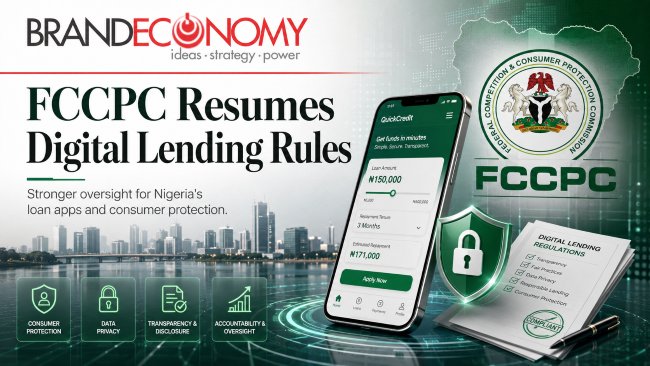
 The Federal Competition and Consumer Protection Commission has resumed implementation and enforcement of Nigeria’s digital lending regulations following a court judgment affirming the validity of the regulatory framework.
The decision restores the Digital, Electronic, Online or Non-Traditional Consumer Lending Regulations, 2025, commonly known as the DEON Regulations, after enforcement was temporarily suspended in April 2026.




The suspension followed an interim order issued in a suit instituted by the Wireless Application Service Providers Association of Nigeria Limited/Gte, which challenged the FCCPC’s authority to make and implement the regulations.
The commission said it complied immediately with the interim order in recognition of the judiciary’s authority and its commitment to the rule of law. With the substantive judgment now delivered, the regulator says it will resume its statutory responsibilities.
FCCPC Director of Corporate Affairs, Mr Ondaje Ijagwu, said the commission had consistently maintained that respect for the law remained fundamental to effective regulation and good governance.
“Now that the court has affirmed the validity of the DEON Regulations and delivered judgment, the commission will continue to discharge its statutory responsibilities faithfully, professionally and in accordance with the law,” he said.
A new enforcement phase for digital lenders
The regulations were introduced to establish clearer standards for digital and non-traditional consumer lending, including unsecured loans provided through mobile applications, websites and other electronic platforms.
They apply not only to digital lenders, but also to collaborators, technology partners, intermediaries and service providers participating in consumer-lending arrangements.
The framework requires registration, transparent loan terms, responsible lending, data protection, ethical debt recovery and effective complaint-resolution systems. It also gives the FCCPC powers to approve lending partnerships and sanction operators that violate consumer-protection standards.
Ijagwu said the regulations were designed to promote responsible credit, strengthen regulatory accountability and curb unfair or exploitative practices.
“Our objective has always been to ensure that innovation and financial inclusion flourish within a transparent, fair and accountable regulatory framework that inspires confidence among consumers, investors and responsible operators alike,” he said.
The resumption means operators can expect renewed scrutiny of their registration status, lending agreements, interest disclosures, data-use practices, advertising and collection methods.
Why tighter regulation became necessary
Nigeria’s digital lending market has expanded rapidly, driven by smartphone use, limited access to conventional bank credit and growing demand for emergency household and small-business finance.
Digital lenders have helped consumers obtain loans more quickly, often without collateral or physical bank visits. For workers, informal traders and microenterprises, that speed can provide an important financial lifeline.
But the market’s rapid expansion also produced serious complaints.
Borrowers have reported hidden charges, unclear interest calculations, aggressive collection tactics, data-privacy violations and messages sent to relatives or contacts to pressure customers into repayment.
The FCCPC said the regulations were developed partly in response to harassment, data breaches, deceptive marketing and other abuses associated with unregulated operators. The rules prohibit automatic or unsolicited lending, require accessible loan terms and impose obligations around fair treatment and privacy.
The renewed enforcement drive therefore represents an attempt to preserve the benefits of digital credit without allowing innovation to become a shield for abuse.
Market implications
For compliant lenders, the court decision provides greater regulatory certainty.
Operators that have invested in strong governance, transparent pricing, cybersecurity and customer support may benefit from a more disciplined market in which unregistered competitors face enforcement.
However, compliance will raise operating costs.
Digital lenders may need to strengthen legal teams, upgrade technology systems, improve data-security controls and redesign customer-acquisition and collection processes. Partnerships between lenders, fintech platforms, mobile service providers and other intermediaries must also satisfy approval requirements.
Non-compliant businesses face significant exposure. The regulations provide for financial sanctions that may reach ₦100 million or one per cent of the previous year’s turnover, whichever is greater. Directors may also face disqualification for up to five years in qualifying cases.
This could trigger consolidation as smaller or poorly capitalised operators struggle with the cost of compliance.
Consumer implications
For borrowers, the regulations should strengthen the right to clear information before accepting a loan.
Consumers should be able to understand the principal amount, interest rate, fees, repayment schedule and consequences of default without navigating misleading interfaces or hidden conditions.
The framework also creates stronger expectations around ethical recovery and data privacy.
Yet regulation will only make a difference if enforcement is visible and complaints are resolved promptly. Consumers need a reliable way to verify whether a lender is authorised and to report misconduct without enduring complicated procedures.
The FCCPC maintains a public register of approved digital lenders and applications, which can help users distinguish compliant platforms from unregistered operators.
Investor relevance
For investors, the judgment reduces uncertainty surrounding the regulator’s authority and provides a firmer basis for evaluating Nigeria’s digital-credit market.
A credible framework can attract patient capital by clarifying licensing, partnership and consumer-protection obligations.
It may also support more responsible innovation in alternative credit scoring, embedded lending and financing for underserved consumers.
Investors will nevertheless scrutinise regulatory consistency, enforcement fairness and the commercial sustainability of lenders facing high default risks and rising compliance costs.
Brand implications
Trust is the most valuable asset in digital lending.
Loan apps often serve consumers at financially vulnerable moments. Brands that exploit that vulnerability may achieve rapid downloads but destroy long-term credibility.
Responsible operators should treat transparent pricing, respectful communication and data protection as central brand promises.
For the FCCPC, the court victory strengthens its regulatory authority. But its reputation will depend on balancing firm enforcement with clear guidance and fair treatment of legitimate businesses.
BRANDECONOMY Insight
Nigeria needs digital credit—but it does not need digital exploitation.
The DEON Regulations offer an opportunity to move the market away from anonymous apps, hidden charges and humiliating recovery practices towards accountable, professionally managed lending.
The court judgment settles an important legal question. The next test is execution.
The FCCPC must enforce the rules consistently, protect consumers swiftly and avoid creating unnecessary barriers for responsible innovators.
Digital lending will achieve its greatest economic value when it expands access to credit without sacrificing dignity, privacy or trust.