The dispute over airtime lending is no longer a narrow telecoms matter. It has become a test of consumer protection, regulatory boundaries, fintech confidence and the rule of law in Nigeria’s fast-expanding digital-credit economy.
 The dispute over airtime lending is no longer a narrow telecoms matter. It has become a test of consumer protection, regulatory boundaries, fintech confidence and
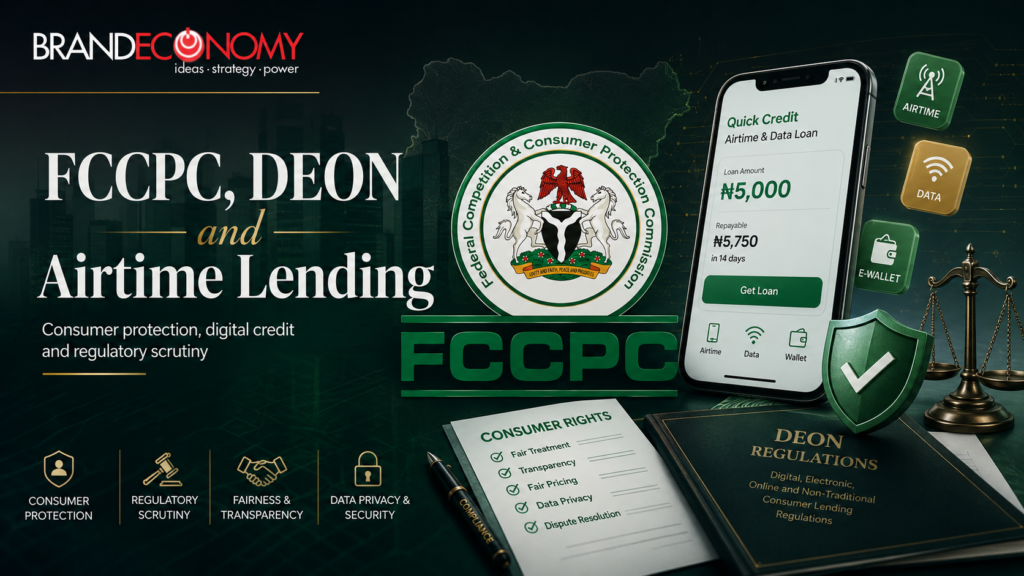
 The Federal Competition and Consumer Protection Commission has clarified that its role in digital and non-traditional lending remains limited to its statutory consumer-protection responsibilities, even as enforcement of its Digital, Electronic, Online or Non-Traditional Consumer Lending Regulations 2025, known as the DEON Regulations, remains suspended pending ongoing litigation.
The clarification follows public debate over airtime lending, fintech participation and claims around the Commission’s role in shaping access to Nigeria’s digital-credit market. FCCPC said it remains a law-abiding institution and has suspended implementation and enforcement of the DEON Regulations in obedience to an ex-parte order of the Federal High Court sitting in Lagos in Suit No. FHC/L/CS/760/2026, filed by the Wireless Application Service Providers Association of Nigeria.



The court order restrained or suspended enforcement of the regulations pending determination of the case. FCCPC said it had instructed its solicitors to challenge both the order and the competence of the suit, while maintaining compliance with the court’s directive.
At stake is a high-growth but sensitive market: digital lending, airtime credit, data advances and other non-traditional consumer-credit products that millions of Nigerians increasingly use for emergency access to value.
What DEON Was Designed to Do
The DEON framework was introduced as a consumer-protection response to abuses in Nigeria’s digital-credit ecosystem. These abuses have included predatory loan practices, opaque charges, privacy violations, aggressive recovery methods and unfair treatment of borrowers.
The regulations cover unsecured loans and consumer-lending services offered through digital, electronic, online or non-traditional channels, including lending by way of cash, airtime, data, cashback, services or barter where monetary value is involved.
The rules also require parties involved in consumer-lending partnerships to seek FCCPC approval, disclose terms, define borrower rights, state interest rates and charges, address data-protection compliance, set out recovery methods and provide dispute-resolution mechanisms.
In policy terms, DEON is an attempt to bring structure to a market that grew faster than consumer safeguards. The logic is understandable: when credit moves from bank branches into mobile phones, regulation must also evolve.
But the legal challenge shows that the issue is not whether consumers should be protected. The issue is how far FCCPC’s jurisdiction should extend where telecoms, fintech, banks and value-added service providers operate under other sector regulators.
The Jurisdiction Question
WASPAN’s challenge raises a fundamental legal question: where does FCCPC’s consumer-protection mandate end, and where do the powers of sector regulators such as the Nigerian Communications Commission and the Central Bank of Nigeria begin?
According to court reporting, WASPAN argued that FCCPC’s powers are limited to consumer protection and cannot override existing sector-specific legislation governing telecommunications and financial services. FCCPC, on the other hand, has defended the regulations as valid consumer-protection measures within its statutory mandate.
That distinction matters for Nigeria’s digital economy. If every digital-credit product sits at the intersection of telecoms, banking, data, competition and consumer protection, regulators must coordinate clearly. Otherwise, businesses face overlapping directives, consumers face service disruptions and investors face legal uncertainty.
The court has adjourned the matter to July 20 for judgment, making the case a potentially important precedent for Nigeria’s digital regulatory architecture.
Airtime Lending and the Consumer Economy
Airtime lending may look small at the level of individual transactions, but its scale is significant. For many low-income and informal-sector consumers, airtime and data credit are not luxuries. They are tools for work, payments, communication, transport coordination, small trading, emergency calls and digital access.
That is why the current dispute is commercially sensitive. A sudden regulatory freeze or uncertainty around service providers could affect millions of users who depend on small-value credit products.
Yet consumer convenience cannot be an excuse for weak safeguards. Where customers borrow airtime, data or digital value, they deserve fair pricing, clear terms, privacy protection, ethical recovery practices and accessible complaint channels.
The policy challenge is therefore to protect consumers without freezing innovation.
Business and Market Implications
For fintechs, value-added service providers, telecom operators and digital lenders, the dispute introduces regulatory uncertainty at a difficult time.
Nigeria’s digital-credit sector is still evolving. Companies need clarity on licensing, partnerships, revenue-sharing, data handling, consumer disclosure and enforcement exposure. If regulatory boundaries are unclear, credible operators may delay investment, while weaker actors may exploit gaps.
For telecoms operators, airtime lending is part of broader customer-value management. It improves usage, keeps subscribers connected and creates revenue opportunities. For fintechs, it is a gateway into micro-credit, behavioural scoring and inclusion. For consumers, it is instant liquidity in small doses.
The market consequence of prolonged uncertainty could be slower product innovation, higher compliance costs, reduced service availability and deeper caution among investors.
Investor Relevance
Investors watching Nigeria’s fintech and telecoms markets will read the FCCPC-WASPAN dispute as a governance signal.
The opportunity remains large. Nigeria has a huge population, strong mobile penetration, a youthful consumer base and growing digital-finance adoption. But investors also want predictable regulation, respect for court processes, clear licensing pathways and coordinated oversight.
Where regulators appear to overlap or where enforcement can suddenly alter market access, investors price in risk.
This does not mean regulation is bad for investment. On the contrary, strong consumer protection can improve trust and expand market depth. But regulation must be clear, lawful, consultative and consistently applied.
Brand Implications
For FCCPC, the brand issue is institutional credibility. The Commission must be seen as a serious consumer-protection authority that respects the rule of law while defending its mandate.
For WASPAN and industry players, the brand issue is legitimacy. They must show that their opposition to disputed provisions is not opposition to consumer protection, but a demand for lawful, coordinated and sector-sensitive regulation.
For fintech and telecom brands, the issue is trust. Customers want convenience, but they also want fairness. The companies that will win in digital credit are those that make borrowing simple, transparent and respectful.
BRANDECONOMY Insight
Nigeria Must Regulate Digital Lending Without Killing Digital Credit
The FCCPC-DEON dispute captures one of the hardest questions in Nigeria’s digital economy: how do you regulate fast-moving innovation without creating confusion, duplication or market paralysis?
Digital credit is important. Airtime lending, data advances and micro-loans help millions of Nigerians stay connected and manage short-term liquidity. But the sector has also produced real consumer-protection concerns, especially around privacy, hidden charges and aggressive recovery practices.
FCCPC is right to insist that consumers deserve protection. WASPAN is also entitled to test the limits of regulatory authority in court. That is how institutions mature.
The deeper issue is coordination. Nigeria’s digital economy cannot be governed by regulators acting in silos. FCCPC, NCC, CBN, NDPC and other relevant agencies must build a shared framework for digital-credit oversight. Each regulator should know its lane, but consumers should not fall between the lanes.
The best outcome is not regulatory victory for one side. It is a clearer, lawful and investor-friendly framework that protects consumers, preserves innovation and gives credible operators certainty.
Nigeria needs digital credit. But it needs digital credit with discipline.