
When the Runway Ran Out: First Major Test of Safety, Governance and Brand Trust for Enugu Air

 How Flight 4264’s wet-weather landing became a test of operational discipline, airport resilience, regulatory transparency and brand trust
 How Flight 4264’s wet-weather landing became a test of operational discipline, airport resilience, regulatory transparency and brand trust
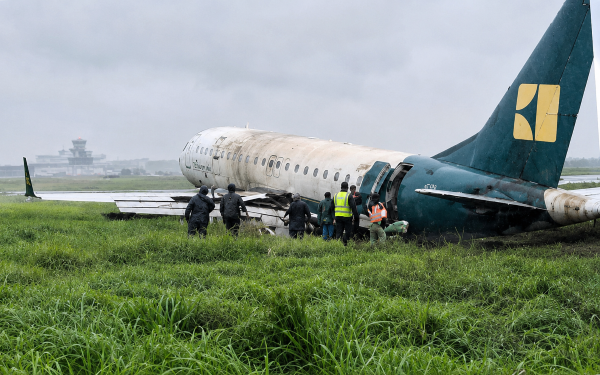
At approximately 3:10 p.m. on Thursday, July 23, 2026, Enugu Air Flight 4264 arrived at Benin Airport from Lagos carrying 63 passengers and five crew members. The Embraer E170, registered 5N-ENR, landed on Runway 05 but continued beyond the runway’s paved end during its landing roll.
All 68 people aboard were accounted for. No injuries or fatalities were officially reported.



That is the most important fact—and the one deserving the greatest relief.
But a safe human outcome must not be mistaken for an inconsequential occurrence. The aircraft’s departure from the runway forced the closure of Benin Airport’s runway, triggered flight cancellations by Air Peace and United Nigeria Airlines, disrupted passengers’ travel plans and activated an investigation by the Nigerian Safety Investigation Bureau, NSIB.
Minister of Aviation and Aerospace Development Festus Keyamo subsequently directed relevant aviation agencies to work with Enugu Air to establish what happened. Enugu Air’s Chief Executive Officer and Accountable Manager, Captain Tolu Ita, described the occurrence as a serious runway excursion rather than a crash or emergency landing. She said the aircraft hydroplaned during its landing roll.
Hydroplaning is therefore the airline’s preliminary explanation—not yet the independent finding of the NSIB.
That distinction is crucial. Aviation safety is not strengthened by speculation, political defensiveness or dramatic headlines. It advances through evidence: weather information, flight-data recordings, cockpit decisions, aircraft performance, touchdown position, runway condition, braking action, airport drainage, air-traffic communication and compliance with operating procedures.
The Benin incident must now be treated as more than an aircraft-recovery exercise. It is an opportunity to examine the interconnected system that makes every commercial flight either resilient or vulnerable.
First, Call the Incident What It Was
Some early accounts described the occurrence as a crash-landing; others said the aircraft skidded sideways or carried 68 passengers in addition to its crew. The NSIB’s account provides the more authoritative baseline: Flight 4264 had 63 passengers and five crew members and overran the end of Runway 05 during landing.
The correct aviation classification is a runway excursion—a broad term covering an aircraft that veers off the side or overruns the end of a runway during take-off or landing.
It is also different from a runway incursion, which ordinarily involves the incorrect presence of an aircraft, vehicle or person on a protected runway area.
This precision is not semantic housekeeping. Accurate language affects public confidence, insurance assessment, regulatory response and the quality of lessons eventually drawn from an occurrence.
Calling every excursion a “crash” may cause unnecessary panic. Calling a serious incident “just a skid,” on the other hand, can trivialise a recognised global aviation risk.
The responsible position lies between sensationalism and minimisation: everyone survived without reported injury, but the incident was serious enough to require a rigorous and independent investigation.
What Investigators Must Establish
Enugu Air has attributed the excursion to hydroplaning, a condition in which a layer of water reduces effective contact between an aircraft’s tyres and the runway surface, diminishing braking or directional control.
That explanation is technically plausible during heavy rainfall. It is not, by itself, a completed investigation.
A professional safety inquiry must determine not merely whether the runway was wet, but how the entire operation was planned and executed under the prevailing conditions. The critical questions include:
- What were the actual weather, rainfall, wind and visibility conditions at the time of arrival?
- What runway-condition or braking-action information was available to the crew?
- Was there standing water, and how effectively was the runway draining?
- Was the approach stable within the airline’s prescribed parameters?
- At what point did the aircraft cross the runway threshold and touch down?
- What were its approach, touchdown and ground speeds?
- Were spoilers, wheel brakes and reverse thrust functioning and deployed as designed?
- Did the crew’s landing-distance calculation sufficiently reflect the wet-runway conditions?
- Was a go-around considered or required under the airline’s procedures?
- Were there any technical, maintenance or tyre-performance issues?
- Did airport infrastructure, including the runway surface, markings, drainage and safety area, perform to the expected standard?
These questions should not be interpreted as allegations against the pilots, airline, airport operator or regulator. They illustrate the breadth of evidence required before a responsible conclusion can be reached.
A runway excursion is rarely explained adequately by a single word such as “rain,” “pilot,” “runway” or “brakes.” Aviation incidents are commonly the result of interacting conditions: weather may affect the surface; the surface affects braking; speed and touchdown position affect the runway remaining; procedures determine whether an approach continues; infrastructure influences the consequences after an aircraft leaves the pavement.
The NSIB has said its investigators will preserve evidence, interview relevant personnel, inspect the aircraft, assess runway conditions and review operational and technical information. That is the proper course.
Its statutory purpose is not to distribute blame but to identify circumstances and contributing factors, and then make recommendations capable of preventing a recurrence.
A Fortunate Outcome, but Not a Free Pass
The absence of casualties deserves celebration. It should also make the industry more—not less—determined to learn.
The International Air Transport Association identifies runway excursions as one of commercial aviation’s most persistent accident categories. Between 2016 and 2025, IATA recorded 98 runway-excursion accidents, representing approximately 20 per cent of all accidents during the period. Eight were fatal.
The Benin occurrence therefore belongs to a global safety problem, not an obscure Nigerian anomaly. Runway excursions can affect highly experienced airlines, modern aircraft and advanced airports.
But universality is not an excuse for complacency. It is the reason international aviation has developed detailed controls around stabilised approaches, landing-performance calculations, runway-condition reporting, weather monitoring, drainage, crew training, go-around policies and runway-end safety areas.
The central lesson is simple: the safest incident is not merely one from which everyone walks away; it is one that produces enough institutional learning to prevent the next occurrence from having a worse outcome.
Benin Airport’s Closure Exposed a Wider Infrastructure Weakness
Once the aircraft came to rest beyond the runway, Benin Airport’s runway was closed for recovery operations, inspection and safety assessment. Air Peace suspended its Benin services, while United Nigeria Airlines cancelled flights pending reopening.
That operational chain exposes the fragility of Nigeria’s single-runway airports.
When a lone runway becomes unavailable, the airport effectively stops functioning. One occurrence can therefore disrupt multiple airlines, strand passengers, alter aircraft rotations and impose costs far beyond the carrier directly involved.
The consequences spread quickly:
- Passengers miss meetings, appointments and connecting flights.
- Airlines bear rebooking, diversion and schedule-recovery costs.
- Aircraft and crews fall out of their planned rotations.
- Airport concessionaires lose passenger traffic.
- Hotels, transport operators and local businesses experience cancellations.
- Confidence in the affected destination’s accessibility is weakened.
For a commercial centre such as Benin City, aviation is not simply a transport service. It supports government activity, corporate travel, investment visits, tourism, family movement and time-sensitive commercial transactions.
Nigeria may not be able to provide parallel runways at every regional airport. It can, however, strengthen contingency planning, recovery capability and inter-agency coordination. Airports should know how quickly disabled aircraft can be removed, how passengers will be protected, how airlines will be updated and how runway integrity will be certified before operations resume.
Resilience must become a measurable airport capability, not an improvisation after an incident.
Enugu Air Faces Its First Major Brand-Test
The runway excursion comes at a sensitive stage in Enugu Air’s development.
The Enugu State Government-owned airline began commercial services in July 2025, initially operating through a partnership with XEJet. On March 10, 2026, the Nigeria Civil Aviation Authority granted Enugu Air its own Air Operator Certificate, authorising scheduled operations under its independent regulatory approval.
The carrier has presented itself as an instrument for strengthening South-East connectivity, promoting investment, expanding tourism and building Enugu into a regional aviation and logistics hub. It has also pursued an ambitious fleet-growth and route-expansion programme.
The Benin incident is therefore more than a technical event involving one aircraft. It is the young airline’s first major test of institutional maturity.
New airlines usually build reputation through aircraft appearance, competitive fares, punctual departures and friendly service. But the deepest layer of an aviation brand is trust: the passenger’s belief that the organisation possesses the competence, discipline and honesty to manage risk.
Enugu Air’s initial communication contained several positive elements. It confirmed the occurrence, prioritised the safety of passengers and crew, notified the authorities, acknowledged possible schedule disruption and pledged cooperation with investigators.
The harder test now begins.
The airline should avoid treating its reference to hydroplaning as the final answer. It should communicate regularly without attempting to pre-empt the independent inquiry. A strong safety brand does not fear scrutiny; it demonstrates that scrutiny is embedded in its operating culture.
The Special Burden of Public Ownership
Enugu Air’s ownership adds another dimension. The carrier is not merely a private company protecting shareholder value. It is a state-backed enterprise carrying the reputation, development ambitions and financial exposure of Enugu State.
That status can be a strategic advantage. Government support may help an airline deepen regional connectivity, stimulate economic activity and serve routes whose wider developmental value exceeds their immediate commercial returns.
It also creates special governance obligations.
Political considerations must never influence technical decisions. Fleet expansion must not outpace recruitment, training, maintenance capacity, safety management systems or operational control. Commercial ambition must remain subordinate to aviation discipline.
The Enugu State Government should therefore resist the temptation to frame every question about the incident as an attack on the state or its development agenda. Transparency would protect the Enugu brand more effectively than defensiveness.
The public deserves assurance that the airline’s board has the independence, aviation expertise and authority required to hold management accountable. It also deserves clarity on how risks, insurance, aircraft acquisition, operational performance and public investment are governed.
A state-owned airline should not receive a lower level of scrutiny because government stands behind it. It should accept a higher standard because citizens ultimately stand behind the government.
Lessons for Nigeria’s Aviation System
The most valuable response to Flight 4264 would be a coordinated safety-improvement programme built around the following priorities.
1. Publish Findings Promptly and Transparently
The NSIB should issue a preliminary account as soon as sufficient facts have been verified and publish the final report without avoidable delay. Recommendations should identify responsible organisations and provide a mechanism for tracking implementation.
2. Audit Runway Drainage and Surface Performance
FAAN and the NCAA should conduct wet-season inspections of runway drainage, surface texture, rubber deposits, friction characteristics and water accumulation at regional airports. Compliance on paper is not enough; runway performance must be verified under realistic weather conditions.
3. Improve Real-Time Runway-Condition Reporting
Pilots require current, standardised and operationally useful information. Reports about rainfall, standing water and braking action must move quickly and accurately among airport operations, air-traffic control and flight crews.
4. Reinforce Stabilised-Approach and Go-Around Discipline
Every airline should revisit policies governing unstable approaches, long touchdowns and deteriorating runway conditions. A go-around is not a sign of failed piloting. It is a legitimate risk-control decision.
5. Review Emergency and Recovery Capacity
The safe evacuation of Flight 4264 is reassuring, but every airport should test its readiness through realistic drills. Rescue response, passenger accountability, medical support, family information and disabled-aircraft recovery must work as one system.
6. Build Better Single-Runway Contingencies
Airlines, FAAN and consumer-protection authorities need clear protocols for closures, diversions, refunds, rebooking and passenger communication. Travellers should not have to rely on social-media rumours to understand their options.
7. Protect the Independence of Safety Decisions
Political officeholders may demand urgency, but investigators must be allowed to work without pressure to absolve or indict any institution. The credibility of the findings will depend on independence, evidence and technical competence.
8. Turn Recommendations into Measurable Action
Nigeria has no shortage of reports. The more difficult challenge is implementation. Safety recommendations should carry deadlines, responsible agencies and publicly trackable progress.
Market and Investor Implications
Investors and commercial partners will watch three areas closely.
The first is the condition and return-to-service timeline of aircraft 5N-ENR. Any significant damage could affect Enugu Air’s available capacity, schedule reliability, insurance costs and fleet deployment.
The second is the quality of the airline’s response. Transparent communication, professional passenger care and visible cooperation with investigators can contain reputational damage. Evasion or contradictory messaging would increase it.
The third is what the investigation reveals about Nigeria’s broader aviation environment. Airlines do not operate independently of airport infrastructure, weather services, air-traffic management and regulatory oversight. Persistent weaknesses in any part of that chain raise operating costs and can discourage long-term capital.
For investors, safety is not an abstract social obligation. It is a financial variable. It influences insurance premiums, asset values, financing terms, operational continuity, customer loyalty and corporate reputation.
Brand Implications: Trust Is Built After the Incident Too
Enugu Air cannot undo what happened at Benin Airport. It can determine what the incident comes to represent.
If the carrier communicates honestly, supports affected passengers, learns visibly and implements every relevant recommendation, Flight 4264 may ultimately demonstrate resilience and institutional seriousness.
If it retreats into public relations, prematurely closes the question of causation or allows political loyalty to replace professional accountability, the incident could become a lasting reputational burden.
The same principle applies to FAAN, the NCAA, the NSIB and the Aviation Ministry. Nigerians will judge not only the occurrence but the quality of the response.
Safety is the aviation industry’s most powerful brand promise. It is delivered not through slogans, but through decisions made before departure, during approach, after an occurrence and throughout the investigation that follows.
BRANDECONOMY Insight
The most important story from Benin Airport is that 68 people returned safely to their families. The second most important story is whether Nigeria’s aviation institutions will convert that fortunate outcome into measurable safety reform.
Flight 4264 should neither be sensationalised as a catastrophe nor dismissed as an unfortunate skid on a rainy afternoon. It was a serious runway excursion involving a recently certified, publicly owned airline at a strategically important regional airport. It disrupted an entire destination because one runway became unavailable. It also exposed the fine line between weather as a known operational hazard and weather as an inadequate explanation.
The ultimate test is not whether rain fell over Benin. It is whether every layer of the aviation system anticipated the risk, communicated it accurately, responded professionally and will now learn from the result.
All 68 people aboard survived. Nigeria must ensure that the lessons survive too.