Africa’s largest single-train refinery – Dangote Refinery – has moved beyond promise into performance, surpassing its original nameplate capacity and strengthening Nigeria’s claim to energy self-sufficiency, industrial confidence and continental refining leadership.
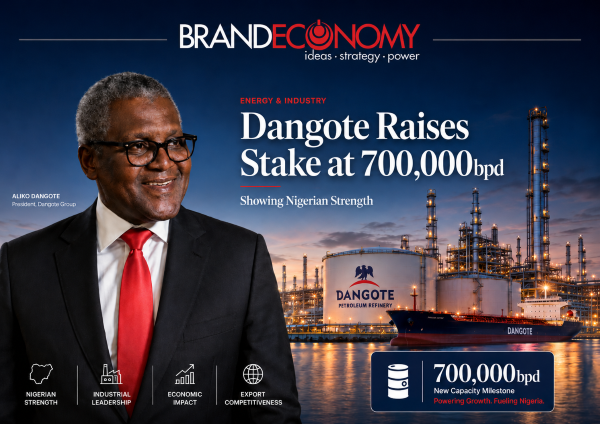 Africa’s largest single-train refinery – Dangote Refinery – has moved beyond promise into performance, surpassing its original nameplate capacity and strengthening Nigeria’s claim to energy self-sufficiency,
 Dangote Petroleum Refinery & Petrochemicals has raised its crude-processing capacity to 700,000 barrels per day, exceeding its original 650,000bpd nameplate capacity and sending a powerful signal about Nigerian industrial capability.
The milestone followed a performance test conducted by the refinery’s process licensors, confirming that the facility can process additional feedstock while sustaining efficiency across its production units.




For Nigeria, this is more than a technical achievement. It is a statement of national possibility.
For decades, Africa’s largest crude oil producer remained dependent on imported refined petroleum products, losing value, jobs, foreign exchange and industrial leverage. Dangote Refinery’s ramp-up to 700,000bpd challenges that old economic model and places Nigeria in a stronger position to refine, export and compete in the global energy market.
According to Devakumar Edwin, Vice-President, Oil and Gas, Dangote Industries Limited, the current ramp-up forms part of a bigger plan to more than double the refinery’s capacity to 1.4 million barrels per day within 30 months.
If achieved, that ambition would move the facility from being the world’s largest single-train refinery into the league of the most influential refining platforms globally.
A New Energy Confidence for Nigeria
The refinery began fuel production in 2024 and has steadily expanded output across petrol, diesel, aviation fuel and other refined petroleum products.
Its growing production has strengthened local supply, reduced dependence on imports and created fresh possibilities for Nigeria’s downstream petroleum economy.
The refinery has also developed a growing export footprint, supplying refined products to several African countries and key international destinations, including markets in Europe, the Americas and the Middle East.
This is where the story becomes bigger than Dangote.
Nigeria is beginning to capture more value from its crude oil. Instead of exporting raw crude and importing finished fuel, the country now has a major domestic refining platform capable of supplying both local and international markets.
That is the true meaning of value addition.
From Import Dependence to Export Ambition
Dangote Refinery’s rise comes at a time when global energy markets are under pressure from geopolitical tension, supply disruptions and rising concerns over energy security.
For African countries that depend heavily on imported refined products, a major refinery within the continent offers a strategic supply alternative. Shorter supply routes, regional proximity and growing product availability can reduce exposure to distant market shocks.
The refinery’s role in supplying diesel, petrol and aviation fuel also gives Nigeria a stronger voice in regional energy trade.
If output remains stable and distribution improves, Nigeria could gradually shift from being a vulnerable fuel-importing economy to a refining and export hub for West Africa and beyond.
That transformation would have direct benefits for foreign exchange, jobs, trade balances, industrial production and investor confidence.
Policy Implications: Nigeria Must Build Around the Refinery
Dangote Refinery’s performance should push policymakers to think more strategically about the entire petroleum value chain.
The country must now ensure that domestic refining is supported by reliable crude supply, efficient logistics, transparent regulation and fair competition.
The lesson is clear: Nigeria should not simply celebrate one major refinery. It should build a broader refining and petrochemical ecosystem around it.
That means encouraging more investment in refining, modular processing, petrochemicals, storage, pipelines, depots, marine services, engineering support and downstream manufacturing.
Government must also manage competition wisely. Local refining should be encouraged, but consumers must be protected. Import dependence should be reduced, but supply security must remain strong. Market dominance should be regulated, but industrial scale should not be punished.
The right policy response is intelligent regulation, not policy confusion.
Petrochemicals: The Next Big Opportunity
Beyond fuels, Dangote Refinery’s wider value lies in petrochemicals.
The facility is expected to strengthen the supply of LPG and industrial feedstocks such as polypropylene, which is used in packaging, consumer goods, plastic products and industrial materials.
Future production of Linear Alkylbenzene, used in detergent manufacturing, could further deepen Nigeria’s manufacturing base.
This matters because petrochemicals create stronger industrial multipliers than fuel alone. They support factories, packaging companies, household-product manufacturers, logistics firms, exporters and small businesses.
If properly connected to industrial clusters, the refinery can become a powerful anchor for Nigerian manufacturing.
Brand Implications: Dangote as a Symbol of Nigerian Scale
For the Dangote brand, the move to 700,000bpd strengthens its position as one of Africa’s most ambitious industrial brands.
The refinery is now more than a company asset. It has become a symbol of Nigerian scale, resilience and industrial courage.
But with scale comes responsibility.
The refinery will be judged not only by capacity figures, but by product availability, pricing behaviour, environmental standards, supply reliability, stakeholder engagement and its contribution to the wider economy.
A brand of this size must show that its success benefits the nation, the consumer, the market and the continent.
Investor Relevance
For investors, the 700,000bpd milestone is a strong execution signal.
Large industrial projects often struggle to move from construction to stable operations. Surpassing nameplate capacity suggests that Dangote Refinery is entering a more mature operational phase.
This will matter to crude suppliers, financiers, commodity traders, downstream marketers, petrochemical investors and regional buyers.
However, investors will still watch key risk areas: crude availability, regulatory stability, refining margins, pricing policy, foreign exchange conditions, logistics efficiency, competition rules and export demand.
The refinery’s proposed expansion to 1.4 million bpd is especially significant. It could transform Nigeria’s position in global refining, but it will require sustained technical performance, feedstock security and disciplined capital execution.
Market Consequences
Dangote Refinery’s growing output will continue to reshape Nigeria’s downstream petroleum market.
Importers will face stronger competition. Marketers will adjust sourcing strategies. Regional buyers will have a major African supplier closer to home. Global traders will increasingly factor Nigeria into refined-product flows.
Consumers could benefit if increased local supply helps stabilise prices and reduce exposure to international supply shocks.
But the full market impact will depend on distribution efficiency. Refining capacity alone is not enough. Nigeria still needs better storage, trucking, pipelines, depots, retail discipline and transparent pricing.
The refinery has strengthened the supply side. The country must now fix the market-delivery side.
BRANDECONOMY Insight
Dangote’s 700,000bpd Push Shows What Nigerian Capital Can Build
Dangote Refinery’s push to 700,000 barrels per day is an upbeat moment for Nigeria because it shows what is possible when ambition, capital, engineering and persistence meet.
For too long, Nigeria’s oil story was defined by contradiction: abundant crude, weak refining, heavy imports and avoidable foreign-exchange pressure. This refinery is changing that narrative.
It demonstrates Nigerian strength in practical terms — not slogans, not promises, but installed capacity, rising output and global market relevance.
Yet the bigger challenge is still ahead.
Nigeria must turn this achievement into a national industrial advantage. That requires smart regulation, stable crude supply, transparent market rules, stronger logistics and deeper petrochemical linkages.
Dangote Refinery should not stand alone as a monument. It should become the anchor of a wider energy and manufacturing ecosystem.
If Nigeria gets the policy framework right, Dangote Refinery can support lower import dependence, stronger exports, more jobs, deeper manufacturing and greater investor confidence.
The message is powerful: Nigeria can build big. Now Nigeria must govern big.