


The Nigeria Customs Service is preparing to expand non-intrusive cargo inspection across the country with 22 additional scanners, advancing a modernisation programme intended to reduce physical examinations, accelerate cargo clearance and strengthen confidence in Nigeria’s trade gateways.
The equipment is expected to be deployed across seaports, airports and land-border stations. If properly installed, integrated and maintained, the scanners could address one of the most persistent sources of frustration for importers: the time, cost and uncertainty associated with opening containers for manual inspection.


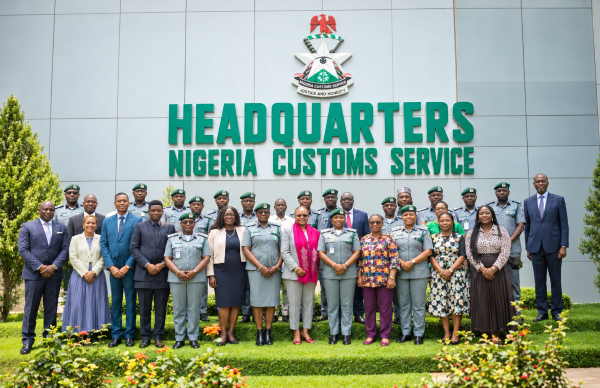
NCS spokesperson, Abdullahi Maiwada, disclosed the initiative following a quarterly engagement in Abuja involving Customs, the US Chamber of Commerce, its US-Africa Business Centre and the American Business Council Nigeria.
The meeting focused on trade facilitation, customs predictability and the operating conditions confronting American and other international businesses in Nigeria.
Comptroller-General of Customs, Bashir Adeniyi, represented by the Deputy Comptroller-General responsible for Tariff and Trade, Caroline Niagwan, said the Service was building a more transparent, responsive and digitally enabled customs administration.
That objective requires Customs to perform an increasingly difficult balancing act: facilitating legitimate commerce, collecting revenue, protecting Nigeria’s borders and enforcing compliance without turning every shipment into a prolonged investigation.
Scanners must become infrastructure, not decoration
Cargo scanners enable Customs officers to examine the contents of containers and vehicles without unloading every consignment. When connected to credible risk-management systems, the technology can direct physical inspections towards suspicious shipments while allowing compliant cargo to move faster.
Acquisition, however, does not automatically translate into operational capacity.
The newly acquired equipment recently underwent factory acceptance testing in China between October 9 and 20, 2026. The exercise was conducted to determine whether the non-intrusive inspection systems and accompanying electronic cargo-tracking technology satisfied contractual specifications and international operating standards before shipment to Nigeria.
The 22-scanner programme should therefore be understood as an implementation pipeline—not 22 fully operational machines already processing cargo nationwide.
The decisive milestones will include shipment, site preparation, installation, systems integration, operator training, commissioning and sustained availability. Customs should publish a deployment schedule identifying the intended locations, scanner types, installation status and expected commissioning dates.
Without such visibility, businesses cannot incorporate the anticipated efficiency gains into their logistics, financing and investment decisions.
The real prize is lower trade friction
For import-dependent manufacturers, retailers, healthcare companies and technology businesses, cargo delays are not abstract inconveniences. They tie down working capital, interrupt production schedules, increase storage and demurrage charges and make inventory planning less reliable.
Those additional costs eventually migrate into consumer prices.
Reliable scanning could shorten examination queues, reduce the number of containers subjected to full physical inspection and limit discretionary contact between traders and officials. It could also improve the detection of concealed goods, prohibited items and false declarations.
The reform is therefore capable of supporting revenue collection and trade facilitation simultaneously. Faster clearance does not have to mean weaker enforcement if Customs deploys better intelligence, advance information and risk-based selectivity.
Nigeria’s National Single Window, the B’Odogwu customs platform, electronic advance-ruling system and Authorised Economic Operator programme should reinforce that architecture. Their value, however, depends on interoperability.
A scanner that generates images which cannot move seamlessly into Customs’ clearance and risk-management workflow merely transfers congestion from one operational point to another.
American businesses demand predictability
Adeniyi said the engagement with American business organisations created an opportunity to address emerging concerns and strengthen economic cooperation between Nigeria and the United States.
Kendra Gaither, President of the US-Africa Business Centre at the US Chamber of Commerce, identified effective customs administration as an important condition for investment in agriculture, energy, critical minerals, healthcare and the digital economy.
Margaret Olele, Chief Executive Officer and Executive Secretary of the American Business Council Nigeria, acknowledged the Service’s progress in trade facilitation, stakeholder engagement, advance rulings, dispute resolution and the Authorised Economic Operator programme.
She also recognised Customs’ strong performance in the Presidential Enabling Business Environment Council’s compliance assessment.
These endorsements are useful, but investors ultimately judge border reforms through operational experience. Predictable tariff classification, consistent valuation, reliable clearance timelines and credible dispute resolution carry more commercial weight than institutional presentations.
A manufacturer considering a Nigerian production facility needs to know how quickly machinery, spare parts and raw materials can enter the country. An exporter needs confidence that compliant consignments will not miss shipping schedules. A multinational requires assurance that rules will not change midway through a transaction.
For such businesses, customs efficiency is a fundamental part of the investment climate.
Paperless ambition meets physical constraints
Deputy Comptroller-General for ICT and Modernisation, Oluyomi Adebakin, said the Service was automating applications for licences and permits while transitioning towards paperless administration.
This process could reduce delays, improve transaction traceability and make it easier to identify the precise point at which an application or consignment has stalled. It could also reduce opportunities for unofficial intervention.
Digital processes, nevertheless, remain dependent on functional physical infrastructure. Scanners require stable electricity, secure connectivity, trained image analysts, dependable maintenance and prompt access to replacement parts.
Nigeria’s previous experience with underutilised or non-functional public equipment makes lifecycle management as important as procurement.
Maritime stakeholders have repeatedly raised concerns about inadequate scanning capacity at Lagos ports, arguing that insufficient or malfunctioning equipment forces containers back into congested manual-examination channels.
Customs must therefore disclose more than the number of scanners acquired. It should report equipment uptime, daily throughput, average inspection time and the percentage of selected cargo successfully processed through scanning.
Market and brand implications
For terminal operators, freight forwarders and shipping companies, faster examination could improve asset utilisation and reduce congestion. For manufacturers and retailers, it could lower inventory and financing costs. For consumers, greater efficiency could moderate some of the logistics expenses embedded in final prices.
The initiative also carries a major brand implication for Customs.
The institution is attempting to reposition itself from a border-enforcement agency into an intelligent trade-management organisation. Every idle scanner, unexplained queue and unnecessary physical inspection weakens that promise. Conversely, measurable reductions in clearance time could strengthen Customs’ reputation as an economic facilitator.
Businesses have been encouraged to continue reporting operational difficulties. That feedback should become structured performance intelligence, with complaints categorised, tracked and resolved transparently.
BRANDECONOMY Insight
The 22-scanner programme should not be judged by procurement value, equipment count or commissioning ceremonies. Its proper scorecard is operational: fewer physical examinations, shorter cargo dwell times, reduced diversion, lower business costs and stronger detection of high-risk shipments.
Customs should publish a location-by-location deployment dashboard showing installation, commissioning, uptime and throughput. It should establish clear contingency procedures for equipment failure and demonstrate how scanner images connect with B’Odogwu, cargo-risk assessment and the activities of other border agencies.
Nigeria does not merely need more machines. It needs a functioning inspection ecosystem.
If the scanners reduce uncertainty, human discretion and logistics costs, they could become valuable infrastructure for investment confidence. If they operate intermittently or remain disconnected from an integrated clearance system, they risk becoming expensive symbols of reform without the promised economic dividend.