COREN Warns Over Substandard Imported Construction Materials as Building-Collapse Crisis Deepens

 Nigeria’s construction industry is facing a dangerous quality-control problem: materials entering building sites are increasingly failing integrity tests, while weak enforcement, poor supervision and developer shortcuts continue to expose workers, investors and residents to avoidable tragedy.
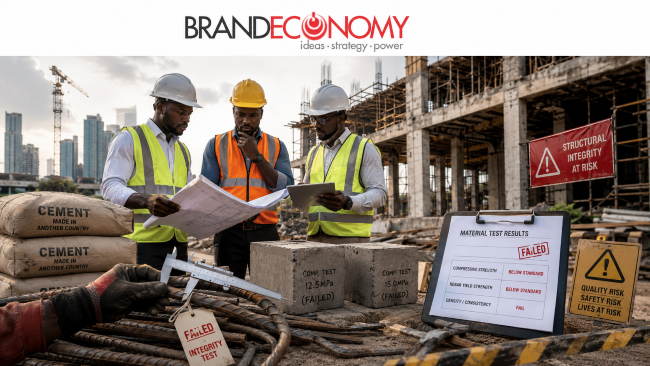 Nigeria’s construction industry is facing a dangerous quality-control problem: materials entering building sites are increasingly failing integrity tests, while weak enforcement, poor supervision and developer shortcuts continue to expose workers, investors and residents to avoidable tragedy.
The Council for the Regulation of Engineering in Nigeria (COREN) has raised a fresh alarm over the growing influx of imported construction materials that fail basic integrity and quality tests, warning that substandard products are becoming a major driver of structural failure and building collapse across the country.




The warning comes in the wake of the tragic collapse of a three-storey building under construction at Durumi 3, near Gudu Market, Abuja, on May 16, which reportedly killed at least five workers and injured several others. The incident has again forced attention onto a recurring national scandal: buildings that should stand for decades are failing before completion, while construction sites increasingly become danger zones for workers and communities.
Speaking in Abuja during an interactive session with media and stakeholders, COREN Registrar, Okorie Uche, said investigations and engineering assessments had shown that several construction materials sold in Nigerian markets, particularly reinforcement bars, do not meet approved engineering specifications.
According to him, the problem is not limited to one category of building input. It reflects a wider failure in the quality-control chain, from importation and market distribution to site testing and professional enforcement.
“We construct works with standard specifications, but when most materials are tested, they often fall below the required strength,” Uche said.
His warning is both technical and economic. In construction, material quality is not cosmetic. It determines whether a building can carry its intended load, withstand stress and protect lives. When reinforcement bars are undersized, concrete strength is compromised or materials are used without testing, the entire structure becomes a gamble.
When a Y-16 Rod Is Really Y-14
One of COREN’s most worrying disclosures concerns the mismatch between labelled and actual reinforcement-bar sizes.
Uche explained that rods presented as Y-16 may, when measured, turn out to be Y-14, while rods labelled 12mm may measure 10mm or less. To the ordinary buyer, such differences may appear minor. To an engineer, they can be fatal.
In reinforced concrete construction, the steel bar is not merely an accessory. It carries tensile forces and works with concrete to give the structure its strength. When the reinforcement used is thinner than specified, the building may still look correct on the surface, but its load-bearing capacity has already been weakened.
That is why COREN’s concern goes beyond market malpractice. It touches on public safety, professional ethics and the credibility of Nigeria’s built environment.
The Durumi Collapse and the Concrete Integrity Question
COREN also disclosed that the concrete used in the collapsed Durumi structure was expected to achieve a strength of 25 newtons per square millimetre, but tested at only 18 newtons per square millimetre.
That gap is significant. It suggests that the material deployed on site failed to meet the design expectation, either because of poor batching, weak inputs, inadequate supervision, improper curing, substandard cement or aggregates, or a combination of technical failures.
In a country where building collapse has become tragically frequent, such findings reinforce a painful truth: many structures are failing not by accident, but by accumulated negligence.
Every collapse usually carries a chain of failure: poor design, weak materials, unqualified supervision, regulatory gaps, developer pressure, inadequate testing and sometimes outright corruption. By the time the building falls, the damage has already been engineered into the structure.
Imported Materials and the Standards Problem
The COREN Registrar identified imported materials from some Asian markets as part of the problem, saying products arriving from countries such as China and Malaysia sometimes fail to meet required standards or are deliberately misrepresented.
The issue is not that all imported construction materials are bad. It is that Nigeria’s control systems must be strong enough to prevent inferior products from entering the market, being relabelled, distributed and used in critical projects.
This is where the Standards Organisation of Nigeria (SON) becomes central. COREN said SON has a critical responsibility to ensure that imported construction materials conform to Nigerian specifications before they are cleared into the market.
But import control alone is not enough. Quality assurance must continue at the point of distribution and at the construction site. A material that has a certificate on paper must still be tested before use, especially in structural works where failure can cost lives.
Developers, Site Testing and the Cost of Shortcuts
COREN also warned that some developers resist proper quality-control procedures and simply offload materials on construction sites without testing.
That culture of shortcutting is one of the most dangerous habits in Nigeria’s property and construction economy. Developers under cost pressure may be tempted to reduce quality, skip tests, hire unqualified personnel or pressure professionals to approve materials they have not verified.
The result is a market where buildings are sometimes priced as assets but constructed as liabilities.
Professional engineers are expected to conduct quality assessment tests on construction materials before deployment. But, as COREN noted, this does not always happen. When tests are skipped, the construction site loses its first line of defence.
In properly regulated markets, no structural material should be used merely because it has arrived on site. It should be verified against design specifications, tested for compliance and documented as part of the project’s quality-control record.
Nigeria must move closer to that discipline.
Building Collapse as an Economic Risk
Building collapse is often treated as a human tragedy — and rightly so. Lives are lost, families are broken and workers are buried under the consequences of decisions they did not make.
But it is also an economic problem.
Every collapse destroys capital, reduces investor confidence, increases insurance risk, raises litigation exposure, weakens mortgage and real estate credibility, and damages the reputation of the construction industry. For a country facing a massive housing deficit, weak construction integrity is a serious development threat.
No serious real estate market can grow sustainably where buyers are unsure whether buildings were properly designed, supervised and tested. No construction sector can attract long-term investment if regulatory enforcement is seen as weak or negotiable.
The integrity of building materials is therefore not only an engineering matter. It is a foundation of market confidence.
COREN’s Funding Challenge
Uche also disclosed that COREN’s regulatory work continues to face financial constraints following its defunding in 2023, adding that the council had yet to receive full operational support for 2026.
This is a troubling disclosure. Nigeria cannot expect strong engineering oversight without adequately funding the institutions responsible for enforcement, inspection, professional discipline and nationwide monitoring.
COREN says it remains committed to expanding regulatory activities across the 36 states and the Federal Capital Territory, but that ambition requires resources. Regulatory institutions cannot police a large and fast-growing construction economy with weak budgets, limited field capacity and fragmented enforcement.
If Nigeria wants safer buildings, it must invest in the regulators that protect the public from unsafe engineering practices.
The Need for a Stronger Built-Environment Coalition
COREN’s call for stronger synergy among regulators and built-environment professionals is timely.
Preventing building collapse requires coordination among:
- COREN, for engineering regulation and professional accountability;
- SON, for material standards and import quality control;
- state building-control agencies, for site approvals and enforcement;
- town-planning authorities, for development permissions;
- professional bodies, for ethical discipline;
- developers, for compliance and funding of proper processes;
- laboratories, for independent material testing;
- and law-enforcement agencies, where negligence becomes criminal.
The problem is not a lack of laws or institutions. The problem is often weak coordination, under-enforcement and the absence of meaningful consequences for those who compromise public safety.
A building collapse should not end with condolence statements and temporary site sealing. It should trigger technical investigation, public reporting, professional sanctions, prosecution where necessary, and reforms that reduce the chances of repetition.
BRANDECONOMY Insight
Nigeria’s Building-Collapse Crisis Is a Quality-Control Emergency
COREN’s warning should be treated as a national development alarm.
Nigeria’s construction industry cannot continue to absorb substandard materials, weak site supervision and casual regulatory breaches as routine business risks. Buildings are not disposable consumer goods. They are long-term assets in which people live, work, learn, trade and worship. When they fail, the consequences are deadly.
The most disturbing aspect of the latest warning is not merely that some materials fail integrity tests. It is that many of these materials still find their way into active construction sites. That means the system is failing at multiple points — import screening, market surveillance, professional testing, developer compliance and regulatory enforcement.
This has serious implications for real estate investment. A property market depends on trust. Buyers assume that the building they are paying for was constructed according to approved standards. Tenants assume that offices, shops and apartments are safe. Banks and insurers assume that financed assets have structural integrity. When that trust is weakened, the entire market becomes more expensive and more fragile.
Nigeria must now treat building integrity as both a public-safety priority and an economic competitiveness issue.
The way forward is clear: enforce material standards at the border, test structural inputs on site, punish professional misconduct, fund regulators properly, and make developers legally accountable for unsafe construction practices.
The cost of doing things properly is always lower than the cost of pulling bodies out of rubble.