
ANAMMCO Urges Nigerians to Patronise Locally Assembled Vehicles, Pledges Quality

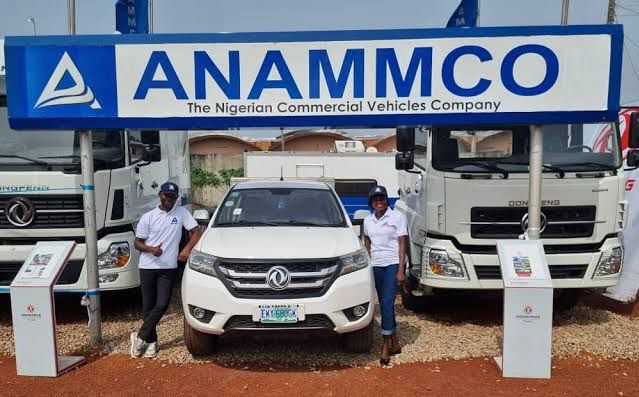 The Anambra Motor Manufacturing Company, better known as ANAMMCO, has urged Nigerians to patronise its vehicles, assuring customers that it remains committed to quality, durability and after-sales support as the country continues to search for a stronger local automotive manufacturing base.
The company’s Sales Manager, Mrs Chinelo Igwe, said in Enugu that ANAMMCO would not compromise on the standard of its products, stressing that the company had built a long reputation for assembling vehicles capable of withstanding Nigeria’s difficult road, logistics and operating conditions.


According to her, ANAMMCO’s current product range, including its Dongfeng heavy-duty trucks and Hilux vehicles, has been designed to offer strength, affordability, fuel efficiency and lower maintenance costs.
She said some of the Dongfeng models include the Dongfeng KR Cargo Chassis and Dongfeng KL Tractor, with load capacities of about 10,000kg and 70,000kg respectively.
“We do free services for the first 5,000 kilometres covered by our vehicles after purchase,” Igwe said, adding that customers are encouraged to stay in close contact with the company after purchase.
She explained that before a vehicle reaches the 5,000km mark, customers are expected to notify the company from around 1,000km so that ANAMMCO’s technical team can inspect the vehicle and ensure optimal performance.
This after-sales support is central to the company’s renewed appeal. In Nigeria’s transport and logistics market, vehicle purchase is only one side of the business equation. Maintenance cost, spare-parts availability, servicing response time and fuel economy often determine whether fleet operators, manufacturers, transporters and government agencies remain loyal to a brand.
Igwe said ANAMMCO’s local assemblage model gives it an advantage in spare-parts availability, with components easier to source and more affordable than some imported alternatives.
She added that the company now operates branches in Lagos and Abuja, in addition to its main office in Enugu, with plans to expand its footprint to other parts of the country.
The company is also investing in human capacity development, particularly through refresher training for drivers. According to Igwe, better-trained drivers are essential to improved vehicle performance, reduced maintenance pressure and longer product life.
She commended the Enugu State Government for its support and patronage, describing such institutional backing as important for the growth of local vehicle assembly and manufacturing.
Why ANAMMCO’s Appeal Matters
ANAMMCO’s renewed call for Nigerian patronage comes at a critical moment for the country’s auto industry.
Nigeria remains heavily dependent on imported vehicles, including used vehicles that dominate the market because of price sensitivity and limited consumer purchasing power. Yet the country’s long-term industrial ambition requires a stronger local automotive ecosystem — one that can assemble, service and eventually manufacture more vehicles domestically.
For local assemblers such as ANAMMCO, the challenge is not merely to produce vehicles. It is to persuade customers that locally assembled vehicles can deliver the three things Nigerian buyers care about most: durability, affordability and dependable after-sales support.
That is why the company’s emphasis on heavy-duty trucks is commercially significant. Nigeria’s logistics, construction, agriculture, distribution and manufacturing sectors depend heavily on reliable commercial vehicles. Trucks move food, cement, fuel, consumer goods, industrial inputs and export-bound commodities. When truck fleets fail, supply chains suffer. When fleet costs rise, prices eventually reach consumers.
A stronger locally supported truck segment can therefore have implications beyond the auto market. It can support logistics efficiency, reduce downtime for businesses and retain more industrial value within the country.
BRANDECONOMY Insight
Local Vehicle Assembly Needs Patronage, Policy Discipline and Proof of Value
ANAMMCO’s message is straightforward: Nigerians should buy what Nigerian industry can produce. But in today’s difficult economy, patriotic appeal alone is no longer enough. Local auto companies must win confidence through product quality, transparent pricing, service reliability and parts availability.
That is why ANAMMCO’s emphasis on free servicing, driver training, low maintenance cost and spare-parts access is important. These are the practical issues that influence fleet-buying decisions. For transporters and logistics companies, a vehicle is not a status item; it is a revenue-generating asset. Every day off the road is lost income.
Nigeria’s auto sector still has enormous potential. The country has a large consumer market, a growing logistics economy, strong demand for commercial vehicles and a clear need to conserve foreign exchange by deepening domestic industrial capacity. But that potential will only be realised if local assemblers, government agencies, financial institutions and large corporate buyers work together.
Government patronage can help. So can auto-financing schemes, fleet-leasing models, tax incentives, stable policy and stronger procurement rules that encourage local content. But the manufacturers must also keep proving that their vehicles can compete on value, not sentiment.
For ANAMMCO, the opportunity is to reposition itself as more than a legacy auto assembler. It can become a serious player in Nigeria’s logistics, construction and commercial mobility economy — if it consistently delivers vehicles that work hard, last long and cost less to maintain.