
APM Terminals’ $600m Apapa Expansion Plan Signals Investor Confidence in Nigeria’s Ports – NSC

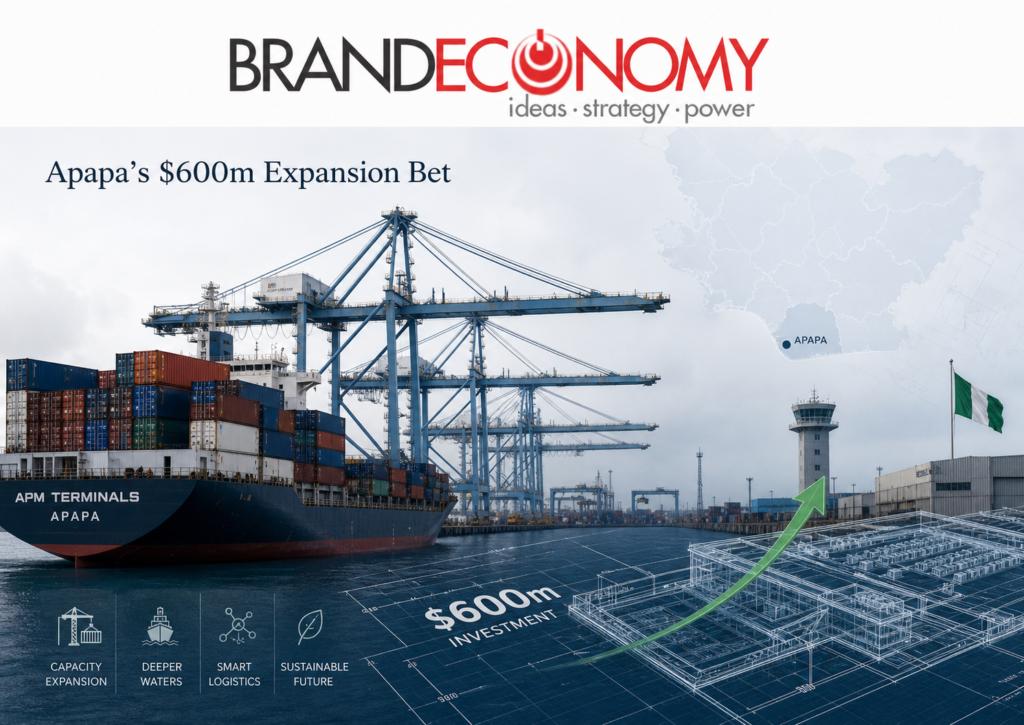 The Nigerian Shippers’ Council has acknowledged APM Terminals Apapa’s proposed $600 million expansion plan, framing it as a signal of renewed investor confidence in Nigeria’s port economy. The proposal comes at a critical moment for the country’s blue economy agenda, as regulators, terminal operators and trade stakeholders push for greater efficiency, deeper digitalisation, stronger export capacity and a more competitive maritime gateway for West and Central Africa.
Nigeria’s maritime sector may be entering another defining investment moment.




The Governing Board of the Nigerian Shippers’ Council has acknowledged a proposed $600 million expansion plan by APM Terminals Apapa, one of the country’s most strategic port operators. The acknowledgement came during a familiarisation visit by the NSC Board to the APM Terminals Apapa facility in Lagos.
For a port economy long burdened by congestion, ageing infrastructure, manual processes and trade imbalance, the proposed investment is more than a corporate expansion plan. It is a test of whether Nigeria can convert private-sector confidence into national logistics competitiveness.
The Chairman of the NSC Board, Dr Ibrahim Shema, said the council remains committed to its role as Nigeria’s port economic regulator and would continue to promote collaboration across the maritime value chain to improve efficiency and competitiveness. His central message was clear: Nigeria’s ports can only become globally competitive when government agencies, regulators and private operators work from the same reform playbook.
Shema also noted that the way sector stakeholders are being engaged reflects a stronger government interest in using maritime trade as a revenue and growth platform. According to him, the proposed investment shows that foreign investors remain willing to commit more resources where they see reform momentum, market opportunity and regulatory engagement.
That confidence matters.
Ports are not merely facilities where vessels berth and cargo is discharged. They are national economic instruments. They determine how fast goods move, how much exporters pay, how competitive manufacturers become, how efficiently customs revenue is collected, and how attractive a country is to regional and global trade flows.
For Nigeria, the Apapa corridor is especially important. It remains one of the busiest maritime gateways in the country and a critical artery for imports, exports, industrial inputs and consumer goods. A major expansion by APM Terminals Apapa could therefore have implications beyond one terminal. It could influence cargo dwell time, vessel turnaround, technology adoption, export handling and investor sentiment across the port system.
The Executive Secretary of the Nigerian Shippers’ Council, Dr Pius Akutah, said the council is strengthening oversight across the sector to improve compliance, innovation and service delivery. He explained that the NSC is monitoring operators to assess performance and support improvements where necessary.
His emphasis on technology-driven processes is significant. The future of port competitiveness will not be determined by quay length alone. It will also depend on digital documentation, automated cargo updates, transparent billing, integrated stakeholder platforms, faster clearance systems and data-led operational planning.
Akutah commended APM Terminals Apapa for operational improvements, noting that export cargo volumes had grown by about 30 percent. That increase is important because Nigeria’s trade structure has long been tilted toward imports. Any sustained improvement in export volumes points to the possibility of a more balanced port economy.
A stronger export base would support foreign-exchange earnings, industrial production, agro-processing, manufacturing and regional trade. It would also align with Nigeria’s aspirations under the African Continental Free Trade Area, where the country’s competitiveness will depend not merely on market size but on the ability to move goods efficiently across borders.
Akutah also pointed to emerging export opportunities in manufacturing and petroleum products, arguing that new industrial capacity could help Nigeria expand its export base. In that context, the proposed $600 million investment by APM Terminals Apapa appears timely. It aligns with the Federal Government’s push to attract foreign direct investment and modernise port infrastructure.
The Managing Director of APM Terminals Apapa, Mr Kamal Alhraishat, said the terminal has embraced digital technology through electronic data interchange systems. These systems replace manual processes with automated platforms that enable stakeholders to exchange documents such as invoices, bills of lading and cargo updates more efficiently.
This is not a minor operational upgrade. In port logistics, paperwork can be as damaging as poor infrastructure. Manual documentation creates delays, errors, rent-seeking opportunities and uncertainty. Electronic data interchange can improve transparency, reduce processing time and strengthen communication across the logistics chain.
Alhraishat said the transition has improved efficiency, transparency and communication. He also reaffirmed the company’s commitment to continued investment in infrastructure and technology to support Nigeria’s trade growth and port competitiveness.
The strategic question now is whether Nigeria can create the policy and operating environment that allows such investment to deliver its full value. Capital alone does not fix ports. Capital must be matched with regulatory clarity, efficient customs processes, stable tariffs, security, reliable road and rail connectivity, strong inland logistics and predictable stakeholder coordination.
For Apapa, APM Terminals Apapa expansion is especially urgent. No terminal can fully optimise if surrounding access roads, traffic systems, customs processes and inter-agency coordination remain weak. A world-class terminal inside a troubled logistics corridor still faces system-wide constraints.
That is why the NSC’s role as port economic regulator is central. The council must balance the interests of terminal operators, shipping lines, importers, exporters, freight forwarders, government agencies and consumers. It must encourage investment while protecting users from inefficiency, excessive costs and poor service delivery.
BRANDECONOMY Insight
APM Terminals’ proposed $600 million expansion plan is a useful vote of confidence in Nigeria’s maritime economy, but it is also a challenge to the country’s reform seriousness.
Nigeria has the cargo base, population, geography and industrial ambition to become a leading maritime hub in West and Central Africa. But the country has too often allowed infrastructure gaps, regulatory overlap, congestion, manual processes and weak logistics coordination to dilute its natural advantage.
The Apapa investment proposal suggests that serious operators still see long-term value in Nigeria. That should encourage policymakers. But investor confidence must be protected by execution.
The government must ensure that port modernisation does not stop at terminal boundaries. Roads, rail links, scanners, customs systems, export desks, truck call-up platforms, inland dry ports and digital documentation must all move together. A port is only as efficient as the weakest link in its logistics chain.
For exporters, the reported 30 per cent increase in export cargo volumes is especially encouraging. Nigeria’s blue economy agenda will remain incomplete if ports continue to serve mainly as import gateways. The real transformation will come when ports become export accelerators for manufactured goods, agro-products, energy derivatives, solid minerals and AfCFTA-bound trade.
APM Terminals Apapa’s digital shift also points in the right direction. Technology is no longer optional in modern port management. The countries that win in maritime trade are those that reduce friction, compress time and make cargo movement predictable.
The lesson is clear: Nigeria does not lack maritime potential. It lacks enough disciplined execution. If the proposed investment is matched by coordinated reforms, Apapa can become a stronger trade engine. If not, another large investment may be trapped inside old bottlenecks.
The opportunity is real. So is the test.