
IMF: AI Could Add 1% to Global Growth as Tech Reshapes the World Economy

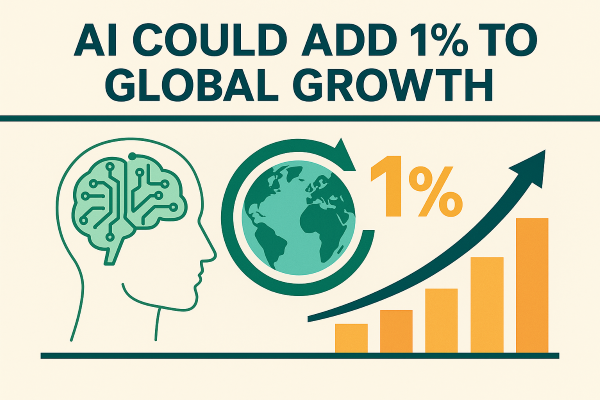
Artificial Intelligence is no longer a buzzword—it is now a macroeconomic force. And according to the International Monetary Fund (IMF), the world is standing at the edge of a historic productivity revolution.
Speaking at the conclusion of the G20 Leaders’ Summit in Johannesburg, IMF Managing Director Kristalina Georgieva delivered a bold projection: AI could add nearly 1 percentage point to global economic growth, reversing a decade of sluggish productivity and unlocking new value across economies.

This is not merely an economic forecast—it is a strategic warning. Nations prepared for AI will prosper. Those unprepared will fall further behind.
AI: The Productivity Engine the Global Economy Has Been Waiting For
Slow productivity growth remains the biggest drag on global GDP expansion.
Georgieva’s message was clear: AI is the strongest tool available to break the stagnation.
According to IMF modelling:
- Advanced economies: up to 60% of jobs may be exposed to AI
- Emerging markets: around 40%
- Low-income countries: roughly 26%
The differential exposure reveals an uncomfortable truth—AI will uplift some economies while widening inequalities in others, unless deliberate action is taken.
“AI is like a tsunami hitting the labour market,” Georgieva warned.
The IMF’s AI Readiness Index: What It Reveals
The IMF now assesses AI preparedness across four critical dimensions:
- Digital Infrastructure – broadband, computing power, connectivity
- Skills & Labour Market Flexibility – talent depth, adaptability, education
- AI Diffusion Across the Economy – enterprise adoption, automation capacity
- Ethics & Regulatory Architecture – governance, safeguards, data protection
The results show deep structural disparities:
- A handful of countries score strongly across all four pillars
- Many middle-income economies excel in one or two areas but fall short on regulation or skills
- Developing nations lag significantly due to infrastructure gaps, talent shortages, and weak regulatory frameworks
This uneven landscape risks creating a global AI divide more severe than the digital divide of the 2000s.
What Governments Must Do Now: IMF’s Policy Blueprint
The IMF is calling for urgent, coordinated reforms to avoid a future where only a fraction of the world benefits from AI acceleration.
1. Invest in Skills
Countries must retool their education systems for:
- Data science
- Machine learning
- Computational thinking
- Continuous re-skilling for displaced workers
2. Strengthen Digital Infrastructure
Power generation, broadband penetration, cloud access and device affordability must become national priorities.
3. Enable Innovation Through Smart Taxation
IMF recommends:
- Incentives for AI R&D
- Tax frameworks that reward digital innovation
- Reduced barriers to knowledge transfer and technology adoption
4. Build Global Ethical and Regulatory Principles
Georgieva called for:
- A United Nations-led global framework
- Standardised AI ethics and safety protocols
- Accountability structures for the public and private sectors
5. Support for Developing Economies
Without direct assistance, low-income countries risk being locked out of the AI-driven economic expansion.
Geopolitical Undercurrents: Why the G20 Summit Matters
The Johannesburg G20 Summit—the first ever hosted in Africa—placed AI, debt sustainability and global inequality at the heart of multilateral dialogue.
Under the theme “Solidarity, Equality and Sustainability”, leaders acknowledged Africa’s vulnerabilities but also its massive potential as the next frontier for AI adoption—provided power infrastructure, skills development and governance improve.
Georgieva emphasised Africa’s debt challenges but also noted that the IMF currently supports:
- 50 financing programmes,
- including 21 in Sub-Saharan Africa,
alongside capacity-building efforts tailored to local economic realities.
BRANDECONOMY Insight: AI Will Reshape Global Wealth—Africa Must Not Miss This Moment
AI is set to become the defining economic differentiator of the next decade.
Countries that invest in skills, infrastructure and governance will attract capital, build competitive industries and create high-quality jobs. Those that delay will face:
- heightened unemployment
- wider inequality
- declining competitiveness
- social instability
Africa in particular stands at a crossroads. With the world’s youngest population and expanding tech ecosystems, AI could unlock unprecedented prosperity—but only with urgent policy reforms, strong public-private partnerships, and continental collaboration.
AI is not just technology.
It is the new global economic currency.
And the race has already begun.