
Youth Must Lead Nigeria’s Renewal, Say Okonjo-Iweala, Sanusi, Kukah at EiE @15

Nigeria’s foremost thinkers in governance, economics, and civic leadership have issued a unified call: the country’s next chapter rests squarely on the shoulders of its young citizens.
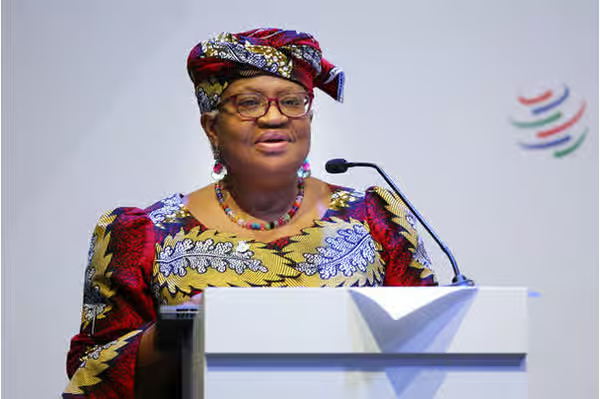
At the 15th anniversary of Enough is Enough Nigeria (EiE)—a movement synonymous with citizen power—leaders including WTO Director-General Dr Ngozi Okonjo-Iweala, Emir of Kano Sanusi Lamido Sanusi, Bishop Matthew Kukah, and former Minister Omobola Johnson challenged young Nigerians to drive reforms, build coalitions and confront the structural failures slowing national progress.



Held in Lagos under the theme “Footprints and Frontlines,” the event doubled as both a celebration of EiE’s nationwide advocacy work and a reminder of Nigeria’s unfinished democratic project.
Okonjo-Iweala: “Do Not Wait. Do Not Ask for Permission.”
Speaking virtually, Dr Ngozi Okonjo-Iweala revisited her famous 2010 charge to young Nigerians—and declared it even more urgent today.
“Do not wait and watch. Do not ask for permission. Get up, organise and make a difference.”
With 70% of Nigerians under age 30, she said, young people hold game-changing demographic power—yet remain constrained by unemployment, weak institutions, and limited access to capital.
Okonjo-Iweala praised EiE’s Office of the Citizen initiative for creating a culture of public accountability and urged youths to deploy technology, numbers, and collective action to demand better governance.
Sanusi: “We Have Done Enough Damage—This Nation Belongs to Us.”
Emir Sanusi’s message was a blunt assessment of Nigeria’s leadership crisis and the complicity embedded in years of silence.
“As citizens, we must remember this nation belongs to us. We have done enough damage. Enough is enough.”
Sanusi warned that Nigeria would remain stuck in a loop of stagnation unless its citizens refuse to treat public office as personal property and instead build a national ethos grounded in merit, fairness, and long-view development.
Kukah: “The Journey to Justice Has No Finish Line.”
Bishop Matthew Kukah commended EiE for 15 years of shaping civic consciousness, urging Nigerians to stay the course in the demanding pursuit of justice.
“Let us remain relentless in building a Nigeria that is just, equitable and bigger than all of us.”
He warned that democracy weakens when citizens retreat from public engagement.
Omobola Johnson: “Nation-Building Requires the Time, Talent and Treasure of Citizens.”
Former Minister Omobola Johnson stressed that national transformation is a shared responsibility—not a spectator sport.
She said development requires collaboration, civic participation, and sacrifice, noting that Nigeria’s challenges cannot be solved by government alone.
EiE: Silence Is Not an Option
EiE’s Executive Director, Yemi Adamolekun, who marked 15 years of advocacy, warned that Nigeria continues to underperform because its citizens are not demanding enough from those in power.
“Whatever industry we work in, if Nigeria becomes a failed state, we will all suffer. Silence is not an option.”
She announced 36-year-old Mrs Ufuoma Nnamdi-Udeh as the new Executive Director, signaling a generational leadership transition within the movement.
The anniversary featured:
- the relaunch of Footprints: Past, Present, Future (2nd Edition),
- a tribute to the late diplomat Dr Christopher Kolade, and
- the premiere of One Voice, Many Echoes, a short film capturing the arc of citizen resistance—from the 1993 protests to #EndSARS.
BRANDECONOMY Insight
Nigeria’s socio-political landscape is entering a decisive window. Three forces converge:
- Demographic Reality: With one of the world’s youngest populations, Nigeria’s economic destiny is inseparable from youth agency.
- Governance Gaps: From fiscal distress to social fragility, institutions are stretched—creating a vacuum only organised civic power can fill.
- Global Context: Nations that successfully leveraged demographic youth waves—Indonesia, India, South Korea—did so through activism, innovation, and civic reforms led by the young.
EiE’s 15-year journey shows that civic movements can shift national conversations. But the next phase will require a strategic evolution—from protests to policy coalitions, legal innovations, sustained civic education, and digital mobilisation at scale.
Nigeria’s youth are no longer bystanders. They are the counterweight, the constituency of the future, and the key to unlocking a more just, productive, and globally competitive nation.