

 Democratic victories across Congress and key governorships in the midterm elections have exposed the limits of presidential influence. Trump’s record, Obama’s mobilisation and voters’ living costs offer Nigeria a demanding lesson in electoral accountability ahead of 2027.
BRANDECONOMY | Special Analysis | November 4, 2026



American voters have sharply curtailed President Donald Trump’s political freedom, handing Democrats control of both chambers of Congress and a series of important governorships in a midterm election shaped by financial hardship and demands for stronger oversight. reuters.com
For Nigeria, approaching another general election, the result raises a question with immediate economic relevance: can citizens use the ballot to change how power manages their money?
That question reaches beyond party competition. It concerns who approves borrowing, scrutinises taxation, investigates public expenditure and insists that economic reforms produce benefits households can recognise.
The Democratic gains in the midterms demonstrate how an electorate can withdraw support from a governing party between presidential contests. They also expose the weakness of a political brand whose promises have become difficult to reconcile with everyday experience.
The results discussed here reflect reported race calls and published tallies available on November 4. Counting continued in some contests; media projections are distinct from official certification.
A Democratic advance across several centres of power
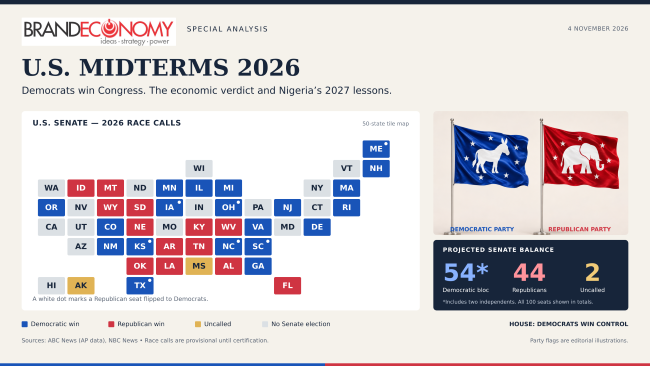
Ballotpedia’s tally at 1.30am Eastern Standard Time on November 4 recorded Democrats with at least 231 House seats and a Democratic-aligned Senate majority of 54 seats against 44 Republicans, with outstanding races. These were snapshots, rather than final national totals. The Senate figure includes two independents. Ballotpedia News
The Senate gains reached seven states Trump carried in 2024, illustrating how quickly a presidential coalition can become vulnerable in a different election.
| State | Democratic winner | Republican opponent defeated |
| Iowa | Josh Turek | Ashley Hinson |
| Kansas | Adam Hamilton | Roger Marshall |
| Maine | Troy Jackson | Susan Collins |
| North Carolina | Roy Cooper | Michael Whatley |
| Ohio | Sherrod Brown | Jon Husted |
| South Carolina | Annie Andrews | Darline Graham |
| Texas | James Talarico | Ken Paxton |
Brown’s victory came in a special election for the remainder of the Senate term previously held by Vice President JD Vance. Ballotpedia News
The governorship results widened the change beyond Washington. Democratic victories included five Republican-held offices:
| State | Democratic winner | Republican opponent defeated |
| Georgia | Keisha Lance Bottoms | Rick Jackson |
| Iowa | Rob Sand | Zach Lahn |
| Ohio | Amy Acton | Vivek Ramaswamy |
| Texas | Gina Hinojosa | Greg Abbott |
| Nevada | Aaron Ford | Joe Lombardo |
Bottoms, a former Atlanta mayor, became the first Black woman elected governor in the United States. Hinojosa became Texas’s first Latina governor, while Ford became Nevada’s first Black governor. Their victories combined representational milestones with changes in who will direct state budgets and public services. investing.com
The breadth of the Democratic advance matters because power in a federal system is distributed. Congressional control affects national legislation and oversight; governors shape state administration, investment conditions and service delivery.
The household economy challenged the political message
The Associated Press Voter Poll identified living costs and dissatisfaction with Trump’s economic policies as central features of the result. About two-thirds of voters said his policies had worsened the economy. Around seven in ten wanted Congress to exercise stronger checks on the president. toronto.citynews.ca
These findings suggest that financial pressure and demands for accountability reinforced one another. A household struggling with bills has a direct interest in whether public officials can explain their choices and be challenged over the consequences.
An election survey records voters’ experiences and judgments. It cannot isolate the precise contribution of each policy to prices, or prove that one campaign event changed a particular seat. Turnout, candidate quality and local conditions also shaped the contests.
The economic lesson remains substantial. Governments can publish indicators showing progress while households continue to experience insecurity. Lower inflation, for example, means prices are rising more slowly; it does not automatically restore the purchasing power lost during earlier increases.
For Nigeria, reform communication must confront that distinction. Citizens assess improvement through the food they can buy, the reliability of electricity and transport, the cost of school fees, and the stability of their livelihoods.
Policy credibility grows when those experiences support the official account.
Trump made his influence part of the test
Trump’s role operated through his record in office, his effort to make the election a judgment on his leadership, and his interventions in Republican candidate selection.
Reuters reported that he encouraged supporters to imagine he was on the ballot. That approach tied Republican candidates closely to a president facing discontent over prices, tariffs and the war in Iran.
Several prominent candidates he backed lost, including Ken Paxton in Texas and Darline Graham in South Carolina. Reuters’ analysis also identified defeats for his preferred Senate candidates in North Carolina and Michigan. investing.com
The result exposed a limit to endorsements: influence over a party’s nomination process does not guarantee acceptance by the wider electorate. A candidate still needs credibility beyond the president’s most committed supporters.
Responsibility should nevertheless be assessed across the party. Local campaigns, organisational decisions and candidates’ own weaknesses contributed to the outcome. Trump’s influence was significant, but the available evidence does not make him the sole cause of every Republican defeat.
For political organisations, concentrating a party’s identity around one personality can make it harder for candidates to distinguish their own records when the national leader loses public confidence.
Obama added money and campaign reach
Barack Obama’s contribution was different. As a former president, he supplied fundraising capacity, endorsements, advertising and appearances alongside Democratic candidates.
ABC News reported on October 9 that his office put his fundraising for party committees that cycle at $13.6 million. His interventions included advertisements and endorsement videos for candidates such as Troy Jackson in Maine and Keisha Lance Bottoms in Georgia. ABC News
On October 24, he campaigned in Cleveland with Sherrod Brown and Amy Acton, then appeared in Detroit with Senate candidate Abdul El-Sayed and gubernatorial candidate Jocelyn Benson. His campaign activity also extended to Georgia, including support for Jon Ossoff and Bottoms. news4jax.com
Such appearances can attract coverage, support fundraising and encourage participation. The election results, however, do not establish how many votes Obama personally delivered. His contribution should be understood alongside candidate performance, campaign organisation and dissatisfaction with the administration.
His post-election message also placed responsibility on the winners. Reuters reported that he urged Democrats to use their gains to deliver practical solutions and meet public expectations. kathmandupost.com
Former leaders can help a party communicate and organise. Their stature becomes more useful when it supports candidates who can withstand scrutiny on their own merits.
Congressional control creates leverage with limits
The incoming Congress’s term begins on January 3, 2027. Democratic control will give the party substantial influence over legislation, committee investigations and the terms of federal spending negotiations. The Senate majority will also be able to block presidential nominees.
Hakeem Jeffries is positioned to become House speaker and, if elected by the chamber, its first Black speaker. His elevation still requires the House’s formal vote. senate.gov
Democrats’ victory leaves Trump in the White House with presidential powers, including the veto. Most legislation still faces the Senate’s usual 60-vote threshold to end debate, unless an exception applies. A majority therefore creates negotiating power without guaranteeing enactment of the party’s programme. senate.gov
Nor does congressional control automatically remove a president. The House can approve impeachment charges by a simple majority, while Senate conviction requires two-thirds of members present. senate.gov
For investors, these distinctions determine what an election result can change. More oversight may expose administrative failings. Divided government may also produce difficult budget negotiations or delays. The economic outcome will depend on how both sides use their powers.
What Nigerian businesses and investors should watch
Nigeria’s exposure will emerge through specific US policy decisions. A change in congressional control does not, by itself, establish a direction for the naira, oil prices or Nigerian equities.
Trade is one channel. Exporters and investors should watch enacted legislation, tariff decisions and the legal powers available to the executive. Congressional criticism of a trade policy is different from its amendment or repeal.
Energy and geopolitics are another. Decisions concerning Iran, sanctions and security can affect expectations about global supply and shipping. For Nigeria, a rise in crude prices may support export receipts while increasing pressure on fuel costs and inflation. Production volumes, import costs and exchange-rate conditions determine how those effects are distributed.
US appropriations and programme decisions also matter for organisations working in health, humanitarian assistance and development. Commitments must be assessed against authorised funding and actual implementation.
Businesses with dollar financing should monitor fiscal negotiations, US interest-rate expectations and global appetite for risk. Electoral commentary is a poor substitute for examining the decisions that affect financing costs and cash flow.
The practical response is to maintain alternative assumptions for trade, energy and funding exposure, then update them as policies change. Claims of an automatic Nigerian market windfall would outrun the evidence.
The brand lesson is the distance between promise and experience
Political brands depend on expectations. Promises of prosperity create a standard against which voters assess the government’s performance.
When lived experience falls short, stronger messaging alone has limited power to restore confidence. The same principle applies to businesses. A bank advertising ease of service must deliver reliable transactions; a consumer brand promising value must make that value visible in price, quality or usefulness.
Governments face an additional obligation because citizens cannot simply stop consuming public security, infrastructure or economic policy. Elections give them a mechanism to change the managers of those services.
Democrats now inherit their own credibility test. A vote against the governing party can create an opportunity for the opposition, but lasting trust requires evidence that the new officeholders use their authority competently.
Nigeria’s 2027 test begins with citizens’ ability to choose
INEC’s current calendar schedules presidential and National Assembly elections for January 16, 2027, followed by governorship and state assembly elections on February 6. The two dates matter because accountability extends across the offices that approve and administer public spending. Independent National Electoral Commission
The American outcome does not predict a Nigerian opposition victory. Electoral systems, party structures and political conditions differ. Its relevance lies in the standards Nigerians should be able to demand from their own process.
Make economic promises measurable
Parties should explain how their programmes affect disposable income, employment, electricity and the cost of doing business. They should identify funding sources, implementation responsibilities and dates for reporting progress.
An opposition proposal deserves the same scrutiny as an incumbent’s claim of achievement. The cost of a promise and the competence required to deliver it belong in the campaign debate.
Treat legislative elections as decisions about public money
The US result illustrates why voters should assess legislators independently. Nigeria’s National Assembly approves budgets and scrutinises borrowing; state assemblies perform comparable functions within their jurisdictions.
Candidates should be questioned about committee work, expenditure oversight and their willingness to demand explanations from the executive. A legislature’s value depends partly on the quality of the questions it asks before public money is committed.
Require election technology to produce verifiable evidence
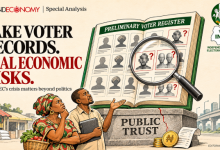
INEC should demonstrate the integrity of the voter register, reliable accreditation and a result process that observers and parties can verify. Testing, access controls, incident records and published explanations of corrections should support those assurances.
AI can assist legitimate administrative work and also create convincing false material. A synthetic portrait or fabricated result sheet must be assessed against original records and documented procedures. Technology becomes useful to public trust when its operation can be checked.
For citizens, the practical safeguards include checking registration through official channels, protecting identity details and reporting discrepancies through documented processes. Political participation should not require surrendering control of personal data.
Explain counting and resolve disputes with evidence
The US Election Assistance Commission distinguishes election-night reporting from canvassing and certification. Officials reconcile records and complete the relevant checks before results become official. U.S. Election Assistance Commission
Nigeria should apply its own law rigorously and explain each stage clearly. Media organisations should distinguish reported figures from formally declared outcomes. Parties alleging irregularities should preserve records and specify the discrepancy; election authorities should respond with information that can be examined.
Public confidence requires officials to account for delays and errors. Speed is valuable when the figures remain accurate and traceable.
Make public service answerable after election day
The accountability test continues through budget implementation, procurement and service delivery. Civil society, professional groups and the media should track the commitments made during campaigns against spending and measurable results.
For business associations, that means demanding predictable rules and competitive procurement while resisting dependence on privileged political access. A stronger commercial environment gives firms reasons to invest that survive a change of administration.
BRANDECONOMY Insight
Electoral credibility contributes to economic confidence because it gives citizens a peaceful means to impose consequences for failure. That possibility changes the incentives surrounding taxation, borrowing and public expenditure.
A credible election cannot guarantee sound economic management. It can strengthen the pressure on officeholders to explain decisions, correct mistakes and produce results before seeking another mandate.
The Democratic sweep therefore carries a demanding message for Nigerian incumbents and challengers alike. Public frustration can weaken a governing party; converting that frustration into durable confidence requires capable candidates and credible plans.
For INEC and the wider institutions responsible for the election, the obligation is to protect the process through which citizens make that assessment. For the winners, accountability begins when the campaign ends.
Takeaways
- Democrats’ gains across Congress and key governorships reflected economic dissatisfaction and demands for stronger oversight.
- Trump’s endorsements faced limits; Obama supplied substantial campaign support, although his separate effect cannot be quantified from the results.
- Congressional control creates legislative and investigative power within constitutional constraints.
- Nigerian businesses should track specific US policy changes rather than assume an immediate market effect.
- Nigeria’s 2027 elections should test economic claims through credible voting, verifiable results and continuing scrutiny of public spending.