

Spotify Sets One-Billion-User Ambition, Pivots to AI Audio Ecosystem

 The streaming giant is no longer positioning itself as a music app alone. Its next phase is an AI-powered audio ecosystem built around personalisation, creator monetisation, social listening, audiobooks, podcasts and premium fan experiences.
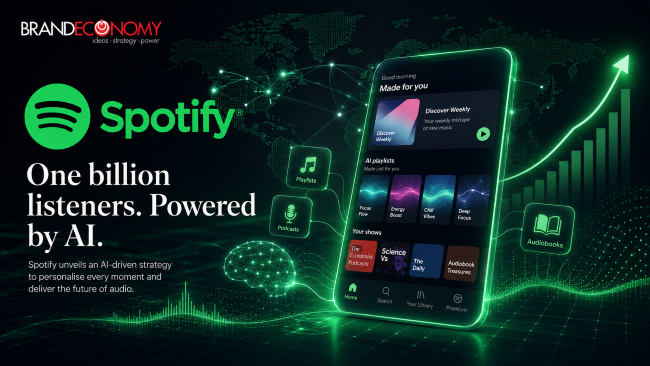 The streaming giant is no longer positioning itself as a music app alone. Its next phase is an AI-powered audio ecosystem built around personalisation, creator monetisation, social listening, audiobooks, podcasts and
 Spotify has unveiled an ambitious long-term growth strategy anchored on artificial intelligence, premium subscription expansion, deeper personalisation and new creator-economy tools, as the company targets a future subscriber base of one billion users globally.
The roadmap was presented during Spotify’s 2026 Investor Day in New York, an event that coincided with the company’s 20th anniversary and offered investors a clearer view of how the Swedish audio platform intends to defend its lead in streaming while expanding into a broader media and entertainment ecosystem. Spotify said the event focused on its next era of growth, product innovation, financial ambition and the role of AI in reshaping how users discover, remix, share and pay for audio experiences.




Spotify currently operates in 184 markets and reported 761 million monthly active users and 293 million Premium subscribers in the first quarter of 2026, alongside revenue of €4.5 billion, gross margin of 33 per cent and operating income of €715 million.
For a company that began as a disruption against music piracy, the new ambition is larger: Spotify wants to become the operating system of global audio culture — music, podcasts, audiobooks, creator subscriptions, fan engagement and AI-assisted entertainment.
From Streaming Platform to AI-Powered Media Engine
Spotify’s Co-Chief Executive Officers, Alex Norström and Gustav Söderström, positioned the company’s next phase around what they described as the generative era of media — a period in which users will not merely listen to content, but increasingly shape, remix, share and personalise it.
Norström said Spotify remains focused on helping artists, creators and authors connect with audiences and build careers, while Söderström stressed that the company’s data advantage is central to its future. Spotify’s personalisation engine is built on vast user signals across music, podcasts and audiobooks, giving it the ability to interpret taste, context and intent at scale.
The strategic implication is important. Spotify is moving beyond conventional recommendation systems into more dynamic AI-generated experiences. Instead of simply suggesting the next song, the company wants to generate listening journeys, playlists, interactions and creator tools that feel more personally relevant and socially engaging.
This is where AI becomes more than a technology feature. It becomes Spotify’s defensive moat.
The Premium Push: Monetising the Most Engaged Users
Spotify’s one-billion-subscriber ambition will depend not only on adding users, but on converting more of them into paying customers and extracting more value from highly engaged fans.
At Investor Day, executives outlined growth pillars that include deeper monetisation of premium users, expansion of social and interactive listening, AI-powered personalisation and a user-experience philosophy the company calls “Time Well Spent.” The idea is to build experiences that feel meaningful rather than merely addictive — a positioning that gives Spotify a more emotionally intelligent brand language in a digital economy increasingly criticised for compulsive engagement loops.
Spotify’s premium opportunity is global. In mature markets such as Sweden, paid penetration is already approaching very high levels. In growth markets such as India, subscriber expansion has accelerated sharply since the company’s previous Investor Day. The lesson is clear: localisation, pricing discipline, mobile-first design and cultural relevance will determine whether Spotify can convert scale into sustainable subscription depth.
AI Covers, Remixes and the Copyright Question
The most commercially significant announcement may be Spotify’s landmark licensing agreement with Universal Music Group and Universal Music Publishing Group, which will allow Premium users to create AI-generated covers and remixes using catalogues from participating artists and songwriters. Spotify said the feature will launch as a paid add-on and will include rights-holder protections around consent, credit and compensation.
This matters because generative AI has created one of the most disruptive questions in music: who owns value when machines can imitate, remix or transform creative works at scale?
Spotify’s answer is to bring AI-generated fan creativity inside a licensed framework rather than allowing it to grow entirely outside the formal music economy. The strategy could open a new revenue stream for artists and songwriters while reducing the risk of uncontrolled AI exploitation.
It is also a shrewd business move. If fans want to remix songs, recreate covers or personalise music experiences, Spotify would rather own that behaviour, regulate it, monetise it and share revenue with rights holders than watch it migrate to competing AI platforms.
A New Social Layer for Listening
Spotify also emphasised the growing importance of collaborative and social listening. Features such as Jam and collaborative playlists are now used by tens of millions of users, reflecting a shift from audio as a solitary experience to audio as a shared digital ritual.
That is commercially valuable. Social listening increases engagement, strengthens network effects and gives Spotify more ways to make its platform feel culturally alive. Music has always been social; technology is now turning that social behaviour into product architecture.
For younger listeners especially, discovery is not only about algorithms. It is about friends, fandoms, group identity and cultural participation. Spotify’s challenge is to combine machine intelligence with human connection — the algorithm and the community, not one against the other.
Podcasts and Audiobooks Become Serious Growth Engines
Spotify’s strategy is also built on diversification beyond music. Executives highlighted stronger performance in podcasts and audiobooks, with podcasting now entering its second consecutive year of profitability on the platform.
The company also announced new tools that will allow creators to offer direct subscriptions to loyal listeners, deepening its role in creator monetisation. In audiobooks, Spotify said its Premium catalogue has expanded rapidly, with listening hours rising strongly between 2024 and 2025 and younger users driving much of the growth.
This diversification matters because music streaming alone has margin constraints due to licensing costs. Podcasts, audiobooks, creator subscriptions and fan tools offer Spotify a wider monetisation base and more ways to increase average revenue per user.
The company is essentially building a broader audio marketplace — part entertainment platform, part creator economy, part subscription business, part AI media engine.
AI Inside the Company, Not Just the Product
Spotify also disclosed that AI is becoming central to its internal engineering culture. Niklas Gustavsson, Vice President of Engineering, said the overwhelming majority of Spotify engineers use AI tools weekly and that a large share of code contributions are AI-assisted.
That is not a minor operational detail. If AI helps Spotify reduce product-development cycles, test features faster and deploy improvements more efficiently, then the technology supports both user experience and cost discipline.
In the streaming wars, speed matters. Platforms that learn faster, personalise better and ship product updates more efficiently can preserve advantage even when competitors copy visible features.
BRANDECONOMY Insight
Spotify Is Building the Next Entertainment Moat Around Taste, Trust and AI
Spotify’s new strategy reveals a company trying to solve the central paradox of the AI era: how to make technology feel more personal without making creativity feel less human.
Its advantage is taste data. With hundreds of millions of users across music, podcasts and audiobooks, Spotify understands listening behaviour at a scale few rivals can match. That gives it a powerful foundation for AI-driven personalisation.
But the more important issue is trust. AI in music is controversial because it touches identity, voice, ownership and compensation. By striking licensing deals with Universal Music, Spotify is attempting to build a rights-respecting model for fan-made AI covers and remixes. That could become a template for the industry if artists, publishers and labels believe the value flows back fairly.
For Africa and Nigeria’s creative economy, the implications are significant. AI will increasingly reshape music discovery, fan engagement, catalogue monetisation and global reach. Artists who understand these tools early may find new ways to deepen audience relationships. But rights protection, fair royalties and cultural authenticity will matter more than ever.
Spotify’s race to one billion subscribers is therefore not only a technology story. It is a brand story, a creator-economy story and a battle for the future of global audio culture.
The company that wins may not simply be the one with the best algorithm. It may be the one that makes listeners feel understood, creators feel protected and fans feel more connected to the music they love.