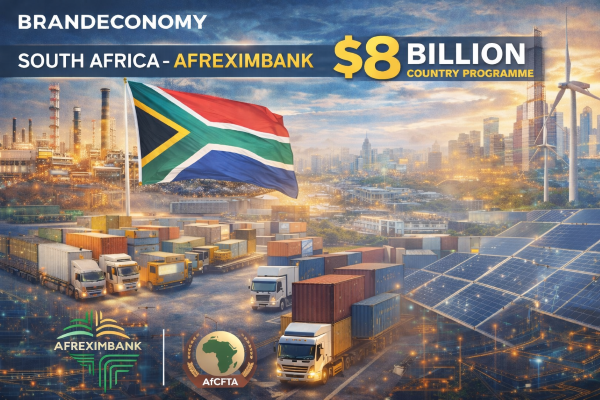
 South Africa’s formal accession to the Establishment Agreement of African Export-Import Bank (Afreximbank) marks a strategic re-anchoring of Africa’s most industrialised economy within the continent’s financial sovereignty project. This is not a symbolic membership. It is a capital-backed commitment—headlined by an $8 billion country programme—to rewire trade, industrial capacity, and regional value chains at a time when global finance is fragmenting along geopolitical lines.
By becoming the 54th participating state, South Africa completes Afreximbank’s continental coverage and moves from the periphery of Africa’s trade-finance architecture to its operational core.




Why This Matters Now
The global trading system is undergoing a structural reset. Protectionism is rising, supply chains are regionalising, and access to affordable, counter-cyclical finance is becoming a competitive advantage. For Africa, this moment demands institutions that can intermediate trade, finance industrialisation, and absorb shocks without excessive dependence on external capital.
South Africa’s accession answers that call. It signals a strategic choice to deepen Africa-first trade and finance solutions, leveraging Afreximbank’s balance sheet, instruments, and pan-African reach to protect and expand export competitiveness.
Context: From Industrial Powerhouse to Continental Anchor
South Africa already sits at the centre of Africa’s intra-continental trade—accounting for 19.1% of total intra-African trade in 2024. Yet scale alone has not insulated the economy from external volatility, logistics constraints, or capital market cycles.
Afreximbank’s model—combining trade finance, guarantees, project preparation, and industrial park financing—offers a platform to convert South Africa’s industrial depth into continent-wide supply-chain leadership, particularly under the AfCFTA framework.
Accession also aligns South Africa’s National Development Plan 2030 and industrial policy with a continental financier purpose-built to support manufacturing, export diversification, and regional integration.
Core Analysis: What the $8bn Country Programme Unlocks
1. Industrial Deepening with Balance-Sheet Support
The $8bn programme targets sectors where South Africa has scale advantages—manufacturing, energy, mining, healthcare, and financial services—while crowding in private capital through guarantees and structured finance.
2. Regional Value Chains, Not Just Exports
Afreximbank’s emphasis on regional supply chains reframes South Africa’s export strategy from shipping finished goods to building production networks across Africa—lowering costs, reducing FX risk, and expanding markets.
3. Trade Finance as Industrial Policy
Instruments such as the Afreximbank Guarantee Programme, project and asset-based finance, and conventional trade finance convert liquidity into policy outcomes—speeding up trade flows while de-risking investment.
4. Inclusion Through Transformation Capital
A notable early focus is reinforcing South Africa’s Transformation Fund, aimed at expanding access to capital for black-owned businesses historically excluded from the economy—aligning inclusion with growth.
Leadership Signals and Institutional Alignment
Afreximbank President George Elombi described South Africa’s entry as a “decisive step” toward uniting around continental economic interests—bringing the country into the heart of Afreximbank’s vision to change the structure of Africa’s trade.
South Africa’s President Cyril Ramaphosa framed the accession as a milestone in Africa’s economic integration—underscoring the intent to operationalise the programme rapidly across trade and industrial clusters.
The partnership is further anchored by coordination with the Department of Trade, Industry and Competition under Parks Tau, aligning national priorities with Afreximbank’s financing toolkit.
Implications for Business, Markets, and Policy
For business: Improved access to trade finance, guarantees, and project preparation reduces execution risk and lowers the cost of capital for exporters and manufacturers.
For investors: Afreximbank’s involvement enhances bankability, particularly for cross-border projects and regional value chains.
For policymakers: The partnership provides an execution platform—turning industrial policy into financed projects rather than aspirational plans.
For Africa: Continental coverage strengthens Afreximbank’s role as a systemic stabiliser—supporting trade flows during external shocks and advancing AfCFTA objectives.
Forward Outlook: From Accession to Acceleration
Beyond the initial $8bn, Afreximbank’s project pipeline in South Africa already exceeds $6bn, spanning healthcare, energy, manufacturing, mining, and financial services. Joint initiatives—including the South Africa–Africa Trade and Investment Promotion Programme (SATIPP), financing for industrial parks and SEZs, and support for creative and cultural industries—signal breadth as well as depth.
Execution will be the differentiator. If projects move swiftly from approval to ground-breaking, South Africa could emerge as the principal industrial hub of a continental trade network, backed by Africa’s most consequential trade-finance institution.
BRANDECONOMY INSIGHT
South Africa’s accession to Afreximbank is best understood as a sovereignty upgrade. In a fragmented global system, countries with strong regional finance institutions gain strategic autonomy—over trade routes, industrial priorities, and crisis response.
The $8bn country programme is not merely capital; it is coordination power. It aligns finance with policy, industry with trade, and national ambition with continental scale. For Africa, this is how integration moves from treaty text to transaction flow.
If sustained, this partnership could redefine how African industrial power is financed—less as a collection of national projects, more as a connected continental economy. In today’s world, that shift is not optional; it is strategic.