
SON Takes MANCAP Register Online: Can Digital Verification Defeat Nigeria’s Fake-Product Economy?

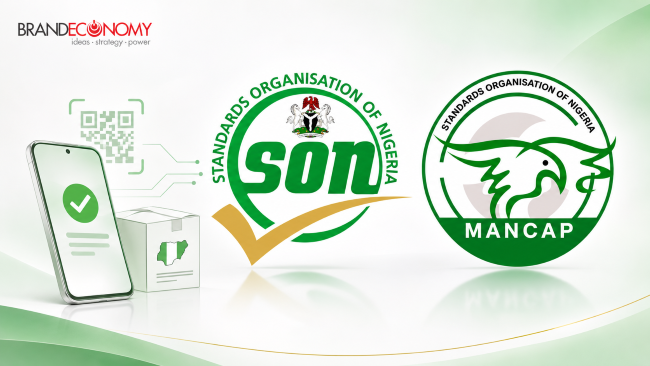 The Standards Organisation of Nigeria has moved its register of locally manufactured products certified under the Mandatory Conformity Assessment Programme (MANCAP) online, opening a potentially important front in the country’s long-running battle against substandard and counterfeit goods.
SON Director-General, Dr Ifeanyi Okeke, announced the development at Creative Africa Nexus Weekend 2026, held at the Wole Soyinka Centre for Culture and Creative Arts, formerly the National Theatre, in Iganmu, Lagos.



The four-day CANEX gathering, running from November 5 to 8, brings together entrepreneurs, creatives, investors and policymakers from Africa, the Caribbean and the wider diaspora. Its strong commercial and cultural focus made it a strategically relevant platform for SON’s outreach to manufacturers and consumers. National Theatre
The online register is intended to help buyers verify whether locally manufactured products have passed SON’s conformity-assessment process before making purchases. It should also make it easier to identify manufacturers legitimately authorised to display the MANCAP certification mark.
For consumers routinely confronted by imitation products, misleading labels and questionable quality claims, the development promises a greater measure of transparency. For responsible manufacturers, it offers something equally valuable: visible regulatory validation in a marketplace where compliant and non-compliant products often compete on the same shelf.
“This development will help consumers find and buy quality products easily,” Okeke said, adding that public access to the register should reward businesses that have invested in meeting approved standards.
From compliance document to market signal
Introduced in 2006, MANCAP is SON’s mandatory certification programme for products manufactured in Nigeria. It seeks to establish that locally produced goods conform to applicable Nigerian Industrial Standards before being distributed or exported.
That distinction is important. MANCAP applies principally to locally manufactured products, while the Standards Organisation of Nigeria Conformity Assessment Programme—SONCAP—addresses regulated imports.
Certification ordinarily involves an application, factory inspection, product sampling, laboratory testing, evaluation of quality-control processes and approval where requirements have been satisfied.
At the SON exhibition stand, officials explained these processes to manufacturers, exhibitors and visitors. Participants were also shown how to recognise approved certification marks and report suspicious or potentially counterfeit goods.
Small businesses received guidance on progressing from application and testing to formal approval.
For micro, small and medium-sized enterprises, this assistance can be commercially significant. Many Nigerian businesses do not necessarily lack product ideas or market ambition; they lack the technical documentation, testing capacity and procedural knowledge required to move from informal production into recognised retail and export channels.
Certification can provide a bridge between those worlds.
A trust infrastructure for Made-in-Nigeria
Nigeria’s consumer market suffers from a profound information problem. Buyers frequently cannot distinguish between a genuinely certified product, an imitation and an item bearing an unauthorised conformity mark.
That uncertainty damages every participant except the dishonest operator.
Consumers face safety and financial risks. Compliant manufacturers incur costs that counterfeiters avoid. Retailers face reputational exposure, while regulators must police a vast market with limited personnel.
A credible online register can reduce this information gap by turning certification into a publicly verifiable market signal.
It can also strengthen the Federal Government’s Nigeria First policy. Preferential support for locally made goods will have limited credibility if nationality becomes a substitute for quality. Nigerian products must be competitive because they are well designed, safe, reliable and consistently manufactured—not simply because they were produced within the country.
National preference without enforceable standards risks protecting mediocrity. National preference supported by transparent certification can build industrial capacity.
Creative businesses also need standards
SON’s presence at CANEX reflects an important change in how industrial regulation should be understood.
Africa’s creative economy is not limited to music, film and performance. It includes fashion, cosmetics, jewellery, furniture, crafts, packaged food, leather goods, children’s products, digital devices and lifestyle merchandise.
Many of these products combine cultural expression with physical manufacturing. Once they enter formal retail chains or export markets, creativity alone is insufficient. Buyers, distributors and regulators will demand evidence of safety, labelling accuracy, material quality and production consistency.
Okeke said SON’s participation was designed to take the quality message directly to manufacturers, small businesses and consumers.
The central proposition is sound: standards should not be presented only as punitive rules. They should function as commercial infrastructure that helps good products win trust, enter larger markets and command stronger pricing.
Market and investor implications
An accessible certification database could help banks, distributors, supermarkets, e-commerce platforms and institutional buyers conduct basic due diligence before financing, stocking or procuring products.
It could also reduce the reputational risk confronting investors considering Nigerian consumer-goods and manufacturing businesses.
Under the African Continental Free Trade Area, conformity will become even more commercially important. Nigerian firms cannot build sustainable continental brands if their products face repeated testing, rejection or distrust in destination markets.
MANCAP certification is not an automatic passport into every foreign jurisdiction. Exporters must still satisfy the technical and regulatory requirements of destination markets. But a credible domestic conformity system creates a stronger starting point.
The digital test SON must now pass
Uploading a list is not the same as building an effective verification system.
The register must be searchable, mobile-friendly and continuously updated. Consumers should be able to search by product, manufacturer, certification number, category and validity status.
Expired, suspended and withdrawn certificates should be clearly identified. Each product record should contain enough information to prevent a counterfeiter from simply copying a legitimate certification number onto another package.
The stronger model would connect the register to QR codes or secure serial identifiers, allowing a shopper to scan a product and confirm its status instantly.
SON should also establish measurable service standards for processing applications, testing products, resolving disputes and investigating reported misuse of its marks.
Without enforcement, digital transparency may expose violations without stopping them.
Brand implications
For manufacturers, MANCAP should become more than a regulatory mark. It should serve as a trust asset.
Brands that meet the requirements should communicate certification responsibly across packaging, retail displays and digital channels. They should explain what was assessed without exaggerating certification into a blanket endorsement of every corporate claim.
For SON, the online register represents a brand promise of its own: that certification records are accurate, accessible and current.
If consumers repeatedly search for products and encounter incomplete information, broken records or outdated approvals, the platform could weaken rather than strengthen confidence.
BRANDECONOMY Insight
SON’s online MANCAP register can become a powerful piece of Nigeria’s consumer-protection and industrial-development infrastructure—but only if it evolves from a static directory into a trusted verification ecosystem.
The real measure of success will not be the number of certificates uploaded. It will be whether consumers check before buying, retailers screen products before stocking them, banks use certification in credit decisions and enforcement teams act swiftly against counterfeit marks.
Nigeria cannot build globally respected brands while quality remains difficult to verify.
By making certification visible, SON has taken an important first step. The next challenge is to make verification simple, enforcement credible and compliance commercially rewarding.