Playtek Technologies Targets Africa’s Mobile Advertising Gap with Q3 2026 4-Product Rollout
Challenges Global Platforms with Africa-Focused Solutions

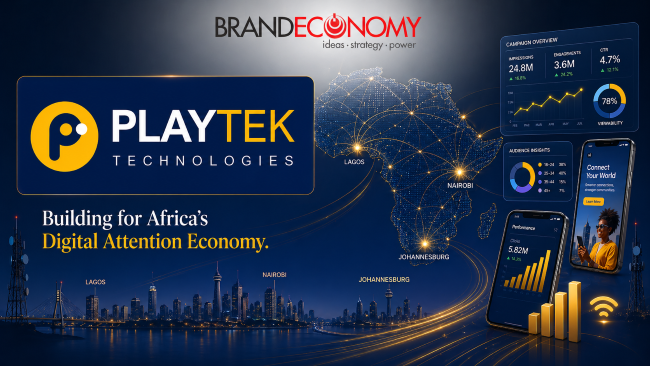 Playtek Technologies Limited plans to launch four new products across Africa in Q3 2026, targeting mobile advertising, mobile commerce, data exchange and telecoms intelligence. With Nigeria as its primary entry market, the company is positioning itself as a specialist African technology player built to solve the continent’s most persistent digital-advertising gaps.
A New Technology Push into Africa’s Digital Economy
Playtek Technologies Limited is preparing a bold entry into Africa’s mobile advertising and digital-commerce ecosystem with the planned launch of four new products at the start of the third quarter of 2026.




The company says the launch will mark one of the most significant African market entries by a specialist telecoms technology company focused on mobile advertising, campaign accountability, mobile commerce and telecoms intelligence. Its ambition is clear: to compete in a market currently shaped by global platforms that were largely designed outside Africa and later adapted to the continent.
Playtek’s argument is both commercial and strategic. Africa’s digital advertising market is expanding rapidly, but the infrastructure required to make it more accountable, measurable, locally relevant and operator-led remains underdeveloped. For a continent where mobile phones are not just communication devices but primary tools for commerce, entertainment, payments, identity and information, the opportunity is substantial.
The company’s Q3 2026 rollout will be pan-African in scope, with Nigeria serving as the main launch market before expansion to other African territories.
Four Products, One Ecosystem Strategy
Playtek Technologies says its four products will address some of the most expensive and persistent weaknesses in the continent’s mobile advertising and digital-commerce chain.
The first area is mobile commerce. In African markets, commerce increasingly starts on mobile devices, but the journey from interest to payment is often broken by friction. Any platform that improves conversion, reduces drop-off and aligns with local telecom and payment behaviour could create significant value.
The second area is campaign reach and accountability. As advertising budgets grow, advertisers will demand stronger evidence of delivery, audience quality, engagement and return on investment. Verified reach is becoming more important than raw impressions.
The third area is data and signal exchange between telecom operators and partners. Operators hold valuable audience and network signals, but these must be structured, governed and commercialised responsibly. If done properly, this can create new revenue lines while preserving trust and regulatory compliance.
The fourth area is telecoms intelligence and analytics. As competition intensifies, operators and advertisers need better insight into market behaviour, campaign outcomes, user patterns and commercial opportunities.
Playtek says the products are designed to work with existing operator infrastructure, not against it. They can be deployed individually or as a fully integrated stack, depending on partner needs.
The CEO’s Case for Africa-Built Technology
Osa Umweni, Chief Executive Officer of Playtek Technologies Limited, frames the launch as a response to a major infrastructure gap in Africa’s digital economy:
“Africa’s mobile advertising ecosystem is one of the most exciting and most underserved markets in the world. The infrastructure that should be unlocking its full potential simply does not exist yet at the level it needs to. We have spent the last three years studying this market from the inside, understanding exactly where the gaps are and why the existing tools fall short. What we are bringing to market in July 2026 is our answer to that — built from scratch, built for Africa, and built to operate at a scale that this market deserves. This is not a regional experiment. This is a platform-grade play for one of the fastest-growing digital economies on the planet, and we are ready.”
The statement reveals the scale of Playtek’s ambition. The company is not positioning the launch as a small local experiment. It is presenting it as a platform-grade intervention in one of the world’s most rapidly expanding digital regions.
A Market Growing Faster Than Its Infrastructure
The timing is deliberate. Africa’s advertising economy is entering a decisive phase. Total advertising spend across the continent was estimated at $9.74 billion in 2024, with digital channels accounting for approximately $4.4 billion. By 2028, digital advertising spend is expected to reach about $5.8 billion.
Nigeria is central to this shift. As Africa’s most populous country and one of its most dynamic entertainment, media and technology markets, Nigeria recorded digital advertising spend of more than $1.3 billion in 2024, with projected compound annual growth of 7.8 per cent.
The broader continental trend is even more compelling. By 2029, digital is forecast to account for 59 per cent of all advertising spend across Africa. Mobile is expected to drive more than half of all digital advertising revenue on the continent by 2028, while programmatic advertising is projected to represent about 80 per cent of digital advertising revenue within the same period.
These numbers point to a market no longer waiting to happen. Africa’s digital advertising economy is already scaling. But scale without reliable infrastructure can produce inefficiency. More advertisers are spending money, yet many still lack the tools to verify reach, measure real engagement, reduce waste and convert attention into commerce.
That is the gap Playtek Technologies wants to close.
The Problem: Africa’s Digital Ad Market Still Leaks Value
Behind the impressive growth figures lies a more complicated reality.
Advertisers are investing heavily in campaigns but often struggle to confirm whether real, opted-in subscribers were reached. Mobile commerce remains fragmented, with many users dropping off before completing transactions. Telecom operators sit at the centre of the digital ecosystem—with subscriber relationships, network infrastructure and mass audience reach—but do not always have the tools to fully monetise those assets.
Meanwhile, the intelligence layer that should guide decision-making is often weak, inaccessible or unreliable. Campaign data can be scattered. Audience signals may be poorly structured. Operators, advertisers and digital platforms frequently operate in silos.
This is why Playtek’s entry matters. The company is not merely offering another advertising tool. It is presenting itself as a builder of market infrastructure: systems that help operators, advertisers and platforms transact more intelligently, measure more accurately and retain more value within the African digital economy.
The global platforms currently dominant in digital advertising have helped expand the market, but they were not built around Africa’s telecom realities, regulatory conditions, payment behaviours or subscriber patterns. Playtek’s proposition is that Africa deserves tools designed from the beginning for Africa.
A Challenge to the Status Quo
Playtek Technologies is entering a market where global technology platforms currently set many of the rules. They dominate advertising flows, command advertiser relationships and control large parts of the measurement and distribution ecosystem.
But Africa’s digital future may not be defined by imported systems alone. The continent’s telecom operators, fintech platforms, media companies, ad-tech firms and commerce platforms are increasingly seeking ways to capture more value from local users, local data and local infrastructure.
Playtek’s challenge to the status quo is therefore direct. It wants to give African operators, advertisers and digital platforms the tools to compete and transact on their own terms. This does not mean global platforms will disappear. They will remain powerful. But it does suggest that the next phase of Africa’s digital advertising market could become more locally grounded, more telecom-linked and more accountable.
Nigeria is a logical starting point. It has scale, mobile depth, digital culture, entertainment influence, fintech adoption, SME intensity and one of Africa’s most competitive advertising markets. It also has the complexity that makes it a useful testing ground. Products that work in Nigeria often have a stronger chance of travelling across Africa.
BRANDECONOMY Insight
Playtek’s planned launch should be read as more than a product announcement. It is part of a bigger question: who will own the infrastructure of Africa’s digital attention economy?
Africa’s users are online. Its brands are spending. Its operators have reach. Its consumers are mobile-first. Yet too much value is still captured through platforms and systems built outside the realities of African markets.
Playtek is attempting to enter this gap with products focused on mobile commerce, verified reach, operator data exchange and telecoms intelligence. If it succeeds, it could help shift more value toward African operators, advertisers and platforms.
For telecom operators, the opportunity is new monetisation from assets they already possess. For advertisers, it is stronger accountability and better campaign efficiency. For digital platforms, it is deeper integration with African mobile behaviour. For the wider economy, it is another step toward building local digital infrastructure rather than merely consuming imported technology.
The burden of proof, however, is high. Playtek must demonstrate product reliability, partner adoption, regulatory responsibility, data protection, measurable advertiser value and scalability across different African markets.
The opportunity is real. So is the execution test. By July 2026, Playtek’s claim—that Africa’s digital advertising ecosystem is ready for tools built from scratch for its own realities—will begin its market examination.