NRS, DigiTax Deepen Support as Nigerian Businesses Adopt E-Invoicing Framework

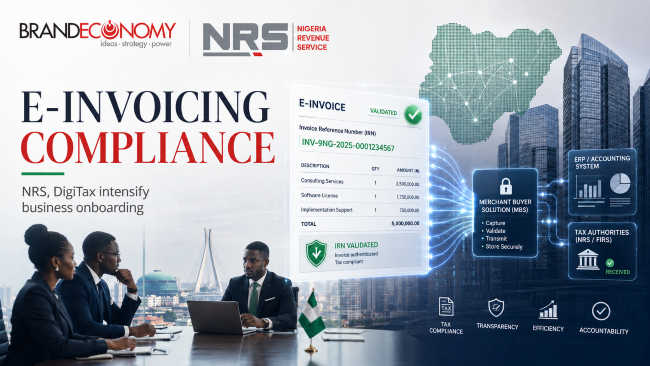 Nigeria’s e-invoicing framework is entering a decisive implementation phase, with large taxpayers already under compliance requirements and medium-sized businesses expected to onboard later this year. For companies, the message is clear: invoicing is no longer just an internal finance process; it is becoming a regulated digital tax trail.
Nigeria’s tax digitalisation agenda is gaining momentum as the Nigeria Revenue Service, NRS, DigiTax and other technical partners intensify support for businesses adopting the country’s new e-invoicing framework.




According to a statement by DigiTax Nigeria in Lagos, compliance obligations have already taken effect for large taxpayers, while medium taxpayers are expected to be brought into the system later in the year.
The framework requires businesses to transmit invoices through the Merchant Buyer Solution, MBS, platform for validation and processing. Each transaction receives an Invoice Reference Number, IRN, which serves as proof of compliance under the new arrangement.
The move places Nigeria within a wider global shift towards real-time or near-real-time tax reporting, where tax authorities increasingly use digital systems to close revenue leakages, improve VAT visibility, reduce invoice fraud and make compliance more transparent.
Compliance Clock
According to an implementation notice issued by the NRS on February 17, businesses that have not completed integration risk non-compliance measures when enforcement begins.
The notice also warned that buyers transacting with non-compliant suppliers may lose the ability to claim Value Added Tax, VAT, input credits on such transactions.
That is one of the most important business implications of the new framework.
E-invoicing compliance will not affect only the company issuing an invoice. It may also affect the buyer’s tax position, procurement decisions, vendor selection and finance controls.
In practical terms, large businesses may increasingly prefer suppliers that have completed onboarding, integrated their systems and can generate compliant IRNs.
Early Progress
The NRS said significant progress had been recorded since the platform became operational.
According to the Service, most large taxpayers have been onboarded, with many already transmitting invoice data successfully through the MBS platform.
Speaking at a post-go-live workshop for large taxpayers in Lagos, Mr Mohammed Bawa, Project Manager of the National E-Invoicing Project, described the initiative as a collaborative reform.
“Everyone benefits from the bigger picture; taxpayers, banks, service providers and government,” Bawa said.
The collaborative framing is important because e-invoicing is not simply a tax-authority project. It affects enterprise resource planning systems, procurement workflows, banks, payment reconciliation, auditors, tax advisers, system integrators, software vendors and finance teams.
DigiTax’s Role
DigiTax, an NRS-accredited e-invoicing platform developed by Namiri Technology Ltd, is one of the service providers supporting business integration.
The company is accredited as both a System Integrator and an Access Point Provider under the framework.
Its platform connects with existing finance systems and enterprise resource planning, ERP, platforms to validate and transmit invoices through the MBS platform.
This is critical for businesses that cannot afford to run tax compliance manually at scale.
For large companies with thousands of transactions, multiple branches, different product lines and complex procurement systems, e-invoicing compliance will require careful integration with accounting, ERP, billing, procurement and reporting tools.
Business Questions
Mr Olumide Akinsola, Country Director of DigiTax Nigeria, said the company would host an E-Invoicing Compliance Breakfast on July 14, 2026, at The Wheatbaker Hotel, Lagos.
He said the event would bring together NRS officials, technical experts and finance leaders to discuss integration, onboarding and compliance strategy.
According to him, businesses are seeking practical answers on implementation timelines, integration requirements and the implications for finance and ERP systems.
Companies are also worried about the risk of trading with suppliers that have not completed onboarding.
“We designed the Compliance Breakfast to connect businesses directly with regulators and technical partners behind the platform,” Akinsola said.
He added that the event would also unveil original research titled “The State of E-Invoicing Readiness in Nigeria.”
The whitepaper, according to him, examines compliance patterns in comparable African markets and projects Nigeria’s readiness landscape.
The Technology Backbone
The technical architecture behind the NRS e-invoicing system was developed by D’Accubin Technology.
The company built the platform using Peppol BIS Billing 3.0 structured invoice standards, implemented through Universal Business Language, UBL.
At an earlier stakeholders’ session in Lagos, Mr Sadiq Arogundade, Chief Executive Officer of D’Accubin Technology, said the system was built locally and aligned with global best practice.
“We built this in house, ensuring it aligns with global best practices,” Arogundade said.
That point matters for Nigeria’s digital public infrastructure story.
Tax modernisation increasingly depends on technical standards that can support interoperability, data integrity, audit trails, secure transmission and scalable adoption across many industries.
Medium Taxpayers Next
The NRS said the framework will be extended to medium taxpayers with annual turnover of between ₦1 billion and ₦5 billion.
This next phase could be more challenging.
Large taxpayers typically have stronger finance teams, ERP systems, tax advisers and technology budgets. Medium-sized companies may face more pressure around integration cost, internal capacity, staff training and vendor readiness.
That makes technical support and clear communication essential.
If medium taxpayers are to onboard smoothly, they will need practical guidance, realistic timelines, accessible integration options and clear rules on enforcement.
Market Implications
Nigeria’s e-invoicing framework could reshape business-to-business transactions in several ways.
First, it will make tax compliance more visible. Transactions that once sat largely inside company systems will now move into a validated digital reporting environment.
Second, it will improve VAT monitoring. With compliant invoices linked to IRNs, tax authorities can better track input and output VAT claims.
Third, it could reduce disputes. Standardised invoice data can help improve reconciliation between buyers, suppliers, tax teams and auditors.
Fourth, it will raise the compliance premium. Businesses that onboard early may become more attractive vendors to large corporates that do not want VAT-credit exposure.
Fifth, it could create new demand for tax technology, ERP integration, compliance advisory and digital finance solutions.
Brand Implications
For businesses, e-invoicing compliance is becoming a trust signal.
A supplier that can issue validated invoices, provide IRNs and align with buyer compliance requirements will look more credible than one struggling to meet basic digital tax standards.
For NRS, the brand test is execution. The Service must show that the framework improves compliance without creating unnecessary friction for legitimate businesses.
For DigiTax and other accredited providers, the brand opportunity lies in reliability. Businesses will choose partners that make integration easier, reduce operational risk and provide responsive support.
In the new tax environment, compliance experience becomes part of brand experience.
Investor Relevance
Investors should watch this reform closely because it touches revenue assurance, corporate governance and business transparency.
Companies with weak invoicing controls may face higher tax risk, procurement risk and audit exposure. Companies with strong digital compliance systems may benefit from cleaner records, faster reconciliation and stronger financial discipline.
The reform also creates opportunities in:
- tax technology
- ERP integration
- compliance advisory
- audit and assurance
- data analytics
- digital payments
- cybersecurity
- business-process automation
For listed companies and large corporates, e-invoicing readiness may increasingly become part of operational resilience.
What Businesses Should Do Now
Companies should not treat the NRS e-invoicing as a last-minute IT project.
They should:
- confirm whether they fall under large or medium taxpayer requirements
- assess ERP and billing-system readiness
- choose accredited integration partners where needed
- train finance, tax, procurement and sales teams
- update vendor onboarding processes
- review VAT input-credit exposure
- communicate requirements to suppliers
- test invoice transmission before enforcement pressure begins
- maintain clean audit trails
The companies that prepare early will avoid disruption. Those that delay may face compliance risk, customer friction and avoidable tax exposure.
BRANDECONOMY Insight
Nigeria’s e-invoicing framework marks a major shift in the relationship between tax administration and business operations.
The invoice is no longer just a commercial document. It is becoming a regulated digital signal: proof of transaction, proof of tax visibility and proof of compliance.
For government, the opportunity is improved revenue transparency.
For businesses, the challenge is integration, discipline and readiness.
For technology providers, the NRS e-invoicing opportunity is to make compliance seamless.
The winners will be companies that understand the new reality early: in a digital tax economy, clean invoicing is not paperwork. It is strategy.