

No Bank Credit, No Industrial Revolution: MAN Warns as Factory Lending Drops 22.5%, Manufacturers Lose ₦1.92 Trillion Credit

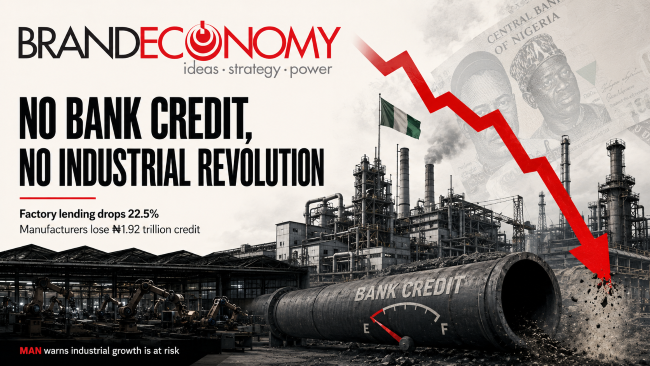 Nigeria’s manufacturing sector lost ₦1.92 trillion in commercial-bank credit in 2025, according to the Manufacturers Association of Nigeria, exposing a widening gap between the country’s industrial ambitions and the financing reality confronting its factories.
Nigeria cannot build an industrial revolution by starving its factories of capital.




That is the essential warning from the Manufacturers Association of Nigeria, MAN, after commercial-bank credit to the manufacturing sector reportedly fell by ₦1.92 trillion in 2025.
According to the association, lending to manufacturers declined from ₦8.53 trillion in December 2024 to ₦6.61 trillion by December 2025, representing a 22.5 per cent year-on-year contraction.
The figures are troubling not simply because of the size of the decline, but because of what they reveal about the structure of Nigeria’s economy. At a time when government is talking up local production, import substitution, export competitiveness, value addition and job creation, the sector expected to deliver those goals is finding it harder to access the capital required to produce.
For many factories, the problem is no longer whether there is demand for locally made goods. The larger question is whether they can finance raw materials, machinery, energy, logistics, product development and working capital at borrowing costs that allow them to remain competitive.
MAN Director-General Segun Ajayi-Kadir has warned that unless Nigeria urgently repairs the financing pipeline to industry, the dream of a production-led economy could remain trapped in policy documents rather than translated into factory floors.
The ₦1.92 Trillion Warning Signal
Manufacturing is one of the most capital-intensive parts of the economy.
Unlike trading, financial intermediation or short-cycle commerce, production often requires long-term financing. A factory needs to buy and maintain equipment, secure raw materials, keep inventory, train workers, power machines, manage supply chains and survive the gap between production and customer payment.
That makes credit not just desirable, but foundational.
When commercial-bank lending to manufacturers falls sharply, the consequences are immediate. Companies defer expansion. Production lines are delayed. Equipment upgrades are postponed. Working capital becomes scarce. Capacity utilisation drops. Jobs become vulnerable. Consumer prices rise.
The 22.5 per cent reduction in credit therefore represents more than a decline in sectoral financing. It is a warning that the Nigerian economy may be allocating scarce capital away from the productive base required to create sustainable wealth.
MAN argues that manufacturing was among the sectors most affected by the credit contraction, trailing oil and gas and the financial-services sector in access to commercial-bank funding.
That contrast is important.
Nigeria cannot diversify its economy by speaking about factories while directing a larger share of available finance towards sectors that do not necessarily create the same depth of value addition, employment, technology transfer and export capacity.
Industrial Policy Meets Financial Reality
Nigeria’s new industrial-policy direction has placed manufacturing at the heart of the country’s economic future.
The ambition is compelling: deepen value chains, expand domestic production, reduce import dependence, support small and medium-sized businesses, create jobs and make Nigeria more competitive within African and global markets.
But industrial policy without industrial finance is little more than aspiration.
Factories do not respond to policy declarations alone. They respond to electricity costs, foreign-exchange availability, logistics efficiency, market demand, tax burdens, regulatory certainty and access to reasonably priced capital.
The biggest contradiction facing Nigerian manufacturing today is that government wants producers to expand, while the cost of borrowing can make expansion commercially dangerous.
For many manufacturers, commercial interest rates are simply too high for long-cycle investment. A business that borrows at elevated rates must either absorb the cost, pass it on to consumers, reduce investment, cut production or seek cheaper alternatives outside the formal credit system.
Each option weakens industrial competitiveness.
A company that cannot finance modern machinery will struggle to improve productivity. A company that cannot finance inventory will struggle to meet demand. A company that cannot finance energy solutions will remain exposed to erratic power costs. A company that cannot finance research, packaging and distribution will lose ground to imported brands.
That is why affordable credit is not a technical banking issue. It is one of the building blocks of national competitiveness.
Why Banks Are Pulling Back
The commercial banks’ perspective must also be understood.
Banks operate in a difficult environment. They must protect deposits, manage liquidity, control non-performing loans, meet capital requirements and lend in a market affected by inflation, currency volatility, high operating costs and uncertain demand.
Manufacturers can appear risky because their businesses are exposed to multiple shocks at once.
They often rely on imported machinery or inputs. They face energy and logistics costs that can change quickly. Their customers may have weak purchasing power. Their cash cycles are longer. Their repayment capacity can be affected by currency movements, policy changes, import competition and disruptions in supply chains.
In such circumstances, banks naturally gravitate towards shorter-tenor opportunities, heavily collateralised borrowers and sectors with faster cash conversion.
But that commercial logic creates a development problem.
An economy cannot become industrial by financing only the easiest transactions. It needs institutions capable of taking a longer view of productive investment.
Nigeria therefore requires a stronger partnership between commercial banks, development-finance institutions, government guarantee schemes and private investors.
The goal should not be to force banks into reckless lending. It should be to reduce the risk and cost of lending to productive businesses.
The Missing Middle: Patient Capital for Factories
Nigeria’s manufacturers are not asking for free money. They are asking for finance that reflects the life cycle of industrial investment.
A factory that installs a new production line cannot repay the loan within a few months. A company building a processing plant needs time to commission equipment, train workers, secure supply contracts and develop markets.
That is why manufacturing requires patient capital.
Patient capital means longer tenors, manageable interest rates, transparent eligibility requirements, predictable disbursement processes and repayment schedules that reflect the cash-generating capacity of the business.
It can come through development banks, structured commercial-bank lending, credit guarantees, leasing arrangements, export-credit support, supply-chain finance and blended-finance structures.
Nigeria has some of these tools. The problem is scale, speed and access.
The Bank of Industry has remained a key source of development finance for businesses, including manufacturers. However, the gap between the financing needs of the country’s industrial base and available concessionary funds remains substantial.
MAN’s concern over the delayed ₦1 trillion Manufacturing Stabilisation Fund speaks directly to this gap.
The proposed fund was expected to help manufacturers manage the pressure created by currency depreciation, rising energy costs and more expensive borrowing. But manufacturers say the delay in operationalising the programme has left many businesses to face severe financing conditions without the promised support.
This is where public policy is most tested: not in the announcement, but in the implementation.
What the Credit Squeeze Means for Inflation
The effect of weak manufacturing finance will eventually be felt by consumers.
When factories struggle to obtain working capital, they buy fewer raw materials, reduce production runs and operate below capacity. When they borrow at high rates, they price financing costs into their products. When they cannot invest in energy efficiency or local sourcing, costs rise further.
The result is supply-side inflation.
Consumers may see higher prices for food, pharmaceuticals, household goods, building materials, plastics, beverages, textiles, personal-care products and other manufactured goods.
The lesson is simple: industrial finance affects the cost of living.
A factory with access to affordable capital can buy inputs in bulk, maintain steady production, invest in efficiency and offer more predictable prices. A factory trapped by expensive debt is more likely to cut output or transfer costs to consumers.
Nigeria’s inflation challenge is therefore not only about money supply or consumer demand. It is also about the cost of producing goods locally.
The Jobs Question
Manufacturing remains one of the most important channels through which Nigeria can create productive employment at scale.
Factories employ machine operators, technicians, engineers, sales teams, quality-control staff, warehouse workers, transporters, accountants, marketers, distributors and suppliers. They also stimulate activity across agriculture, logistics, packaging, construction, retail and services.
When factory credit declines, employment growth becomes harder.
The immediate impact may not always be mass layoffs. Often, it begins with delayed recruitment, reduced shifts, slower wage growth, suspended expansion plans and greater reliance on casual labour.
Over time, however, a sustained financing drought can force businesses to scale down or leave the market entirely.
That would be particularly damaging for a country with a young population and urgent need for employment opportunities beyond the public sector, informal trade and low-productivity services.
The Foreign-Exchange Consequence
A weaker manufacturing sector also increases pressure on foreign exchange.
Every product Nigeria does not produce competitively at home is likely to be imported. Every local factory that cannot secure raw materials, finance equipment or maintain production creates more room for imported substitutes.
This weakens the country’s import-substitution agenda and sustains demand for foreign currency.
Nigeria’s long-term foreign-exchange stability will depend partly on its ability to produce more of what it consumes and export more of what it produces.
That requires factories with reliable access to financing.
Industrial credit is therefore not just a banking issue. It is an exchange-rate issue, a trade issue, a jobs issue and an inflation issue.
What Should Change Now
MAN has called for measures that would restore access to affordable industrial finance.
Its recommendations include lower benchmark interest rates over the coming quarters, incentives for banks that lend meaningfully to manufacturers, a stronger capital base for the Bank of Industry, expansion of intervention funds and the immediate release of the ₦1 trillion Manufacturing Stabilisation Fund.
The association has also proposed a government-backed loan-guarantee scheme for small and medium-sized manufacturers, as well as an arrangement that could allow qualified producers to access funds at a more sustainable interest rate.
These proposals deserve serious attention.
A well-designed credit guarantee can reduce banks’ fear of lending to smaller manufacturers. A stronger BOI can provide longer-tenor capital. Better incentives can encourage banks to build specialist manufacturing-finance desks. Faster processing can ensure that factories access funds before business conditions deteriorate further.
The key is to avoid another cycle of bold policy announcements followed by slow or opaque implementation.
Market Implications for Banks
For Nigeria’s banks, the manufacturing-credit challenge presents both a risk and an opportunity.
The risk is that excessive concentration in short-term or non-productive lending may limit their role in the country’s long-term growth story.
The opportunity is to build better financing models for industry.
Banks that develop expertise in supply-chain finance, receivables finance, equipment leasing, inventory-backed lending, export finance, distributor finance and renewable-energy financing for factories may find a major growth market.
The future of manufacturing finance does not have to depend entirely on traditional collateral-based lending.
Banks can work with manufacturers, insurers, development-finance institutions and government guarantee programmes to structure finance around real cash flows and supply chains.
The institutions that understand productive-sector risk best will be positioned to support the next generation of Nigerian industrial champions.
Brand Implications: Local Production Needs Stronger Brands
The credit crisis is also a brand issue.
Nigerian manufacturers can only build durable brands when they can guarantee quality, consistency, product availability, innovation and competitive pricing.
A brand cannot grow when production is unstable. It cannot earn loyalty when shelves are empty. It cannot invest in packaging, advertising, distribution and customer experience when all available cash is consumed by interest payments and energy costs.
Affordable financing helps brands grow.
It allows companies to improve quality assurance, develop new products, strengthen distribution, invest in marketing and compete more effectively against imported alternatives.
The future of “Made in Nigeria” will depend not only on patriotism, but on whether local brands can offer consumers real value.
Investor Relevance
For investors, the manufacturing-credit decline should be read as both a warning sign and a screening tool.
Companies with strong operating cash flows, manageable debt, local sourcing capacity, efficient energy systems and credible pricing power may be better able to withstand high financing costs.
Companies with large short-term debt obligations, heavy reliance on imported inputs, weak margins or poor working-capital discipline may face greater pressure.
Investors should pay close attention to finance costs, debt maturity profiles, capacity utilisation, inventory levels, energy expenditure, foreign-exchange exposure and the ability of companies to pass costs through without losing customers.
The central investment question is whether policy intervention will arrive early enough to prevent the credit squeeze from becoming a deeper industrial slowdown.
BRANDECONOMY Insight
Nigeria’s manufacturing problem is not that the country lacks entrepreneurs, consumers or market opportunities.
It is that the economy still makes it easier to trade than to produce.
The ₦1.92 trillion decline in factory credit is a warning that industrial policy and financial policy are pulling in different directions.
Nigeria cannot build an industrial revolution with costly capital, delayed intervention funds and banks that see factories mainly as risk rather than opportunity.
The path forward is clear: make credit cheaper, longer-term, transparent and targeted at productive enterprises. Strengthen the Bank of Industry. Activate guarantees. Support local value chains. Reward banks that finance factories. Ensure that announced intervention funds reach the businesses they were designed to support.
No bank credit, no industrial revolution.
And without an industrial revolution, Nigeria’s hopes for jobs, lower imports, stronger brands, export growth and durable prosperity will remain difficult to achieve.