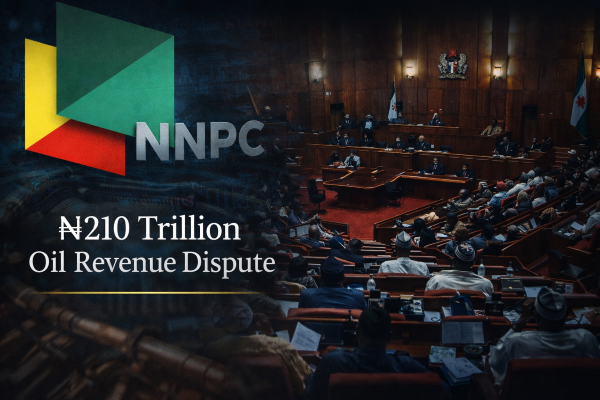
 Nigeria’s oil sector has entered a moment of profound institutional scrutiny. At the centre of the unfolding confrontation is a staggering ₦210 trillion in disputed financial entries linked to the Nigerian National Petroleum Company Limited (NNPCL)—a figure large enough to trigger political shockwaves across Abuja and reignite long-standing questions about transparency in the management of Africa’s largest petroleum economy.
What began as an audit query has rapidly evolved into one of the most consequential legislative probes in recent Nigerian history. The Senate’s Public Accounts Committee has demanded explanations from both former and current executives of the national oil company, warning that failure to appear before lawmakers could lead to compulsory attendance through arrest warrants.




Beyond the dramatic rhetoric lies a deeper institutional issue: whether Nigeria’s oversight framework can effectively monitor the financial operations of its most strategic economic enterprise.
The Origins of the ₦210 Trillion Controversy
The controversy emerged from audit queries relating to NNPCL’s financial statements covering 2017 to 2023, a period that coincided with major transitions in Nigeria’s petroleum governance structure.
Two large accounting figures have triggered alarm among lawmakers:
- ₦103 trillion linked to cumulative expenditure attributed to joint venture cash calls.
- ₦107 trillion recorded as receivables related to subsidy financing arrangements.
Combined, the figures total approximately ₦210 trillion, an amount that dwarfs many years of Nigeria’s federal budgets.
According to Senator Aliyu Wadada, Chairman of the Senate Public Accounts Committee, the explanations provided so far have not adequately clarified how the figures were derived or reconciled within the national oil company’s accounts.
“NNPCL must account for these figures,” said Senator Aliyu Wadada, Chairman, Senate Public Accounts Committee.
“The combined amount of ₦210 trillion cannot simply be netted off without proper reconciliation.”
For lawmakers, the issue extends far beyond accounting semantics. It touches on public confidence in the governance of Nigeria’s most critical revenue-generating institution.
At the centre of the storm is the former Group Chief Executive Officer of the NNPCL, Mele Kyari, along with other senior officials who managed the national oil company during the period under investigation.
Thisday reports that the Senate committee, chaired by Senator Aliyu Wadada, has summoned Kyari, the former Chief Financial Officer, Umar Ajia Isa, and the former Group General Manager of the National Petroleum Investment Management Services (NAPIMS), Dr. Bala Wunti.
They are expected to appear before the panel alongside the current leadership of the company to respond to audit queries covering the period between 2017 and 2023.
The lawmakers’ message has been unequivocal: failure to honour the invitation could lead to compulsory appearance through an arrest warrant. Wadada, speaking after a committee meeting in Abuja, made it clear that the Senate would not tolerate any attempt to evade accountability.
He said, “The NNPCL should refund the sum of N210 trillion, being the combined figure of N103 trillion and N107 trillion, which were not properly accounted for as contained in the audit reports. NNPCL should and must account for the two figures.”
Wadada was even more emphatic in detailing the committee’s concerns.
He said, “Five billion naira is also lingering on NNPCL. In this day and age, who will comprehend such a figure to be expended just to change the name of NNPC incorporation from NNPC to NNPCL? Five billion naira !
“NNPCL should refund the sum of N210 trillion being the combined sum of N103 trillion and N107 trillion which were not properly explained to the committee as the aggregate sum cannot be netted off in tandem with accounting principles.
“Mele Kyari as the Group Managing Director, Umar Ajia as the Chief Financial Officer and Bala Wunti as the then GGM NAPIMS should and must appear before the committee and be led by the present management with the entire body of the external auditors that served within the period under review that put together this report.
“NNPC paid N2.9 billion for incorporation expenses from petroleum product proceeds while NAPIMS charged another N2.9 billion against crude oil revenue for the same purpose.
“This resulted in a combined total amount of N5.9 billion being expended for incorporation by NNPCL just to change the name from NNPC to NNPCL, which is unacceptable and rejected.”
The committee’s insistence reflects the gravity of the situation. The amount in question dwarfs many of Nigeria’s annual budgets and represents a significant portion of the country’s cumulative public revenues over several years.
The Key Officials Under Legislative Scrutiny
The Senate committee has summoned several senior figures associated with the management of the oil company during the period under review.
Among those expected to provide explanations are:
- Mele Kyari, former Group Chief Executive Officer of NNPCL
- Umar Ajia Isa, former Chief Financial Officer
- Dr Bala Wunti, former head of the National Petroleum Investment Management Services (NAPIMS)
They are expected to appear alongside current management and external auditors involved in preparing the financial reports.
The committee has also signalled that persistent failure to honour summons could be interpreted as contempt of the National Assembly, escalating the confrontation between the legislative and executive branches.
The Controversial ₦5.9 Billion Name Change
While the ₦210 trillion figure dominates the headlines, lawmakers have also raised questions about a separate expenditure of ₦5.9 billion reportedly linked to the corporate transition from NNPC to NNPCL following the implementation of the Petroleum Industry Act (PIA).
The transformation was designed to convert the national oil corporation into a commercially driven entity operating under corporate governance rules.
However, senators have questioned the scale of spending associated with the transition.
“Incorporation expenses amounting to ₦5.9 billion for a name change are unacceptable,” Senator Wadada said during committee deliberations.
Though small relative to the larger accounting dispute, the issue has become symbolically important because it highlights the broader debate about cost discipline within state-owned enterprises.
The Power Struggle Beneath the Investigation
The confrontation between the Senate and NNPCL reflects a deeper institutional tension embedded in Nigeria’s governance framework.
Under the 1999 Constitution, the National Assembly is empowered to investigate the finances of public institutions to ensure accountability for public revenues. At the same time, the national oil company operates as a commercial entity under the Petroleum Industry Act, a structure intended to reduce political interference.
The result is a delicate balancing act between legislative oversight and corporate autonomy.
For many observers, the current probe represents a critical test of how effectively Nigeria can enforce transparency within strategic state-owned enterprises.
Why NNPCL Matters to Nigeria’s Economic Future
Few institutions wield as much influence over Nigeria’s economic stability as the national oil company.
For decades, NNPCL—formerly the Nigerian National Petroleum Corporation—has served as:
- the government’s commercial vehicle in the petroleum industry
- the custodian of Nigeria’s oil production partnerships
- a central conduit for billions of dollars in petroleum revenues
Yet the institution has also been dogged by persistent criticism regarding opacity in financial reporting and operational decision-making.
Despite reforms introduced by the Petroleum Industry Act, critics argue that structural transparency challenges remain.
Oil Revenues and Nigeria’s Fiscal Survival
The stakes are particularly high because Nigeria’s public finances remain heavily dependent on oil revenues.
Petroleum earnings fund a significant share of:
- federal government spending
- infrastructure development programmes
- social interventions and public services
At a time when the country faces rising debt levels and fiscal pressures, the clarity of oil revenue accounting has become an urgent national concern.
Ensuring transparency in this sector is therefore not merely an administrative exercise—it is central to Nigeria’s economic credibility and investor confidence.
The Broader Reform Moment
The investigation also unfolds against the backdrop of broader energy reforms under President Bola Tinubu’s Renewed Hope Agenda, which aims to restore confidence in Nigeria’s petroleum sector.
Key objectives of the reform agenda include:
- strengthening corporate governance in NNPCL
- attracting investment into upstream oil and gas production
- expanding domestic refining capacity
- improving transparency in revenue reporting
The Senate’s probe aligns with these objectives by attempting to establish clearer financial accountability within the national oil company.
What Happens Next
The Senate committee has directed NNPCL to provide detailed explanations of the disputed figures and ordered the Auditor-General for the Federation to undertake a forensic review of the company’s accounts.
Several possible outcomes now lie ahead:
Scenario 1: Clarification and Reconciliation
The disputed figures could ultimately be explained through detailed accounting adjustments and documentation.
Scenario 2: Financial Restatement
If inconsistencies are confirmed, NNPCL may be required to revise its financial statements.
Scenario 3: Structural Reforms
The investigation could trigger wider governance reforms within Nigeria’s petroleum institutions.
Regardless of the outcome, the probe has already elevated transparency in the oil sector to the centre of Nigeria’s national policy debate.
BRANDECONOMY Insight
The ₦210 Trillion Question Is Really About Governance
The Senate’s investigation reflects a deeper truth about Nigeria’s petroleum economy: transparency is the ultimate determinant of energy-sector credibility.
Three structural issues define the debate:
- Institutional Accountability
State-owned enterprises must balance commercial independence with public financial accountability. - Investor Confidence
Clear financial reporting is essential to attract international investment into Nigeria’s energy sector. - Public Trust in Resource Governance
Oil revenues remain the backbone of Nigeria’s fiscal system, making transparency critical for social and economic stability.
If the current investigation produces credible financial clarity, it could mark a turning point in Nigeria’s long struggle to reform its petroleum governance system.
If it fails, the perception that powerful institutions remain beyond scrutiny may deepen.