Power Minister Tegbe Says No Tariff Hike Planned as Nigeria Tackles ₦3.3 Trillion Power Debt

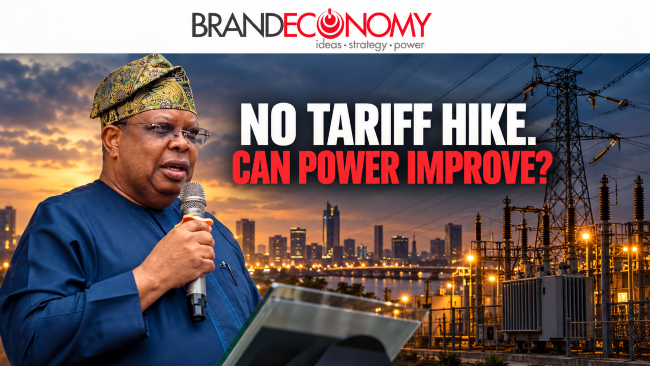 Power Minister Joseph Tegbe has presented a 100-day scorecard whioch points to repaired capacity, more meters and progress on legacy debt. The harder test, however, is whether households and businesses see dependable power without a deeper financing gap.
Nigeria’s government has ruled out an immediate increase in electricity tariffs, placing the burden of its next power sector gains on better performance rather than a higher price paid by consumers. Minister of Power Joseph Tegbe gave the assurance at a briefing with power correspondents in Abuja on Monday, 21 September, as he reviewed his first 100 days in office.



For households and manufacturers already paying to keep generators running, the commitment offers welcome breathing space. For electricity companies and investors, it raises a more demanding question: can the administration of President Bola Tinubu repair the industry’s cash flow while holding tariffs steady? The answer depends on whether physical upgrades, better collections and settlement of old debts translate into electricity that customers actually receive and pay for.
Tegbe said his period from 8 June to 16 September was spent diagnosing and stabilising the full supply chain. His account described damaged gas pipelines and commercial terms that constrain fuel supply; ageing thermal plants and deferred maintenance; vandalised transmission assets and overloaded equipment; and distribution companies losing 30 to 40 per cent of power and revenue through technical faults, billing gaps and weak collection. He said generation companies were being paid only 27 per cent of their bills, limiting their ability to service plants and pay gas suppliers. That figure should be read as the minister’s diagnosis of generator payments, not as a measure of every distributor’s remittance performance.
Repairing capacity is only the first step
The government’s early scorecard includes the restoration of the 375 megawatt Alaoji open cycle plant after three years out of service. Substation upgrades at Apapa, Ijora, Alausa and Lekki in Lagos are said to have unlocked 672MW of transmission capacity, while a 300 megavolt ampere transformer at Katampe, Abuja, is credited with making another 240MW available. These are capacity claims, not a promise that equivalent additional power is continuously delivered to homes and factories.
Tegbe reported generation and transmission above 5,000MW in recent weeks, compared with a pre June range of 3,700MW to 4,700MW, and cited a peak of 5,330MW in August and September. The improvement matters, but peaks alone cannot establish sustained supply. More useful tests are average output over time, feeder level hours of service and the share of available energy that distributors take up and sell. A business in Port Harcourt or Kano will judge reform by the reliability of its own connection, not a national maximum.
The minister also said more than 300 containers of Transmission Company of Nigeria equipment had been released from ports. He cited solar and mini grid installations across 30 states delivering 43.6MW and 41,735 new connections. Their value is greatest where they reach unserved communities or productive users, with maintenance and a workable payment model in place. Off grid progress can ease pressure on local demand, although its capacity should not be confused with power added to the national transmission system.
Meters and debt shape the economics
Tegbe put meter installations at 350,000 in his first 100 days and cited a cumulative figure of 1,004,260 as of August, alongside 90,000 meters in military formations. The account did not specify the start date or programme behind the cumulative total, so it should not be mistaken for Nigeria’s total metered customer base. Metering helps replace disputed estimates with measured consumption, but only when devices are installed, working, accessible and paired with credible bills and service.
The commercial challenge is measurable. The Nigerian Electricity Regulatory Commission recorded an aggregate technical, commercial and collection loss of 34.90 per cent in the fourth quarter of 2025. It also found that 57.27 per cent of active registered distribution customers were metered at that year’s end. Those older regulatory figures provide context for the minister’s stated range; they do not independently verify his 2026 installation claims. Each percentage point of avoidable loss represents money that cannot readily fund maintenance, fuel or new connections.
On legacy liabilities, Tegbe said an estimated ₦1.23 trillion had been raised towards a ₦3.3 trillion debt owed to generation companies. The distinction between funds raised and creditors paid is crucial. Investors will want to see the financing instrument, disbursement schedule, reconciliation of claims and treatment of the remaining balance. Settling arrears could improve the willingness of generators and gas suppliers to invest, but the benefit will erode if new unpaid invoices accumulate under the same market rules.
A six month test of trust
The next phase, Tegbe said, will concentrate on the Lagos, Enugu–Port Harcourt and Abuja–Kaduna–Kano corridors, alongside a proposed transmission super grid, bilateral supply arrangements for productive clusters and infrastructure planning for future demand, including Mambilla hydropower. These priorities make economic sense if they match industrial demand with dependable power and enforceable payment. Bilateral deals will still require clear rules on network access, settlement and who bears the cost of shared infrastructure.
The tariff pledge also has a fiscal price. When allowed revenues fall short of the cost of supply, the difference must be covered through budget support, lower industry payments, efficiency gains or some combination. NERC’s fourth quarter 2025 report said the federal government bore about 52 per cent of generation costs under the tariff freeze then in force. That historical figure is not a current subsidy estimate, but it shows why a tariff hold needs transparent funding and disciplined loss reduction.
For power sector brands, the communication challenge is as serious as the engineering. Customers have heard promises of improved supply before. Regular publication of corridor level outages, metering delivery, collections, generator payments and complaint resolution would let the public distinguish repairs from lasting service improvement. Tegbe appealed for protection of infrastructure against theft and vandalism. That appeal will carry more weight when communities can see and measure the benefit of protecting it.
BRANDECONOMY Insight
A stable tariff is politically attractive, but it becomes economically credible only when the sector collects more of what it bills, pays for the energy it buys and delivers more usable hours of supply. The most investable reform story over the next six months will be a verified rise in reliable power and cash recovery on named corridors, backed by an auditable debt settlement plan. Until then, the minister’s 100 day figures are a promising scorecard of interventions, not proof that Nigeria’s electricity market has escaped its funding cycle.