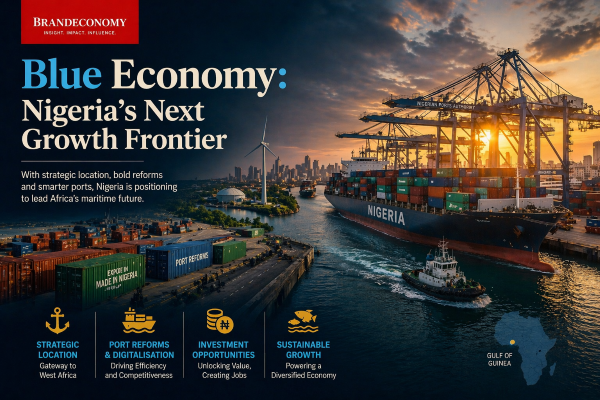
 Nigeria is recalibrating its economic compass—turning seaward in a bid to unlock the vast potential of its blue economy. At the centre of this shift is the country’s port system, which policymakers now see as a strategic lever for investment, trade expansion and long-term growth.
Speaking at a recent investment summit, the Managing Director and Chief Executive Officer of the Nigerian Ports Authority (NPA), Dr Abubakar Dantsoho, positioned Nigeria as a frontrunner in Africa’s evolving blue economy—arguing that ongoing reforms and private sector participation are beginning to reshape the maritime landscape.



A Strategic Pivot to the Sea
For decades, Nigeria’s economic narrative has been anchored in hydrocarbons. The emerging shift toward the blue economy signals a broader rethinking—one that places maritime assets, logistics infrastructure and ocean-based industries at the heart of national development.
With over 823 kilometres of coastline and a commanding position along the Gulf of Guinea, the country possesses the geographic fundamentals of a regional maritime powerhouse. According to the Minister of Marine and Blue Economy, Dr Adegboyega Oyetola, these endowments—combined with improved policy coordination and maritime security—are strengthening investor confidence in the sector.
Ports as Engines of Growth
The NPA’s argument is straightforward: efficient ports are not just gateways for trade—they are engines of economic transformation.
Nigeria’s ports already handle over 90% of the country’s international trade by volume. Yet, paradoxically, the nation captures only about 25% of West Africa’s cargo traffic, despite accounting for more than 60% of the region’s GDP.
This disconnect underscores a critical inefficiency—and a significant opportunity.
If optimised, Nigeria’s port system could serve as a regional logistics hub, rivaling established maritime centres such as Singapore and Morocco. Achieving this, however, will require sustained investment, regulatory clarity and operational efficiency.
Reforms and Digital Transformation
To close the gap, the Federal Government has embarked on an ambitious reform programme.
Key initiatives include port modernisation, deployment of a Trade Single Window, implementation of a Port Community System, expansion of deep seaports, and the full digitalisation of port operations. Together, these measures are designed to streamline processes, reduce turnaround times and enhance transparency.
The emphasis on digital infrastructure is particularly critical. In a global shipping environment increasingly defined by data and automation, competitiveness hinges on the ability to integrate systems across the logistics chain.
The Role of Private Capital
Public resources alone will not suffice.
Recognising this, the NPA is actively courting private sector participation through project financing models aimed at bridging infrastructure gaps. Early indications suggest that such partnerships are already improving efficiency and unlocking funding for critical upgrades.
The logic is compelling: private capital brings not only financing, but also operational expertise and performance discipline.
From Potential to Performance
Ultimately, the success of Nigeria’s blue economy strategy will depend on execution.
Reducing freight costs, improving liner connectivity and attracting larger vessels are immediate priorities. Over the longer term, the goal is to expand non-oil exports, deepen industrial linkages and position Nigeria as a central node in regional and global trade networks.
BRANDECONOMY Insight
Nigeria’s blue economy ambitions reflect a broader structural shift—one that could redefine the country’s growth trajectory if properly executed.
- The Ocean as the New Oil
As global energy transitions accelerate, maritime trade and ocean-based industries are emerging as critical drivers of economic diversification. - Ports Are Competitive Assets
In the modern economy, ports compete globally. Efficiency, pricing and connectivity—not just geography—determine success. - Digitalisation Is Non-Negotiable
Trade Single Windows and Port Community Systems are no longer optional—they are foundational to global competitiveness. - Private Capital Will Shape Outcomes
Infrastructure deficits can only be closed through sustained private sector participation and innovative financing models. - Nigeria’s Opportunity Is Regional Leadership
With its scale and location, Nigeria has a narrow but significant window to establish itself as West Africa’s maritime hub—before competitors consolidate their positions.
In essence, Nigeria stands at a maritime inflection point. The tide is turning—but whether it lifts the economy will depend on the depth of reform and the discipline of execution.