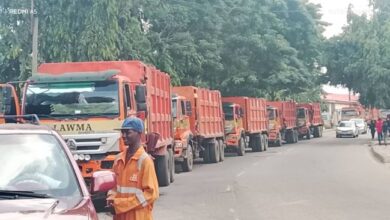


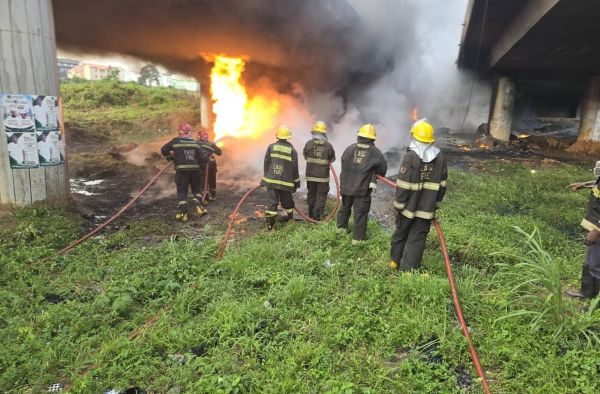
 The Lagos State Emergency Management Agency has extinguished a major fire involving a fallen tanker carrying 33,000 litres of diesel beneath Otedola Bridge, reopening one of Lagos’s most economically important transport corridors after two men sustained serious burns.
LASEMA Permanent Secretary, Dr Olufemi Oke-Osanyintolu, said the adult male victims suffered second- and third-degree burns. Emergency medical teams stabilised them at the scene before transferring them for further treatment.



The fire was contained through a multi-agency operation involving LASEMA, the Lagos State Fire and Rescue Service, Federal Road Safety Corps, Lagos State Traffic Management Authority and Lagos State Ambulance Service.
LASEMA paramedics and ambulance personnel provided pre-hospital care, while firefighters suppressed the flames and worked to prevent a secondary ignition.
At the time of the agency’s operational update, dampening work was about 80 per cent complete. Recovery and evacuation of the fallen tanker were scheduled to begin after the scene had been sufficiently cooled and declared safe.
Traffic was subsequently restored along the Otedola Bridge corridor, although LASEMA advised motorists to reduce speed, exercise caution and obey officials managing movement around the affected area.
A successful response to a recurring danger
The absence of reported fatalities and restoration of traffic represent a significant operational achievement. A tanker transporting tens of thousands of litres of combustible material on a heavily used urban expressway can rapidly turn a road crash into a mass-casualty event.
Yet the latest incident cannot be assessed in isolation.
Otedola Bridge occupies a dark place in Lagos’s transport-safety history. In June 2018, a petrol tanker crashed and exploded on the corridor, killing at least nine people in the initial official count and burning 54 vehicles. In March 2025, another tanker explosion in the same area killed two people and destroyed vehicles, tricycles and nearby structures.
The recurring pattern raises a harder question: why does one of Nigeria’s busiest commercial corridors remain repeatedly exposed to catastrophic tanker incidents?
The latest LASEMA statement did not disclose the tanker’s operator, registration details or the preliminary cause of the crash. It also did not establish whether speed, brake failure, driver fatigue, roadworthiness, load integrity or another factor caused the vehicle to fall.
Those questions should form the basis of a transparent investigation.
Emergency response cannot replace prevention
Lagos has built a stronger emergency-response system around LASEMA, the state fire service, LASTMA and ambulance services. Their capacity to coordinate scene control, firefighting, medical evacuation and traffic restoration matters enormously.
But a city cannot define road safety solely by how efficiently it responds after a hazardous vehicle overturns.
Prevention requires rigorous inspection of tanker heads, braking systems, tyres, couplings, tanks and emergency shut-off equipment. Drivers transporting petroleum products also require specialised training, controlled working hours and enforceable safety certification.
Fleet operators should maintain verifiable service records, install telematics and speed-monitoring systems and ensure that drivers do not enter high-risk corridors with mechanically compromised vehicles.
Regulators, meanwhile, should be able to identify repeat offenders, suspend unsafe fleets and publish enforcement outcomes. Where an investigation establishes negligence, responsibility should extend beyond the driver to the company that owns, maintains or contracts the vehicle.
Without visible consequences, emergency agencies risk becoming highly capable responders to preventable corporate and regulatory failures.
Market implications
Otedola Bridge connects Lagos to the Lagos-Ibadan Expressway, a strategic artery for commuters, fuel distribution, agricultural supplies, manufactured goods and interstate commerce.
A shutdown on the corridor produces costs far beyond the immediate scene. Delivery schedules are disrupted, workers lose productive hours, fuel consumption rises in traffic and businesses face uncertainty over inventory arrival.
Repeated tanker incidents also affect insurance pricing. Fleet owners with poor safety records should expect higher premiums, while responsible logistics operators may increasingly be required to demonstrate vehicle fitness, driver competence and real-time fleet monitoring before securing major contracts.
For companies that depend on road freight, carrier selection is no longer a routine procurement decision. It is a business-continuity, environmental, reputational and public-safety decision.
Brand implications
LASEMA’s swift response strengthens its reputation as a critical public institution. Inter-agency coordination also supports the Lagos State Government’s claim that it is investing in emergency-management capability.
However, institutional trust cannot be built only through post-incident heroism. Lagosians will ultimately judge the state by whether dangerous crashes become less frequent.
The unnamed tanker operator also presents an accountability issue. Where commercial vehicles create significant public risk, the identities of operators and the outcomes of official investigations should not disappear from public view.
For logistics and petroleum-distribution brands, safety performance is part of brand equity. A company may spend heavily on advertising, but one poorly maintained tanker can inflict injuries, disrupt a city and destroy years of reputational investment.
Investor relevance
The incident highlights investment opportunities in fleet telematics, predictive maintenance, driver-monitoring systems, vehicle inspection, emergency-response technology and specialist transport insurance.
Large manufacturers, retailers and petroleum companies should demand stronger safety data from third-party haulage contractors. Investors should also examine whether companies disclose fleet incidents, contractor standards and transport-related environmental and social risks.
A low-cost transporter can become extremely expensive once crashes, cargo losses, litigation, business disruption and reputational damage are included.
BRANDECONOMY Insight
Extinguishing the Otedola Bridge fire was an operational success. Allowing the corridor to remain a recurring theatre of tanker danger would be a policy failure.
The strongest measure of progress is not how quickly traffic returns after another inferno. It is whether the tanker involved was roadworthy, whether the driver was properly trained, whether the operator is held accountable and whether the investigation prevents the next crash.
Lagos should create a publicly reported hazardous-freight safety scorecard covering tanker inspections, crashes, causes, sanctions and operator compliance. That would transform scattered incidents into actionable intelligence.
Emergency response saves lives after failure. Serious transport governance prevents the failure from occurring.