
MTN’s Nigerian Fintech Bet: Why Shareholders Approved the ₦152bn Deal
A Strategic Separation

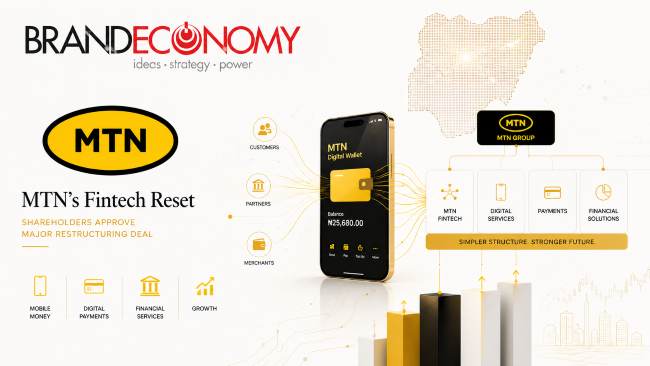 MTN Nigeria shareholders have approved a major restructuring of the company’s fintech operations, clearing the way for MTN Group Fintech Holdings to take 60 per cent control of MoMo Payment Service Bank and Y’ello Digital Financial Services. The transaction, valued at ₦152.06 billion, is designed to reduce MTN Nigeria’s funding burden, sharpen regulatory clarity and reposition its fintech play for scale in Africa’s fast-moving digital finance market.
A Strategic Separation, Not a Retreat
MTN Nigeria’s shareholders have endorsed a major restructuring of the telecoms giant’s fintech operations, approving the transfer of majority ownership in its digital financial services businesses to its South African parent, MTN Group.




The approval, granted at the company’s Annual General Meeting in Lagos, authorises the structural separation of MoMo Payment Service Bank Limited and Y’ello Digital Financial Services Limited into a new financial holding company. Under the approved arrangement, MTN Group Fintech Holdings B.V. will acquire a 60 per cent stake in the fintech businesses through a mix of fresh capital injection and secondary share acquisition, while MTN Nigeria retains 40 per cent.
The deal is valued at ₦152.06 billion, according to reports on the transaction. Some reports also referenced a KPMG valuation of the fintech businesses at ₦95.5 billion on a debt-free and cash-free basis, with the independent valuation describing the transaction terms as fair and reasonable.
For MTN Nigeria, this is not a withdrawal from fintech. It is a restructuring of risk, capital and control. The company is effectively saying that fintech remains strategically important, but its growth demands a dedicated capital structure and a more specialised investment vehicle.
Why MTN Is Rewiring Its Fintech Ambition
The logic is straightforward. Digital financial services require patient capital.
MoMo PSB and Y’ello Digital Financial Services sit at the heart of MTN Nigeria’s attempt to convert telecom scale into financial-services relevance. But fintech platforms do not become dominant cheaply. They require investment in technology, compliance, agent networks, customer acquisition, cybersecurity, payments infrastructure, product development and trust-building.
MTN Nigeria’s board told shareholders that the fintech subsidiaries are still in a growth phase and operating at a loss. That is not unusual for early-stage digital financial platforms, especially in a market where competition is intense and financial inclusion remains both a social need and a commercial contest.
By transferring majority ownership to MTN Group Fintech, MTN Nigeria reduces the pressure on its own balance sheet. It also frees capital for its core telecommunications business: network expansion, service quality, broadband investment, infrastructure resilience and customer experience.
This is especially important at a time when telecom operators are facing rising energy costs, network operating expenses, regulatory obligations and heavy capital expenditure requirements. MTN Nigeria’s latest Q1 update showed strong revenue growth and profit after tax of ₦355.5 billion, but public market reports also noted management concerns that rising energy costs could pressure outlook.
In other words, MTN Nigeria is choosing focus. Keep a meaningful stake in fintech, but let the Group-level fintech platform carry the heavier investment load.
The Regulatory Logic
The new structure is also designed to clarify regulatory oversight.
Telecoms and financial services operate under different regulatory cultures. MTN Nigeria’s core telecom business is supervised by the Nigerian Communications Commission, while fintech and payment-service operations fall under the financial-sector orbit, especially the Central Bank of Nigeria.
By moving the fintech operations into a dedicated holding company to be registered with the CBN, MTN is creating cleaner institutional lines. The telecom business can remain focused on connectivity, while the fintech business operates within a more appropriate financial-services framework.
This matters because payments, wallets, deposits, remittances and digital financial services are sensitive sectors. They require consumer protection, anti-money-laundering controls, data governance, liquidity discipline and operational resilience. A dedicated holding structure can make regulation, capital raising and future partnerships easier to manage.
What Shareholders Are Really Approving
For shareholders, the approval of Resolution Nine is more than a corporate housekeeping decision. It is a bet on a new model of value creation.
MTN Nigeria keeps a 40 per cent exposure to the fintech upside. That means shareholders are not being cut off from the long-term promise of MoMo and Y’ello Digital. But the company avoids carrying 100 per cent of the funding strain from businesses that are still scaling.
The board has also argued that the restructuring should improve MTN Nigeria’s financial ratios, strengthen liquidity and support more sustainable dividend performance over the medium term, because fintech losses would no longer fully weigh on consolidated earnings.
That will be attractive to investors who prefer MTN Nigeria’s core telecom engine: voice, data, enterprise services, broadband, digital infrastructure and network monetisation.
But the deal also raises a strategic question: if fintech becomes highly profitable in future, will MTN Nigeria shareholders wish they had retained more than 40 per cent?
That is the trade-off. MTN Nigeria is reducing near-term strain in exchange for shared long-term upside.
The Bigger African Fintech Play
This transaction aligns with MTN Group’s Ambition 2030 strategy, which seeks to strengthen the company’s position as a leading African digital platform across connectivity, fintech and infrastructure. MTN Group has repeatedly positioned fintech as one of its major growth platforms across the continent.
Nigeria is central to that ambition. It has one of Africa’s largest populations, a youthful consumer base, high mobile usage, deep informal commerce, strong remittance demand and a large financially excluded population. These are precisely the conditions that make mobile money, digital wallets and low-cost payment rails attractive.
Yet Nigeria’s fintech market is not easy. Banks are active. Fintech start-ups are aggressive. Agent banking networks are crowded. Consumer trust is uneven. Regulation is evolving. Margins can be thin. Scale matters, but trust matters more.
MTN has distribution. It has brand recognition. It has customer reach. What it now needs is deeper execution in payments, wallets, merchant services, remittances and financial inclusion.
The new holding company gives that ambition a more focused structure.
BRANDECONOMY Insight
MTN Nigeria’s fintech restructuring is one of the clearest signs yet that telecoms and financial services are converging, but not always comfortably.
The company knows that the future of telecoms cannot be built on connectivity alone. Data will grow. Voice will mature. Enterprise services will expand. But the real prize lies in platforms: payments, identity, commerce, content, cloud, APIs, fintech and digital infrastructure.
That is why MoMo and Y’ello Digital matter.
But fintech is capital-hungry. It requires regulatory patience, customer trust, technology depth and the ability to absorb losses before scale arrives. MTN Nigeria’s shareholders have now approved a structure that transfers the heavier burden to MTN Group while preserving a 40 per cent stake in the future upside.
This is smart financial engineering. It protects MTN Nigeria’s core telecom balance sheet while keeping the company inside the fintech opportunity.
For investors, the key issue is execution. The restructuring must produce more than accounting relief. It must accelerate customer acquisition, strengthen transaction volumes, deepen agent penetration, expand merchant acceptance and ultimately move the fintech units toward profitability.
For regulators, the transaction also matters. It creates cleaner lines between telecom regulation and financial-services supervision. That is important in a market where mobile networks increasingly function as rails for money movement.
For Nigeria, the broader opportunity is financial inclusion. If MTN can convert mobile reach into trusted financial access, the deal could support payments, rural inclusion, small-business transactions and digital commerce.
But ambition is not achievement. MTN Nigeria has bought itself room. MTN Group has taken deeper control. The market will now ask a simple question: can MoMo finally become more than potential?