
Dangote Refinery IPO Shock: SEC Bans Promotions, Warns Investors

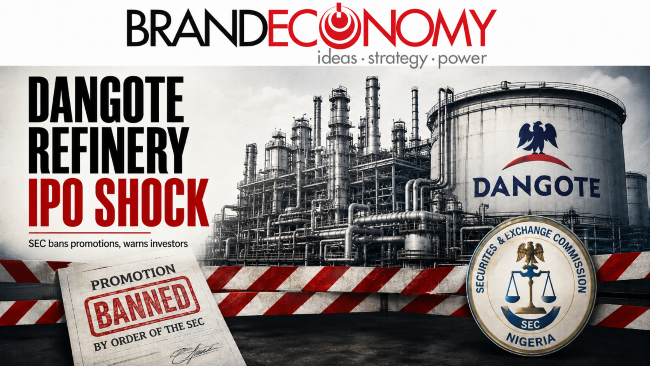 Nigeria’s capital-market regulator has halted promotional activity around a “purported” Dangote Refinery public offer, warning that no approved IPO exists and directing operators to stop taking investor commitments or funds.
The Securities and Exchange Commission has slammed the brakes on promotional activity surrounding a “purported” Initial Public Offering by Dangote Petroleum Refinery and Petrochemicals FZE, warning investors that no application for the offer has been filed with or approved by the regulator.


The intervention has sent a sharp message across Nigeria’s investment community: anticipation is not authorisation.
In a public notice, the SEC said it had identified advertisements, flyers, digital banners, targeted emails and social-media messages suggesting that investors could prepare to buy into a Dangote Refinery IPO, secure allocations, open accounts, pre-fund wallets or participate in a supposed pre-IPO placement.
But the regulator said no such public offer had crossed the formal approval threshold.
The SEC consequently directed registered Capital Market Operators, stockbrokers and digital investment platforms to stop all promotion connected to the purported transaction. It also ordered the removal of unauthorised materials from websites, social platforms and messaging groups, while instructing operators to stop receiving deposits, commitments, account openings or expressions of interest tied to the offer.
Any funds already collected in connection with the purported offering are to be reversed and refunded.
For a market that has been eagerly awaiting a possible listing by one of Africa’s most strategic industrial assets, the development is a sobering reminder that investor excitement must never outrun regulatory process.
The IPO May Be Anticipated, But It Is Not Yet Approved
The SEC’s action does not amount to a declaration that Dangote Petroleum Refinery will never list.
Rather, it establishes a vital distinction that investors, brokers, digital platforms and market commentators must understand: a proposed IPO is not the same thing as a live, SEC-approved public offer.
A business may be exploring a listing. Advisers may be appointed. Investors may be interested. Pension funds may even be considering the opportunity within their permitted investment framework.
Yet none of these developments gives anyone the right to market shares, collect money, promise allocations or invite investors into a subscription process before the SEC has received, reviewed and cleared the transaction.
Until a formal prospectus is approved and issued, there is no public offer to subscribe to.
That is the line the SEC has now drawn.
Why the Regulator Moved
The Commission’s concern is understandable.
The Dangote Refinery has become one of the most closely watched business stories in Nigeria and across Africa. Any eventual public-market offer could rank among the continent’s most consequential capital-raising exercises, attracting interest from retail investors, institutional investors, pension funds, diaspora investors and international capital.
That scale creates opportunity. It also creates vulnerability.
Where a major prospective listing generates widespread excitement, the market can quickly become fertile ground for unofficial campaigns, misleading claims, aggressive account-opening drives, false allocation promises and “pay now or miss out” tactics.
The SEC’s warning is therefore not simply about one company or one possible transaction. It is about defending the integrity of Nigeria’s capital market from the dangers of premature marketing.
The regulator has made clear that invitations to pre-fund accounts, seek guaranteed allocations or transfer money for an unapproved “pre-IPO” placement are not harmless preparatory activities. They can mislead investors, create artificial demand, deepen information asymmetry and undermine confidence in the market.
A Major Test for Nigeria’s Capital Market
The Dangote Refinery IPO narrative matters because of what it represents.
The refinery is more than a large industrial project. It sits at the heart of Nigeria’s ambitions around energy security, import substitution, domestic manufacturing, foreign-exchange conservation, regional trade and industrial competitiveness.
A successful future listing could also offer Nigerians a chance to participate directly in the ownership of a business expected to shape the country’s energy economy for decades.
It could deepen the Nigerian Exchange, create a new benchmark for large-scale African listings and test whether domestic institutional capital can support transformative infrastructure at scale.
But such a transaction can only deliver those benefits if it is built on credible disclosure, disciplined valuation, transparent allocation, sound governance and clear investor protection.
This is why the SEC’s intervention should be viewed as a market-strengthening move.
Nigeria cannot aspire to host landmark listings while allowing unofficial promoters to create the impression that highly sensitive securities are already on sale.
A credible market needs clear rules. A credible IPO needs a prospectus. And a credible investor process requires everyone to work from the same verified information.
The PenCom Waiver Does Not Equal IPO Approval
Part of the confusion may have been fuelled by earlier developments around the proposed Dangote Refinery listing.
Nigeria’s pension regulator had granted a special, case-specific waiver that could allow Pension Fund Administrators to consider investment in a proposed Dangote Refinery IPO, despite normal requirements relating to profitability and dividend history.
That decision reflected the refinery’s strategic importance and the wider policy interest in channelling long-term domestic capital into major productive assets.
However, the waiver was not an SEC approval for public subscription.
It did not create an open offer. It did not approve a prospectus. It did not authorise brokers, digital platforms or promoters to solicit retail investors.
That distinction is now central to the SEC’s warning.
The Brand Risk for Dangote Refinery
For Dangote Petroleum Refinery, the episode carries important brand implications.
The Dangote name is associated with industrial scale, execution, ambition and national economic relevance. A future refinery listing is likely to be one of the most visible corporate transactions Nigeria has ever seen.
That visibility can become an advantage only when communication is controlled, credible and clearly sourced.
In a major capital-market transaction, unofficial activity can damage trust even before the issuing company formally enters the market. Rumours can harden into assumptions. Social-media speculation can be mistaken for investment guidance. Third-party promotional content can create expectations that no official process has validated.
This is why the eventual IPO communication strategy must be as robust as the transaction itself.
The market will need one trusted source of truth: official announcements, properly registered issuing houses, SEC-approved documents, transparent investor education and clear timelines.
Anything less leaves room for confusion—and confusion is costly in financial markets.
What Investors Should Do Now
For prospective investors, the immediate advice is simple: do not pay for what has not been officially offered.
Investors should not transfer money based on social-media posts, WhatsApp messages, flyers, influencer claims, private assurances, digital banners or promises of priority allocation.
They should not assume that opening an account, joining an interest list or funding a wallet gives them any right to Dangote Refinery shares.
They should not rely on unofficial valuation figures, dividend projections, subscription timelines or allocation claims until those details are formally published in an SEC-approved prospectus.
When a legitimate public offer eventually emerges, investors should take a disciplined approach.
They should assess the refinery’s operational performance, financial statements, debt structure, crude-supply arrangements, product-market outlook, domestic demand, export potential, governance structure, dividend policy, regulatory exposure and valuation.
The central investment question will not simply be whether the refinery is important to Nigeria. It will be whether the shares, at the offered price, represent a compelling long-term investment.
A strategic asset can still be overpriced. A strong company can still carry risks. And a successful IPO depends as much on valuation discipline and governance quality as it does on public excitement.
A Wake-Up Call for Digital Investment Platforms
The SEC’s directive should also trigger reflection among stockbrokers, fintech platforms, digital investment communities and financial-content creators.
Digital finance has widened access to investment information and made it easier for young Nigerians to engage with the capital market. That is a positive development.
But access must be matched by responsibility.
Platforms cannot blur the line between investor education and active solicitation. Commentators cannot convert speculation into certainty. Registered operators cannot use market interest as a substitute for regulatory clearance.
The bigger opportunity for Nigeria’s investment ecosystem lies in helping citizens understand how to invest well—not encouraging them to chase every anticipated deal before the facts are available.
BRANDECONOMY Insight
The real shock in the Dangote Refinery IPO story is not that the SEC has stopped an approved offer.
It is that market excitement moved far enough ahead of regulation for the Commission to intervene publicly.
The regulator has made one thing clear: the Dangote Refinery may be a strategic national asset, but strategic importance does not exempt a company—or its promoters—from securities law.
For Nigeria’s capital market, that is the correct signal.
A future Dangote Refinery IPO could become a landmark moment for African ownership, local capital mobilisation and industrial wealth creation. But it must arrive through the front door of disclosure, governance, regulatory approval and investor protection.
Until then, investors should ignore the noise, resist the pressure and wait for the prospectus.